HSA & FSA Reimbursement for Medical Tourism in Taiwan — What You Need to Know

April 24, 2026

7 mins to read
A practical guide for U.S. travelers on using HSA and FSA funds for medical tourism in Taiwan — what the IRS allows, what paperwork you need, and how New Dawn Health sets it up for smooth reimbursement.
HSA & FSA Reimbursement for Medical Tourism in Taiwan — What You Need to Know - Health information for international visitors in Taiwan

One of the most common questions we field from U.S. travelers is some version of: "If I fly to Taiwan for a full-body scan, can I pay for it with my HSA?" The short answer is yes — in most cases — provided you follow the paperwork trail the IRS expects.

This guide walks you through exactly how HSA and FSA reimbursement works for medical tourism, what documentation we provide at New Dawn Health, and how to stay on the right side of IRS Publication 502.

Quick disclaimer: We're sharing general information based on published IRS guidance — not tax advice. Your specific HSA plan, custodian, and personal tax situation may change what's reimbursable. Always confirm with your plan administrator or CPA before booking.

In This Guide

  • Whether medical tourism qualifies for HSA / FSA reimbursement
  • The documentation you'll need to keep
  • How New Dawn Health's paperwork is set up for U.S. tax use
  • Travel and lodging rules — including the $50/night cap
  • A step-by-step checklist for your trip
  • Eligibility quick-reference by service type

Does Medical Tourism Actually Qualify?

Yes — in most cases. According to IRS Publication 502, medical expenses incurred in a foreign country are generally deductible (and therefore HSA / FSA-eligible) as long as they would have been legal and deductible in the United States.

The rule of thumb:

  • Eligible: Comprehensive health screenings (preventive care), diagnostic imaging (MRI, CT, DEXA, ultrasound), dental work, vision, and medically necessary procedures.
  • Not eligible: Purely cosmetic procedures — Botox for aesthetic wrinkles, laser hair removal, most medical beauty treatments — unless a physician certifies them as treating a specific medical condition.

The IRS cares less about where you received care and more about what kind of care it was. A preventive CT angiogram in Taipei is treated the same as one in Texas for reimbursement purposes.

What You Need to Keep for Your HSA Records

Since you generally cannot use an HSA debit card at international payment terminals (and we process all payments through Stripe in USD), the standard play is to pay out-of-pocket with a regular credit card, then reimburse yourself from your HSA. Your HSA custodian will typically need:

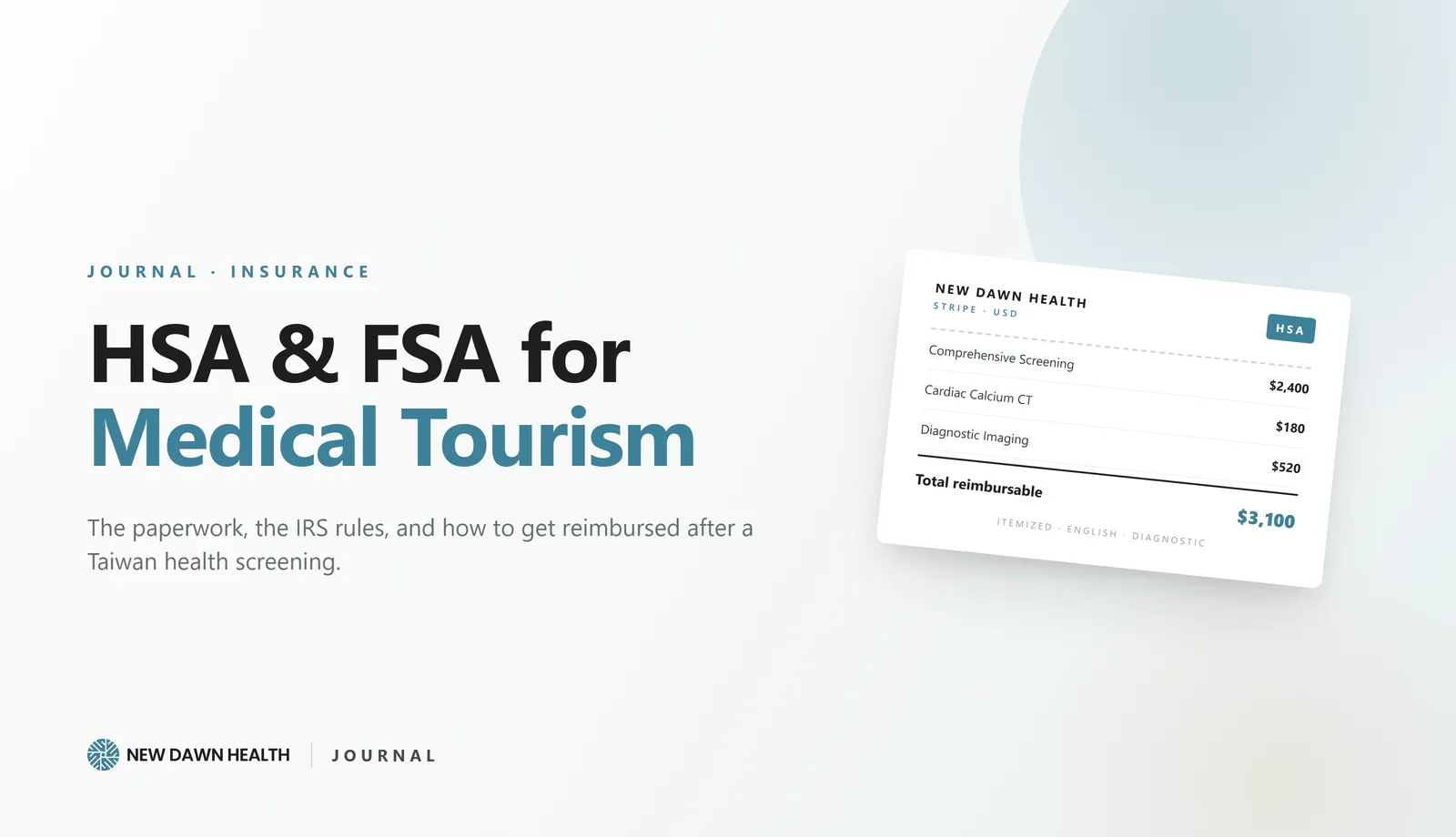
  1. Itemized receipt in English — showing the date of service, the procedure(s) performed, and the amount paid. We provide this on request.
  2. Proof of payment — your Stripe confirmation email plus the matching credit card statement line.
  3. Letter of medical necessity (when applicable) — for specialty imaging tied to a pre-existing condition, or for anything your HSA plan flags as non-routine.
  4. The medical report itself — your final screening results or procedure summary, saved from our portal. If the IRS ever audits the expense, the report is your "proof of service."

How New Dawn Health Handles the Paperwork

We built our documentation flow specifically with U.S. travelers and HSA / FSA users in mind. Here's what that looks like in practice:

USD payments via Stripe

Every package is billed in U.S. dollars through Stripe. You get a clean Stripe confirmation email — which means no currency conversion math for your HSA records and no exchange-rate adjustments to file with your receipts. Your credit card statement will show a single USD line item.

English documentation by default

The IRS requires non-English receipts to be translated before reimbursement. Working with our partner hospitals — including Shin Kong Hospital, Cathay General, and others — we make sure your medical report and billing statement come through in English from the start. No translator fee, no back-and-forth.

Itemized billing with the right language

For HSA purposes, it matters that your receipt clearly reads something like "Comprehensive Medical Screening" or "Diagnostic Imaging" rather than a vague "health package." Our receipts itemize the procedures performed and describe them in the diagnostic / preventive language the IRS expects to see.

Medical necessity notes on request

If you're booking a specialty procedure — say, an MRI tied to a pre-existing back condition, or a specific cardiac scan — let your concierge know when you book. We'll coordinate with the hospital to include a physician note or ICD diagnosis code that establishes the medical necessity of the scan.

We don't "guarantee" IRS approval — no provider honestly can, since that depends on your specific situation. What we do guarantee is the paperwork: itemized English receipts, USD billing, and diagnostic reports in a format your custodian will recognize.

Travel & Lodging — the "Hidden" Benefit (and Its Fine Print)

If the primary reason for your trip is medical care, HSA funds can often cover some of your travel costs — but there are strict limits.

Airfare and transportation

Fully eligible when the trip's primary purpose is medical. That "primary purpose" test is important — a two-day screening tacked on to a two-week leisure trip will likely not qualify. Four days of medical care with a couple of rest days around it usually will.

Lodging — the $50/night cap

This is the rule that surprises most travelers. The IRS only lets you reimburse $50 per night, per person from your HSA for lodging tied to medical care. If a companion accompanies you for medical reasons, the cap is $100 combined.

So if your New Dawn Health package includes a luxury hotel at $280/night, only the first $50 is HSA-eligible — the remaining $230 comes out of pocket. This isn't a provider limitation; it's baked into federal regulations.

Meals

Generally not HSA-eligible unless they're part of an inpatient hospital stay. Eating out during screening days does not qualify.

Step-by-Step: How to Do This Right

  1. Pay out-of-pocket. Use a regular credit card at checkout — earn your points, avoid foreign transaction surprises.
  2. Tell your concierge at booking that you'll need an itemized English receipt for U.S. tax / insurance purposes. We'll flag it on the hospital side.
  3. Save your Stripe confirmation email the moment it arrives.
  4. Download your medical report from the New Dawn Health portal after your appointment — keep the PDF, not just the link.
  5. Match your credit card statement line to your Stripe total. Staple them together in your records.
  6. Submit the reimbursement claim through your HSA custodian's portal (HealthEquity, Fidelity, Optum, etc.) with the itemized receipt attached.
  7. Reimburse yourself — most custodians deposit within 3–5 business days.

Eligibility Quick Reference

Service HSA / FSA? Notes
Full-body scan / comprehensive screening Yes Standard preventive care.
MRI, CT, DEXA, cardiac imaging Yes Diagnostic — eligible as part of a screening or when medically indicated.
Dental exams, cleanings, restorative work Yes Most procedures qualify; cosmetic whitening does not.
Vision exams, prescription glasses Yes Refractive surgery (LASIK) is also eligible.
Specialty imaging for a known condition Yes Ask for a letter of medical necessity or ICD code on the receipt.
Aesthetic laser, Botox for wrinkles Likely no Flagged as cosmetic unless treating a diagnosed condition.
Hair restoration, elective cosmetic surgery No Not HSA-eligible absent specific medical indication.
Airfare (trip primarily medical) Yes Trip's primary purpose must be medical care.
Lodging Partial $50/night per person cap. $100 if a companion attends for medical reasons.
Meals during travel No Only eligible as part of an inpatient hospital stay.

The Bottom Line

Medical tourism in Taiwan is one of the more HSA-friendly moves available to U.S. travelers — provided you treat the documentation with the same care as the care itself. Pay out-of-pocket, keep everything in one folder (physical or cloud), and submit to your HSA custodian when you get home.

What makes New Dawn Health workable for HSA users specifically is that the paperwork is built-in: USD billing, English receipts, diagnostic language, digital reports. You don't have to chase translators or recalculate exchange rates after the fact. The boring infrastructure is already done.

If you have a specific package or procedure in mind and want to know what will and won't qualify before you book, reach out to our concierge team — we'll walk through your plan's specifics alongside you.

Further Reading

FAQ

In most cases, no — HSA debit cards are typically declined at international terminals or hit with high foreign transaction fees. The cleaner approach is to pay out-of-pocket with a regular credit card (we bill in USD via Stripe) and then reimburse yourself from your HSA after the trip. Your custodian just needs the itemized receipt and proof of payment.

Yes. IRS Publication 502 states that medical expenses incurred in a foreign country are generally deductible — and therefore HSA / FSA-eligible — if they would have been legal and deductible in the United States. Comprehensive screenings, diagnostic imaging, dental, and vision care all qualify. Purely cosmetic procedures generally do not.

Four items: (1) an itemized English receipt showing date, procedure, and amount, (2) proof of payment — your Stripe confirmation plus credit card statement, (3) your final medical report (saved as a PDF from our portal), and (4) a letter of medical necessity if you booked a specialty procedure for a pre-existing condition. We provide 1, 3, and help coordinate 4 on request.

Airfare is eligible if the primary purpose of the trip is medical care. Lodging is eligible but capped at $50 per night per person by the IRS ($100 if a companion is accompanying you for medical reasons). Meals during travel are generally not eligible unless they are part of an inpatient hospital stay.

No — because New Dawn Health bills in USD through Stripe, your receipt and credit card line match exactly with no exchange-rate math required. This is one of the biggest HSA-friendly advantages of working with a platform built for U.S. travelers: the IRS gets a clean USD paper trail.

Usually no. The IRS treats purely cosmetic procedures as ineligible. The exception is when a procedure treats a specific diagnosed medical condition — for example, Botox for chronic migraines or hyperhidrosis with a physician's diagnosis. For those cases, ask your clinician for a letter of medical necessity before you book.

The eligibility rules are largely the same — IRS Publication 502 governs both. The practical difference is that FSA funds usually expire at year-end (use-it-or-lose-it), so timing your trip within the plan year matters more. Your HSA rolls over indefinitely. In both cases, the documentation requirements are identical.

Related Posts