Blog
Blog
Computex Through 45 Years: From Songshan 1981 to AI Together 2026 (and What's Next)

Quick answer: Computex began in 1981 as the Taipei Computer Show at Songshan Airport Exhibition Hall — a modest display for Taiwan's then-emerging SMB computer makers. It was renamed COMPUTEX TAIPEI in 1984 at the suggestion of Stan Shih (then TCA chairman, later Acer founder), moved to the Taipei World Trade Center in 1986, weathered the COVID years with a virtual format in 2020–21, and re-emerged in the 2020s as the global stage for the AI hardware revolution. Co-organized by TAITRA (founded 1970) and TCA (founded 1974), the show's 45-year arc mirrors Taiwan's transformation from foundry assembler to indispensable AI-stack participant.
The story of Computex is the story of Taiwan's computing industry compressed into a single annual event. From a 1981 trade show no one outside Asia paid attention to, the show has become the global venue where Jensen Huang and Cristiano Amon now compete for the same Tuesday-morning keynote slot. Understanding how Computex got here is the fastest way to understand why Taiwan sits where it does in the modern AI supply chain — and where both are likely going next.
1981 — The Songshan Airport Beginnings
The first edition was held in 1981 at the Songshan Airport Exhibition Hall, branded simply as the "Taipei Computer Show." The participants were almost entirely small-and-medium Taiwanese enterprises trying to display the components and machines they assembled for export. The visitor mix was overwhelmingly domestic — local distributors, journalists, government trade officials — with a small contingent of curious foreign buyers from Hong Kong, Singapore, and Japan.
Context matters here. Taiwan's industrial planning agency had identified information technology as a strategic export industry in the late 1970s. The Industrial Technology Research Institute (ITRI) had spun out the first generation of Taiwanese semiconductor companies. The Hsinchu Science Park opened in 1980, anchoring what would become the densest semiconductor manufacturing cluster on earth. The 1981 Taipei Computer Show was, in effect, a coming-out party for an ecosystem that did not yet realize how big it would become.
1984 — Stan Shih and the COMPUTEX Rebrand
By the fourth edition in 1984, Stan Shih (施振榮) — then chairman of the Taipei Computer Association (TCA), and already running his own company, Multitech (later renamed Acer) — proposed renaming the show to COMPUTEX TAIPEI. The change was deliberate: drop the parochial "Taipei Computer Show" label, adopt a single coined word that worked in any language, and signal global ambition.
This was not purely symbolic. Stan Shih was already articulating his "smiling curve" theory of value chains — the idea that the most defensible economic position was at the two ends of the curve (brand and components), not the middle (assembly). For TCA and TAITRA, positioning Computex as a global show meant Taiwanese companies could occupy more of those defensible positions, and the show itself became a fixture in the calendars of US, European, and Japanese buyers.
Acer itself would go on to validate the thesis at scale, growing in the 1990s into one of the world's top five PC brands. The lesson — that a small island can build globally recognized brands if it commits to the brand layer — became baked into Computex's mission.
1986 — Move to the World Trade Center
The Taipei World Trade Center (TWTC) opened on Xinyi Road in 1985, and Computex moved into the new exhibition hall in 1986. The move was an order-of-magnitude upgrade in capacity, lighting, climate control, and prestige. It also placed Computex in the heart of Taipei's emerging financial and corporate district — a positioning that has paid compounding returns for four decades.
TWTC remained the primary Computex venue for the next 25 years, accommodating the show's growth through the 1990s PC boom and 2000s components era. Even today, with the show split across four buildings, TWTC Hall 1 remains the home of the most experiential exhibits — in 2026, the new Robotics Zone and TechXperience Zone.
1990s–2000s — The Component Era
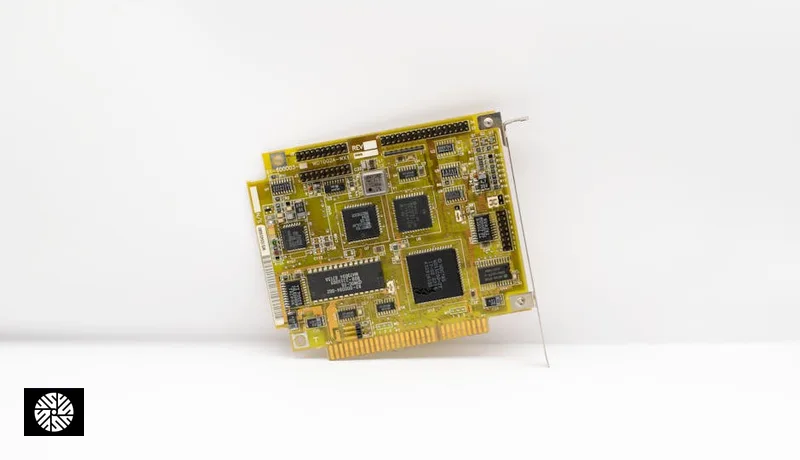
The 1990s belonged to the components. Motherboards, graphics cards, memory modules, power supplies, optical drives — the white-label parts that built every IBM-compatible PC sold worldwide were overwhelmingly designed and manufactured in Taiwan. ASUS, GIGABYTE, MSI, ASRock, Foxconn, and Quanta all grew from this era. So did the Hsinchu fabless ecosystem (MediaTek, Realtek, Novatek).
Computex was where this ecosystem met its buyers. A US PC integrator could spend three days at Computex and walk away with a fully sourced annual bill of materials, validated against six competing suppliers per component. The show became the largest annual procurement event in computing — a status it would hold uninterrupted for nearly two decades.
The 2000s added laptop ODMs (Quanta, Compal, Wistron, Inventec) and the rise of branded Taiwanese consumer laptops led by Acer and ASUS. Computex's exhibitor count climbed past 1,000, professional visitors past 50,000, and the show began to outgrow TWTC alone.
2010s — From Components to Ecosystem
The 2010s were Computex's most disruptive decade. The smartphone era — driven by iPhone and Android — restructured global computing in ways that initially looked existential for a PC-component-centric trade show. The PC market plateaued. Tablets briefly seemed to threaten the laptop. Many of Computex's traditional anchors had to reposition.
The reinvention worked. Computex pivoted to position itself as an ecosystem show, not just a components show. IoT (sensors, connectivity, edge devices) was added as a programmatic track. Cloud and data center components — once a back-office story — got their own exhibitor zones. Gaming hardware, where Taiwanese OEMs had retained a defensible brand position (ASUS ROG, MSI Gaming, GIGABYTE AORUS), expanded into a dominant share of the consumer floor.
Critically, this was also the decade when NVIDIA began appearing in larger and larger Computex booths. Jensen Huang gave his first major Computex keynote in 2017. The seeds of the AI era were planted before anyone realized what they were.
2020–2021 — The Virtual Years
COVID-19 disrupted Computex twice. The 2020 edition was cancelled and rescheduled as a month-long virtual format in September. The 2021 edition was again held online. For a trade show whose value proposition rests almost entirely on physical presence — booth demos, hand-shake meetings, after-hours networking — this was a structural threat.
The forced virtualization had two lasting effects. First, it accelerated Computex's investment in digital infrastructure: a permanent online exhibitor directory, live-streamed keynotes (now standard), and asynchronous matchmaking tools that have remained part of the post-pandemic show. Second, it accelerated supply-chain disruption awareness across the entire computing industry — the geopolitical and pandemic risks of single-point-of-failure manufacturing became newsroom topics, and Taiwan's centrality to the global compute stack became publicly understood in a way it had not been before.
Computex returned to a physical format in 2022, slightly smaller than 2019 but with renewed strategic clarity.
2024–2025 — The AI Renaissance
The launch of ChatGPT in late 2022 set off the most rapid investment cycle in modern computing history. By Computex 2024, the show had been transformed. NVIDIA's GPU shortage had reframed every Taiwanese OEM's roadmap. TSMC's leading-edge wafer capacity became the most contested resource in the global economy. Jensen Huang's Computex keynote became the most-watched event in any tech trade show, anywhere.
The 2024 and 2025 editions cemented the "AI factory" narrative — the idea that data centers are not buildings full of servers but industrial-scale facilities that manufacture intelligence as an output. Taiwan's role in this narrative is foundational: the silicon, the cooling, the power systems, the assembly, and increasingly the integrated AI servers themselves all originate from Taiwanese suppliers.
Taipei in this era is no longer just the "foundry capital." It is the AI factory capital. Computex is where that transition gets announced, partnered, and contracted, year after year.
2026 and Beyond — AI Together
Computex 2026 is, by official numbers, the largest single edition in the show's 45-year history: 1,500 exhibitors, 6,000 booths, 80,000+ professional visitors, four venues, four marquee keynotes. The theme "AI Together" reflects an emerging recognition that the next stage of the AI era is not about one company's GPUs or one cloud's models — it is about coordinated stack assembly across silicon vendors, system OEMs, cloud operators, and end-application developers.
Three trends to watch beyond 2026:
- Sovereign AI — National AI infrastructure investments (Japan, France, India, Saudi Arabia, others) are creating demand for Taiwan-assembled AI factories at country scale. Future Computex editions will likely host more national-level partnership announcements.
- Embodied AI / Robotics — The 2026 Robotics Zone is a leading indicator. Taiwan's component manufacturing depth (motors, sensors, vision systems) gives it a natural advantage in the humanoid robotics supply chain that is now emerging.
- Edge inference and AI PCs — The shift of inference workloads from cloud to client devices reshapes the PC market that Computex was originally built to serve. The Copilot+ PC category is the early signal; Computex 2026 onward will be where successive generations get unveiled.
Forty-five years after a quiet 1981 trade show in a Songshan Airport hall, Computex now sits at the center of one of the largest industrial transformations in modern history. The arc — from anonymous component supplier to indispensable AI-stack architect — is the same arc Taiwan itself has traveled.
A Tale of Two Risings
There is a lesson buried in the Computex story that is worth taking personally. The show is what it is in 2026 because of decisions made in 1981, 1984, 1986 — decisions to commit early to a strategic position, to compound investment year after year, and to stay disciplined through both component-era abundance and post-iPhone disruption. The payoff was not visible for the first decade. It was clearly visible by year 25. And it became defining by year 40.
The same arc holds for personal health. The biomarkers that determine your healthspan at 65 are largely set by decisions made in your 30s and 40s. The five highest-leverage screening biomarkers — ApoB, HbA1c, Coronary Calcium Score, DEXA body composition, and at 50+ Coronary CT Angiogram — work the same way Stan Shih's 1984 rebrand worked: the early commitment compounds quietly for two decades, then becomes defining.
For visitors who travel to Taipei for Computex, the parallel is not abstract. The same city that hosts the AI Together era of Computex also offers the world's most cost-effective comprehensive health screening for international patients — typically 60–70% less than equivalent US concierge clinic pricing, with English reports formatted for US doctors to read. Combining the two on a single trip is the highest-leverage week-long executive itinerary we are aware of.
The compounding logic. If you are flying into Taipei for Computex 2026, consider adding one day for a comprehensive health screening — the same compound-investment thinking that made Computex what it is, applied to your own healthspan. Explore comprehensive screening packages →
Cross-Links & References
- Planning your trip? Start with How to Get to Computex 2026: Venue Map & MRT Routes
- What's on this year? See Computex 2026 Activities Guide: Keynotes, InnoVEX & Highlight Zones
- Related: Longevity Health Screening — An Evidence-Informed 2026 Roadmap
- Computex — Wikipedia (history overview)
- Official "About COMPUTEX" page
- TAITRA — Taiwan External Trade Development Council
- TCA — Taipei Computer Association
FAQ
Computex was founded in 1981 as the Taipei Computer Show, held at the Songshan Airport Exhibition Hall. It was renamed COMPUTEX TAIPEI in 1984 at the suggestion of Stan Shih, then chairman of the Taipei Computer Association (TCA). The 2026 edition marks the show's 45th year.
Stan Shih (施振榮), then chairman of the Taipei Computer Association and founder of Multitech (later renamed Acer), proposed the rename to COMPUTEX TAIPEI in 1984, the show's fourth edition. The change reflected a deliberate strategic shift from a parochial domestic trade show to a globally branded event, aligned with Stan Shih's broader "smiling curve" theory of high-value positioning at the brand and component ends of the supply chain.
The first Computex, then called the Taipei Computer Show, was held in 1981 at the Songshan Airport Exhibition Hall in Taipei. The show moved to the newly opened Taipei World Trade Center (TWTC) on Xinyi Road in 1986, where the main hall remained the primary Computex venue for the next 25 years.
Computex is co-organized by TAITRA (Taiwan External Trade Development Council), a government-funded nonprofit founded in 1970 that handles international promotion and global outreach, and TCA (Taipei Computer Association), a private-sector body founded in 1974 that represents more than 4,000 member companies accounting for roughly 80% of Taiwan's ICT manufacturing output. The two-organization structure has remained consistent since the show's early years.
The 2020 edition was cancelled and rescheduled as a month-long virtual format in September 2020, and the 2021 edition was again held online. The forced virtualization had two lasting effects: it accelerated Computex's investment in digital infrastructure (a permanent online exhibitor directory, live-streamed keynotes, asynchronous matchmaking tools), and it amplified global awareness of Taiwan's centrality to the computing supply chain. The show returned to a physical format in 2022.
TSMC is the underlying physical layer for the AI revolution that has driven Computex's 2024–2026 transformation. TSMC's leading-edge wafer capacity has become the most contested resource in the global economy — every major AI accelerator (NVIDIA Blackwell, AMD MI, Google TPU, Apple silicon) is manufactured at TSMC fabs in Hsinchu. While TSMC itself does not exhibit prominently at Computex, the dependency makes Computex the de facto annual showcase of what TSMC's capacity is being used to build.
Three trends to watch beyond 2026: (1) Sovereign AI — national AI infrastructure investments in Japan, France, India, and Saudi Arabia driving demand for Taiwan-assembled AI factories at country scale; (2) Embodied AI and robotics — Taiwan's component depth (motors, sensors, vision systems) gives it a natural advantage in the humanoid robotics supply chain now emerging, signaled by the new 2026 Robotics Zone; (3) Edge inference and AI PCs — the shift of inference workloads from cloud to client devices reshaping the PC category Computex was originally built to serve.