
People often describe what we do as "medical tourism." It's a convenient label, and for the part of our work that involves international travelers booking screenings in Taiwan, it's not technically wrong. But after several years of building this company, talking with our clients, and watching how they actually use us, we've come to believe the label is too narrow — and that what we're really building deserves a different name.
This post is our attempt to say it plainly. NewDawn Health is not a medical tourism company. We are building the infrastructure for personal healthcare ownership — helping individuals access, understand, and act on their own health.
We do not own patient data. We provide the tools and access that let individuals own and use their own health information.
Medical Tourism Is Too Narrow a Definition
"Medical tourism" frames the customer as someone buying a trip. The word that follows naturally is destination. The word that should follow is decision.
The people who come to us are not shopping for a vacation with a CT scan attached. They are trying to make better health decisions — faster, with cleaner data, in a system they can actually navigate. They come to us because the healthcare system in their home country is reactive when they want to be preventive, fragmented when they want to be informed, and slow when they want to be in control of their time.
Healthcare should not begin only when something goes wrong. And taking care of yourself shouldn't require booking a flight just to get a useful answer about your own body.
The Real Problem: People Don't Truly Control Their Own Health
If you sit down with almost anyone over forty and ask them to produce their full medical record, you'll watch them open three different patient portals, fail to remember a password on one, and find the third has been deprecated. Their imaging from 2019 is on a CD they can't play. Their bloodwork from last year is in a PDF in an email folder they can't search. Their wearable data is in an app that doesn't talk to anything else.
None of this is anyone's fault, individually. It's the structure. Healthcare information is held by institutions, formatted for clinicians, and released to patients only on request — usually slowly, often incompletely. The result is that the person with the most stake in your health (you) has the least coherent picture of it.
The problem isn't a lack of care. It's a lack of infrastructure around the individual.
A Shift Toward Personal Healthcare Ownership
The shift we want to see — and the shift we believe is already underway — is from healthcare delivered to people, to healthcare owned by people. Concretely, that means individuals being able to:
- Access their own health information — labs, imaging, screening reports, longitudinal trends — without asking permission.
- Understand what they're looking at, with help that translates clinical language into clear, actionable context.
- Act on it — through follow-up care, lifestyle changes, second opinions, or specialty referrals — on their own schedule.
None of those three on their own is new. What's new is treating them as a single, integrated layer that sits around the person — not around any one hospital or clinic.
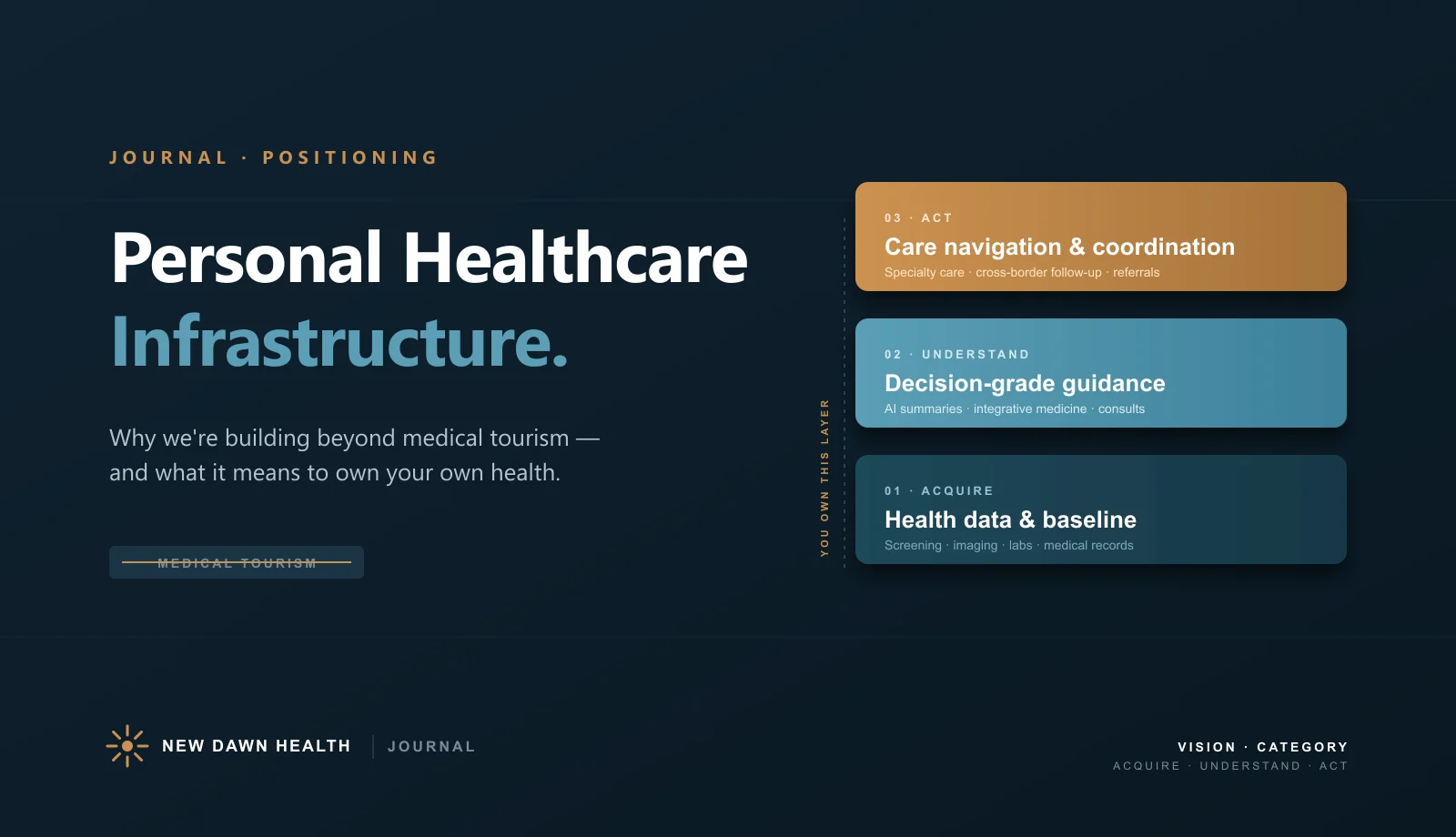
Our Model: Acquire — Understand — Act
Internally, we organize everything we offer into three layers. Each of our service lines maps to one of them.
1. Acquire — generate and access personal health information
This is where most of our visible work happens today. Comprehensive health screenings, advanced imaging (MRI, CT, DEXA, cardiac calcium), bloodwork panels, and specialist consultations — all delivered with English reports that you keep in your portal, downloadable, ready to share with any clinician anywhere. The screening isn't the product. The data and report you walk away with is.
2. Understand — make the information legible and decision-ready
A 14-page radiology report is technically yours, but if you can't read it, you don't really own it. The understanding layer is about closing that gap: clear written summaries, follow-up consultations, and — increasingly — AI-assisted interpretation that surfaces what changed, what's normal for you, and what's worth asking your doctor. Our integrative medicine and Traditional Chinese Medicine services live in this layer too: they're frameworks for interpreting how you actually feel and function, alongside the lab numbers.
3. Act — coordinate the care that follows
Information without action is anxiety. The act layer connects you to specialty care — dental, vision, integrative medicine, dermatology, and more — across our partner network, and helps coordinate cross-border follow-up so a finding in one country doesn't disappear into a void. The medical-travel logistics that get labeled "tourism" sit here, but as one component of a larger care-coordination function, not the headline.
Why This Is Personal Healthcare Infrastructure
The word infrastructure matters because it tells you what we're not. We're not a hospital. We're not a clinic. We're not a destination, a marketplace, or a travel agency. We don't own the medical care; we don't own the data; we don't own the relationship between you and your doctor.
What we operate is the layer that sits in between — the connective tissue that turns a stack of disconnected services into something that serves a single person coherently. Mapped onto the Acquire / Understand / Act model, our service lines become components of that infrastructure:
- Health Screening → access layer
- Medical Records & Reporting → information layer
- AI-Assisted Planning → decision-support layer
- Integrative & Traditional Chinese Medicine → preventive optimization layer
- Specialty Care & Cross-Border Coordination → care navigation layer
None of those are products in isolation. Together, they form the operating layer for a person taking ownership of their own health.
From Reactive Care to Preventive, User-Centered Care
The healthcare system most of us grew up with is built around interventions: you get sick, you see a doctor, the doctor treats you, you go home. That model has saved countless lives, and it isn't going away. But it's incomplete — because it leaves the entire space between visits dark.
Most of the choices that determine your long-term health are made in that dark space. Sleep. Movement. Nutrition. Stress. Whether you act on a nagging symptom in week one or week thirty. The future we're working toward is one where that space is illuminated — gently, on your terms, with information you actually own.
Three trends make this possible now in a way it wasn't ten years ago:
- Imaging and lab pricing have collapsed in markets like Taiwan, making comprehensive baselines accessible to people who would have been priced out at home.
- AI has matured to the point where translating raw clinical data into clear personal guidance is no longer science fiction — it's an engineering problem.
- Consumers expect ownership of their digital lives in a way they didn't a decade ago, and they're starting to expect the same of their health.
The opportunity is to build the infrastructure that lets those trends compound on behalf of the individual, not just the system.
How Our Specialties Fit Into This
One question we get often: "If you're an infrastructure company, why do you also offer dental, vision, integrative medicine, and so on?"
Because all of them are entry points to the same infrastructure. A dental visit produces information about your oral health that, in our model, you walk away owning. A TCM consultation produces a perspective on your constitution that integrates with — not competes with — your Western lab work. A dermatology check produces a longitudinal record that flags changes you'd never notice yourself. Different services, same architecture: data into your hands, understanding within reach, action coordinated.
This is also why we deliberately frame what's often called "TCM" as integrative medicine — because in this stack, it's not a separate category competing with conventional care. It's a parallel diagnostic and optimization framework that earns its place when the data and the patient's own experience say it should.
Our Vision
NewDawn Health is building the infrastructure for personal healthcare ownership — empowering individuals to access, understand, and act on their own health, through preventive care, intelligent guidance, and coordinated access to quality care.
We're not the first company to talk about putting the patient at the center. The ones we admire most don't talk about it — they build the unglamorous plumbing that actually delivers it. Itemized English reports. Reports you can download, not just view. Records that travel with you across borders. Care that follows you home, not just on the day of the scan.
If any of that resonates, the easiest way to feel the difference is to start with a baseline, or talk with our team about what a long-term plan could look like for you. The work we're doing isn't loud. But it adds up — into a healthcare experience where you, not an institution, are at the center.
Further Reading
- Specialties & Services at NewDawn Health
- Comprehensive Health Screening Packages
- Featured Voice: Lisa Anne Chung on Personal Health and AI
- How NewDawn Health Works — From Booking to Report
US / UK terms and the closest Taiwan context
Read this first: These are comparison aids, not claims that coverage, credentials, or care pathways are equivalent. Europe is not one health system; UK examples below refer specifically to NHS England.
PCP / primary care provider; GP / general practitioner
- What it means there
- In the US, a primary care provider may provide prevention, common-illness care, and care coordination. In NHS England, a registered GP commonly coordinates access to non-emergency specialist care.
- Closest Taiwan context
- The closest starting point is a community clinic or family medicine department (基層診所/家庭醫學科).
- Do not treat as equivalent
- Taiwan does not use one universal PCP or GP gatekeeping model. NHI promotes community-first, tiered care, but its referral policy does not make a referral a universal prerequisite to every hospital visit.
- What to ask
- Ask whether this visit is the right first contact, whether direct specialist registration is accepted, and whether a referral changes the appointment or NHI copayment.
Referral
- What it means there
- A US plan, especially an HMO, may require a PCP referral for coverage. In NHS England, specialist hospital care is generally accessed through a GP referral.
- Closest Taiwan context
- Taiwan uses a referral form and two-way referral process (轉診/雙向轉診) when clinical needs call for another facility or level of care.
- Do not treat as equivalent
- A US insurance referral, an NHS clinical access route, and a Taiwan NHI referral do not create the same rights or payment result. Taiwan NHI says referral need not proceed one hospital level at a time and does not universally prohibit direct hospital visits.
- What to ask
- Ask who issues the referral, its validity period, the named facility and department, whether registration is arranged, and what happens to the copayment.
Frequently asked
So is NewDawn Health a medical tourism company or not?
Cross-border travel is part of how we deliver service today, but it isn't the category we're building toward. We describe ourselves as personal healthcare infrastructure — the connective layer that lets individuals access, understand, and act on their own health. Medical travel is one component of the "act" layer; it isn't the headline.
Do you collect or own customer health data?
No. We don't aggregate or sell patient data. The reports, scans, and records generated through our services belong to the individual — delivered in English, downloadable, and portable to any clinician anywhere. Our role is to give people the tools and access to own and use their own information, not to own it ourselves.
What does "personal healthcare ownership" actually look like in practice?
In day-to-day terms: every screening, scan, lab panel, and consultation generates a clean English report in your portal. You can download it, share it with your doctor at home, compare it against last year's baseline, and bring it to a second opinion without paperwork friction. Over time, you build a longitudinal picture of your health that you, not any single institution, control.
How does Traditional Chinese Medicine fit into "personal healthcare infrastructure"?
We frame TCM as integrative medicine — a parallel diagnostic and optimization framework that complements Western clinical data rather than competing with it. In our model, it sits in the "understand" and "preventive optimization" layers: it helps you interpret how you feel and function alongside your lab numbers, and it offers interventions for the everyday space between acute medical events.
Where does AI fit into your model today versus tomorrow?
Today, AI shows up in concrete places: report summarization, longitudinal trend surfacing, and triage of follow-up questions for our concierge team. The longer-term vision is broader — an intelligent layer that takes the unified health information our users own and turns it into decision-grade guidance across sleep, nutrition, prevention, and care. We're building toward that responsibly, with safety and clinical accuracy as the bar.
Who is this model designed for?
People who want to take their health seriously and feel the home-country system isn't set up to support them: U.S. travelers and expats hitting fragmented care or long waits, locals who want a more proactive baseline, and anyone with a family history that makes early data valuable. Our service is intentionally agnostic to where you live — what matters is whether you want to own and act on your health information.
How is this different from a marketplace or a clinic chain?
A marketplace optimizes for transactions; a clinic chain optimizes for its own facilities. We're trying to optimize for the person — which means we're indifferent to whether the right answer for you is a screening at our partner hospital, a specialty referral, an integrative medicine consult, or simply better organization of records you already have. The infrastructure framing gives us permission to recommend the right next step instead of the most billable one.