Blog
Blog
Lost in a New City? Follow the Asian Tour Group

You know the moment. You've just arrived in a city you don't really know, you're standing in some plaza with your phone out, and the map is showing you fifty little pins that all mean nothing. You're hungry, slightly jet-lagged, and quietly aware that you could waste your whole first afternoon walking in the wrong direction.
This is the moment I start looking for a little flag.
The little flag that saves your afternoon
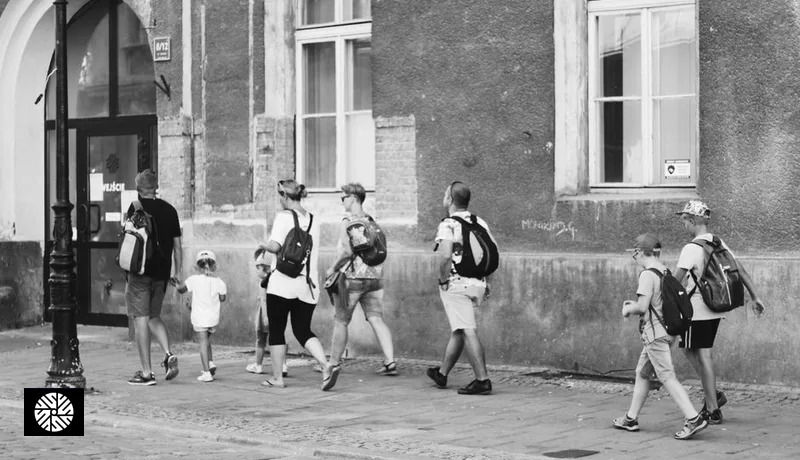
Somewhere in that plaza there is usually a guide holding a small flag — or a folded umbrella, or a laminated sign — with a tidy cluster of travelers behind them. More often than not, it's an Asian tour group: a coach tour from Taiwan, a family group from Japan, a brisk squad from Korea, a sharp-eyed crew from Hong Kong. And here is my slightly shameless travel confession: when I don't know where to go, I follow them.
Not in a creepy way. From a polite distance. But I have eaten some of the best meals of my life because I trailed a Taiwanese group down an alley I'd never have found on my own, and I've stood at viewpoints I didn't know existed because a Japanese guide quietly walked her group to the exact corner where the light was best.
Why Asian tour groups are the best free guides
The secret isn't the flag. It's the homework.
Group travel from much of Asia runs on preparation. By the time that group lands, someone has already done the research you're trying to do live on your phone — except they did it over weeks, in the local language, cross-checked against a dozen blogs and a very opinionated group chat. The itinerary is filtered. The stops are the ones that survived the cut. The timing is deliberate: the famous temple before the crowds, the market while the food is fresh, the lookout when the light is good.
A few things these groups reliably get right:
- The food is real. They're not eating at the place with the English menu and a photo of every dish. They're eating where the guide's cousin said to eat.
- The timing is sharp. They show up just before a place gets busy, because their guide knows the rhythm of the day.
- The route avoids the traps. The "famous" shop that's really just famous for being expensive? They walk straight past it.
- The photo spots are pre-scouted. If twelve people suddenly stop and turn around, turn around too. There's a reason.
How to follow politely
There's an etiquette to this, and it matters. You're borrowing their homework, not joining their trip.
- Keep your distance. Trail behind, don't blend in. You're a happy coincidence, not the thirteenth member.
- Never take a seat, a sample, or a spot arranged for the group. The booked table, the reserved boat, the included tasting — not yours.
- Don't crowd the guide. If you catch a sentence of explanation, lovely. Don't hover for the full lecture.
- Peel off early. The goal is a direction and a couple of great stops, then you're on your own again. Follow for ten minutes, not the whole day.
- A smile and a nod go a long way. Most guides don't mind a respectful stray. They mind a freeloader.
Every country's groups have a personality
After a while you start to read the groups, and it becomes its own little travel game. None of this is a rule — just the fond pattern-spotting of someone who has followed too many flags.
- Japanese groups tend to be punctual and quietly thorough. Want the best light and the cleanest version of a famous view? Follow the calm group that arrived suspiciously early.
- Taiwanese groups will, at some point, detour for food. Trust this completely. The detour is the destination.
- Korean groups often move fast and efficient — great if you want to see a lot in a short window and don't mind keeping pace.
- Hong Kong groups have a sixth sense for value. If they're queuing, whatever's at the front of the queue is probably worth it.
Gentle generalizations, written with affection. The point isn't the stereotype — it's that a group that prepares together moves with a confidence you can borrow.
Steal their homework
Eventually you'll want to do the prep yourself, and the trick is to research the way they do — not in your own language, but in the language of the people who go there most.
- Search in the local-traveler language. The best guide to a Lisbon neighborhood might be written in Japanese; the best night-market map in traditional Chinese. Run it through a translator and you unlock a layer of the internet most visitors never see.
- Ask your hotel's front desk the magic question: "Where do the tour groups go — and where do you go?" The gap between those two answers is gold.
- Watch where the coaches park. Not always pretty, but a cluster of tour buses means something nearby was judged worth the logistics.
- Build a tiny shortlist, not a full plan. Three anchor stops and a willingness to follow a flag beats a rigid twelve-hour schedule.
The point of the flag
Here's what I've come to believe after a lot of plazas and a lot of little flags: the best parts of a place are rarely on the first page of the search results. They're down the alley, around the corner, at the table with no English menu — and quite often, ten steps behind someone holding a flag who cared enough to find out first.
So next time you land somewhere new and the map is just noise, don't panic. Look for the flag. Follow at a polite distance. Eat what they eat. Then wander off and make it your own.
FAQ
It's only weird if you make it weird. Following at a respectful distance for a few minutes — eating where they eat, walking the route they walk — is closer to people-watching than stalking. The line you don't cross is taking something arranged and paid for by the group: their table, their boat, their guide's full attention. Borrow the direction, not the booking.
Look for small signals of preparation: a guide who walks briskly without constantly checking a phone, a group that arrives somewhere just before it gets busy, and detours into streets with no English signage. Those are groups working from real research. A group drifting slowly through the obvious tourist strip is just doing the obvious — you don't need them for that.
Most guides won't mind a respectful stray who keeps their distance and doesn't interrupt. What they mind is someone crowding the group, blocking photos, or trying to get the full explanation for free by hovering in the middle of it. Hang back, smile, and peel off before it ever becomes a thing.
There's no single best — it depends what you want. Follow a Japanese group for timing and calm, well-scouted views; a Taiwanese group when you're hungry and want the food detour; a Korean group when you want to cover ground quickly; a Hong Kong group when you want value. These are affectionate generalizations, not rules — any group that prepares together is worth a few steps.
Research in the language of the people who travel there most, not just English. Translate local-language blogs and forums, ask your hotel front desk where the tour groups go versus where they personally go, and notice where the coaches park. Build a short list of three anchor stops rather than a rigid plan, and leave room to follow a flag when you find one.