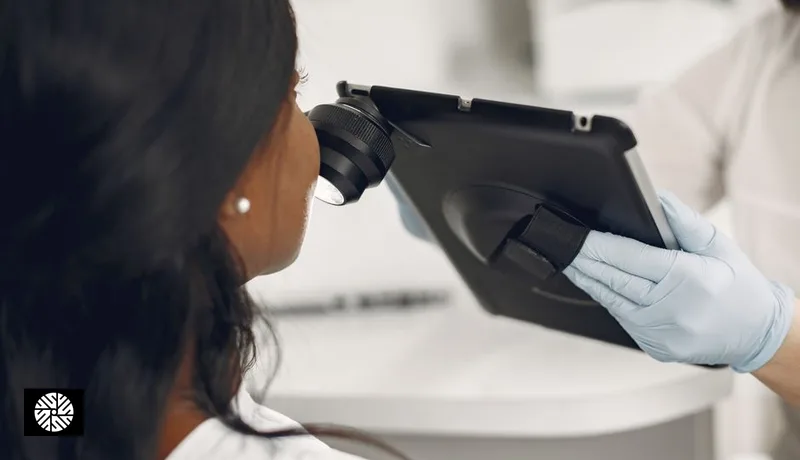

The US Preventive Services Task Force has looked at this question twice, in 2016 and again in April 2023, and both times reached the same conclusion. "The USPSTF concludes that the current evidence is insufficient to assess the balance of benefits and harms of visual skin examination by a clinician to screen for skin cancer in adolescents and adults."
That is a grade I statement, and it is the honest starting point for anyone deciding whether to pay for a whole-body mole check.
Insufficient does not mean useless. It means the trials that would settle the question have not been done.
One distinction decides how much of this applies to you. A screening exam looks over the skin of someone with no complaint. Taking a lesion you have already noticed to a dermatologist is a different appointment, and the I statement does not cover it.
What follows is what the evidence does support, what it does not, and who the guideline bodies actually name.
What exactly does a grade I statement mean?
The USPSTF uses five grades, and the I statement is not one of the four that carry a direction.
| Grade | What the USPSTF says | Suggestion for practice |
|---|---|---|
| A | Recommends the service. High certainty that net benefit is substantial. | Offer or provide this service. |
| B | Recommends the service. Net benefit moderate, or moderate certainty of moderate to substantial benefit. | Offer or provide this service. |
| C | Recommends selectively offering the service based on professional judgment and patient preferences. | Offer for selected patients depending on individual circumstances. |
| D | Recommends against the service. | Discourage the use of this service. |
| I | Evidence is insufficient. Evidence is lacking, of poor quality, or conflicting, and the balance of benefits and harms cannot be determined. | If the service is offered, patients should understand the uncertainty about the balance of benefits and harms. |
The Task Force is direct about where American practice stands on this. The "Recommendations of Others" section of the April 2023 statement reads: "Currently, no professional organizations in the US recommend clinical visual examination for skin cancer screening."
That sentence describes April 2023. We opened the page again on 9 September 2026, and it was still the published text.
The American Academy of Dermatology has no formal guideline on clinician-performed screening. It does encourage and resource free public screening events run by its members.
Who does the I statement not apply to?
Three groups, and the USPSTF names them explicitly. This is the part most summaries drop, and it is where the useful information lives.
The USPSTF states that the recommendation "applies to asymptomatic adolescents and adults who do not have a history of premalignant or malignant skin lesions." It then names the three groups it does not cover.
- Symptomatic patients, including anyone presenting with a suspicious skin lesion.
- People already under surveillance because of a high risk of skin cancer, such as those with a familial syndrome. The example the Task Force gives is familial atypical mole and melanoma syndrome.
- People with a personal or family history of skin cancer.
The same document lists what raises risk.
| Risk factor | How the USPSTF describes it |
|---|---|
| Ultraviolet radiation from the sun, tanning beds and other UV-emitting devices | The major environmental risk factor |
| A history of frequent sunburns | Associated with increased risk |
| Older age | Associated with increased risk |
| Male sex | Associated with increased risk |
| Higher numbers of moles on the skin | Named as a melanoma risk factor |
| Atypical moles | Named as a melanoma risk factor |
| A personal or family history of skin cancer | Named as a melanoma risk factor |
Whether any of that applies to you is a question for your own physician.
It is worth being clear about what the AAD does publish. Its 2019 clinical practice guideline covers the management of primary cutaneous melanoma after diagnosis, including biopsy technique, surgical margins, sentinel lymph node biopsy and follow-up of asymptomatic patients.
That is a treatment guideline dated 2019, written for people who already have a melanoma. It is not a screening guideline for people who do not.
What are the ABCDEs, and what are they for?
The American Academy of Dermatology publishes the ABCDE criteria for spots that may be melanoma.
- A is for Asymmetry. One half of the spot is unlike the other half.
- B is for Border. The spot has an irregular, scalloped, or poorly defined border.
- C is for Color. The spot has varying colors from one area to the next, such as shades of tan, brown or black, or areas of white, red, or blue.
- D is for Diameter. While melanomas are usually greater than 6 millimeters, or about the size of a pencil eraser, when diagnosed, they can be smaller.
- E is for Evolving. The spot looks different from the rest or is changing in size, shape, or color.
The AAD's own advice attached to these criteria is about acting on a change, not about booking a routine exam. "If you notice any new spots on your skin, spots that are different from others, or spots that are changing, itching or bleeding, make an appointment to see a board-certified dermatologist."
Does a dermatoscope actually add anything?
Yes, and this is where the evidence is strongest. A dermatoscope is a handheld magnifier with a light that lets a clinician see structures below the surface of a lesion. Two bodies of evidence measure what it adds over the naked eye.
| Study | What it compared | Result |
|---|---|---|
| Vestergaard et al., British Journal of Dermatology 2008, nine studies in clinical settings | Dermoscopy versus naked eye examination for diagnosing primary melanoma | Relative diagnostic odds ratio 15.6, 95% CI 2.9 to 83.7. Removing two outlier studies changed it to 9.0, 95% CI 1.5 to 54.6. |
| Dinnes et al., Cochrane Database of Systematic Reviews 2018, 103 study cohorts and 42,788 lesions | In-person dermoscopy added to visual inspection versus visual inspection alone | Relative diagnostic odds ratio 4.7, 95% CI 3.0 to 7.5. At a fixed specificity of 80%, sensitivity rose 16 percentage points, from 76% to 92%. At a fixed sensitivity of 80%, specificity rose 20 points, from 75% to 95%. |
The Cochrane review then does the arithmetic that matters to a patient. For a hypothetical 1,000 lesions at the median in-person disease prevalence of 12%, using dermoscopy at a fixed specificity of 80% means 19 fewer melanomas missed, at the price of 176 false positive results. Run it the other way, at a fixed sensitivity of 80%, and dermoscopy means 176 fewer unnecessary excisions, with 24 melanomas missed.
The review's own caution is important. Accuracy was higher for observers with high experience and for those classed as expert consultants. "Data to support its use in primary care are limited." Every one of these numbers describes lesions that were already considered suspicious, not a routine sweep of unremarkable skin.
What is the harm side that rarely gets priced in?
The USPSTF names three categories of potential harm from screening.
- Cosmetic harms, such as scarring from a diagnostic workup.
- Psychosocial harms, such as worry from the screening process.
- Overdiagnosis leading to overtreatment.
Overdiagnosis in melanoma has been quantified. Adamson, Suarez and Welch published an estimate in JAMA Dermatology in 2022, using joinpoint regression on SEER data from 1975 to 2014. They used mortality trends among Black patients as a marker for improvements in medical care, in order to estimate how much of the incidence rise in White patients reflects real disease.
Melanoma incidence rose roughly fourfold in White women and sixfold in White men over that period. Melanoma mortality was stable in White women and rose almost 50% in White men. Incidence among Black patients rose less than 25%.
Their estimate: 59% of White women and 60% of White men diagnosed with melanoma in 2014 were overdiagnosed, with 95% confidence intervals of 45% to 70% and 32% to 75% respectively. The paper was contested in the same journal, and the authors replied. It is not a settled number. It is a serious estimate published in a peer-reviewed journal that anyone weighing a screening exam should have seen.
Why does the local baseline differ outside the United States?
Melanoma is not evenly distributed, and neither is the type of melanoma.
| Fact | Figure | Source |
|---|---|---|
| US melanoma incidence | 22.3 per 100,000 per year, 2019 to 2023 | SEER |
| US melanoma death rate | 2.0 per 100,000 per year, 2020 to 2024 | SEER |
| US lifetime risk of a melanoma diagnosis | About 2.2% | SEER |
| US five-year relative survival | 94.7%, 2016 to 2022 | SEER |
| Melanoma incidence in White versus Black persons | About 30 times more common in White persons | USPSTF 2023 |
| Acral lentiginous melanoma, which occurs on palms, soles and nail beds | Under 2% of melanoma registrations worldwide, 6% in Asia | CONCORD-3, 1,578,482 adults in 59 countries |
The USPSTF also notes that people with darker skin are often diagnosed at later stages, when skin cancer is harder to treat, and that the most common melanoma among Black persons occurs on skin not frequently exposed to sunlight. A whole-body exam that only inspects sun-exposed surfaces is looking in the wrong place for that pattern.
What do the guidelines positively support?
Prevention, not screening, is where the USPSTF issues actual recommendations. The rows below come from its behavioral counseling statement for skin cancer prevention, dated 20 March 2018.
| Who the USPSTF names | What it says about counseling | Grade |
|---|---|---|
| Young adults, adolescents, children and parents of young children, for people aged 6 months to 24 years with a fair skin type | Counsel about minimizing exposure to UV radiation | B |
| Adults older than 24 with a fair skin type | Selectively offer that counseling | C |
| Adults, on skin self-examination | Evidence is insufficient | I |
Which of these two appointments is the evidence about?
The screening one only. Everything above concerns a whole-body examination of a person with no complaint, and that is one of two different appointments a reader might book.
| Appointment | What it is for | Which evidence applies |
|---|---|---|
| Full Body Skin Exam | A whole-body look at skin nobody is worried about | The USPSTF I statement, April 2023 |
| Clinical Dermatologist Appointment | A lesion the person has already noticed | Outside the I statement. The dermoscopy studies sit here |
The Task Force excluded symptomatic patients from its statement, and a suspicious lesion makes a patient symptomatic. The AAD's ABCDE advice points the same way, telling people who notice a change to make an appointment.
The dermoscopy evidence belongs on the second row. Vestergaard and Dinnes both measured lesions a clinician was already suspicious about, not a routine sweep of unremarkable skin.
Buying the first appointment does not buy you the evidence behind the second.
What do the two appointments cost in Taipei?
$145 and $150, and they are not the same purchase.
| Item | Price | Listed appointment length |
|---|---|---|
| Full Body Skin Exam | $145 | 1 hour |
| Clinical Dermatologist Appointment | $150 | 30 minutes |
Our record for the Full Body Skin Exam describes a dermatoscope being used during the exam. Our record for the Clinical Dermatologist Appointment describes a 30-minute consultation with a board-certified dermatologist for rashes, allergies, skin infections and lesions you want looked at, and nothing more.
If you are combining either with other appointments, plan the dates before you book flights.
- Check the live booking calendar, which shows the earliest date.
- Confirm the slot first, before the flight.
- If your dates are tight, ask, because arrangements are made case by case.
Two related pieces on this site may help: our guide to seeing a dermatologist in Taiwan, and what happens when a scan finds something.
The bottom line
The evidence for a routine whole-body skin exam in an asymptomatic adult is insufficient by the assessment of the only US body that grades it, and no American professional organization recommends it.
The evidence that a dermatoscope beats the naked eye on a lesion someone is already worried about is much stronger. The evidence that melanoma is substantially overdiagnosed in the United States is serious and contested.
Those three facts point in different directions, which is why this is a decision for you and your physician rather than one an article should make.
They also point at two different appointments. A lesion that worries you is not what the I statement is about, and if you are in a group the Task Force explicitly excluded, that conversation should happen with a doctor who can see your skin.
Sources
- US Preventive Services Task Force — Skin Cancer: Screening, final recommendation statement, April 18 2023 (accessed 2026-09-09)
- US Preventive Services Task Force — Grade Definitions (accessed 2026-09-09)
- US Preventive Services Task Force — Skin Cancer Prevention: Behavioral Counseling, final recommendation statement, 20 March 2018 (accessed 2026-09-09)
- American Academy of Dermatology — What to look for: ABCDEs of melanoma (accessed 2026-09-09)
- British Journal of Dermatology, Vestergaard ME et al. 2008 — Dermoscopy compared with naked eye examination for the diagnosis of primary melanoma: a meta-analysis of studies performed in a clinical setting (accessed 2026-09-09)
- Cochrane Database of Systematic Reviews, Dinnes J et al. 2018 — Dermoscopy, with and without visual inspection, for diagnosing melanoma in adults (accessed 2026-09-09)
- JAMA Dermatology, Adamson AS, Suarez EA, Welch HG 2022 — Estimating Overdiagnosis of Melanoma Using Trends Among Black and White Patients in the US (accessed 2026-09-09)
- JAMA Dermatology 2022 — Melanoma Overdiagnosis Is Not the Key Problem, reply from the authors (accessed 2026-09-09)
- National Cancer Institute SEER — Cancer Stat Facts: Melanoma of the Skin (accessed 2026-09-09)
- British Journal of Dermatology, Di Carlo V et al. 2022 — Does the morphology of cutaneous melanoma help to explain the international differences in survival? CONCORD-3 (accessed 2026-09-09)
- Journal of the American Academy of Dermatology, Swetter SM et al. 2019 — Guidelines of care for the management of primary cutaneous melanoma (accessed 2026-09-09)