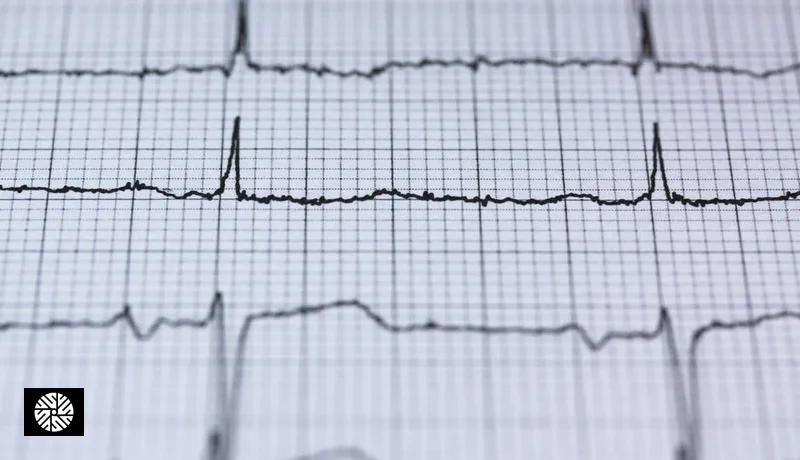

Atrial fibrillation (AF) is an irregular heart rhythm that can come and go. Many people feel it. Many do not, and the registry data below show why that matters. This article covers how often AF is silent, what the trials say about looking for it, and where a multi-day ECG patch fits.
What is atrial fibrillation, and how common is it?
In AF the upper chambers of the heart beat in a disorganised way, so the pulse becomes irregular. In the Framingham Heart Study, the lifetime risk of developing AF at age 40 was 26.0% for men and 23.0% for women. The authors summarised it as "1 in 4 for men and women 40 years of age and older" (Lloyd-Jones et al., Circulation 2004).
The US Preventive Services Task Force (USPSTF) notes that AF becomes more common with age. Prevalence rises from less than 0.2% in adults younger than 55 to about 10% in those 85 or older.
How often does AF cause no symptoms?
The CDC states that "some people who have AFib don't know they have it and don't have any symptoms." Numbers vary by population and by how long the heart is monitored. One example is the GLORIA-AF registry, which followed 15,308 patients with a first episode of AF. About one third, 4,892 people (32%), had asymptomatic AF.
In the same registry, a history of stroke or an acute stroke on admission was recorded in 12.5% of the asymptomatic group (611 of 4,892). In the symptomatic group it was 5.0% (519 of 10,416). That is an association in registry data, not proof that silence itself causes strokes. It does suggest that people without symptoms are not safer for being unaware.
Why does silent AF matter?
AF is a major, independent risk factor for stroke. In the Framingham Study, followed for 34 years in 5,070 participants, the authors reported "a near fivefold excess" of stroke when AF was present (Wolf et al., Stroke 1991). The CDC likewise describes AF as associated with an approximately fivefold increased risk of ischemic stroke.
The same Framingham analysis found that AF's share of stroke risk grew with age. The attributable risk of stroke from AF rose from 1.5% at ages 50-59 to 23.5% at ages 80-89.
Once AF is known, doctors can estimate stroke risk with a scoring system such as CHA2DS2-VASc. In the Euro Heart Survey study that introduced the score, thromboembolism rates rose as scores rose (Lip et al., Chest 2010). Whether a person needs treatment is a decision made on that kind of assessment, after AF has been found. The catch with silent AF is that nobody does the assessment until it is detected.
Why is silent AF hard to catch with a normal ECG?
A standard resting ECG records a few seconds to minutes. AF that comes and goes (paroxysmal AF) is easy to miss if the heart is in normal rhythm during the recording. Longer, continuous recording gives the rhythm more chances to show itself. That is the logic behind wearable ECG patches.
What do the trials show about looking for it?
Two large trials give a balanced picture: more AF is found, but better outcomes are not yet proven.
| Trial | Who and how | What it found | What it did not show |
|---|---|---|---|
| mSToPS (Steinhubl et al., JAMA 2018) | 2,659 people, mean age 72.4, randomised to wear a home ECG patch at once or after a 4-month delay. Mean wear time per patch was 11.7 days. | New AF at 4 months: 3.9% (53 of 1,366) with immediate monitoring versus 0.9% (12 of 1,293) with delayed monitoring. | The authors reported no difference in AF-related emergency visits and hospitalisations at 1 year. The primary end point was a new AF diagnosis, not stroke. |
| LOOP (Svendsen et al., Lancet 2021) | 6,004 people randomised 1:3 to an implanted loop recorder or usual care, median follow-up 64.5 months. | AF diagnosed in 31.8% (477 of 1,501) with the recorder versus 12.2% (550 of 4,503) with usual care. | Stroke or systemic embolism: 4.5% versus 5.6%, hazard ratio 0.80 (95% CI 0.61-1.05). The authors report no significant reduction. |
The honest reading: monitoring finds AF that would otherwise stay hidden. Whether finding it early reduces strokes in people with no symptoms has not been settled by these trials.
What do guidelines say about screening?
The USPSTF reviewed screening for AF in adults 50 and older with no signs or symptoms. Its grade is I: "the current evidence is insufficient to assess the balance of benefits and harms of screening for atrial fibrillation." An I statement is neither a recommendation for screening nor against it. It means the USPSTF could not weigh the benefits against the harms on the evidence available.
Sleep apnea is one reason some people may want a closer look. A meta-analysis of 9 studies (19,837 participants) found a higher risk of AF in people with obstructive sleep apnea or sleep-disordered breathing than in controls (odds ratio 2.12, 95% CI 1.845-2.436). Our guide to sleep apnea signs and testing explains how the two overlap. Blood pressure is another piece of the picture; see blood pressure numbers explained.
Where does ECG patch screening fit in a screening visit?
At iHope Clinic we offer the Rooti ECG patch as a multi-night study. It is a waterproof chest patch worn continuously, day and night. It records a single-lead ECG plus movement and body position. The platform flags breathing events from the ECG signal and rhythm findings such as atrial fibrillation.
| Study | Our price | Worn for |
|---|---|---|
| Rooti 3 Day Sleep Study & Analysis | $210 | 3 days and nights |
| Rooti 7 Day Sleep Study & Analysis | $380 | 7 days and nights |
Know the limits. This is a screening study, not a polysomnogram (a full lab sleep study), and not a diagnosis. A single-lead patch is not a 12-lead ECG. The wear periods are shorter than the mSToPS average of 11.7 days, so a clean result does not rule out AF that happens rarely. If a patch flags a possible rhythm problem, it needs confirmation by a physician with a proper ECG review.
A patch study works as one part of a wider check. The health screening packages cover imaging and labs for other silent conditions. For the brain's blood vessels there is Brain MR Angiography ($699). For general heart and lung prevention, see heart and lung screening in Taiwan.
Who might consider a multi-day patch?
- Adults 50 or older, since AF becomes more common with age.
- People with loud snoring, witnessed pauses in breathing, or daytime sleepiness, given the sleep apnea link above.
- People who sometimes feel fluttering, skipped beats or unexplained breathlessness, even if it passes.
- People with a family history or with high blood pressure.
Symptoms such as chest pain, fainting, or weakness on one side of the body need urgent medical care, not a screening study. If a patch or any other test suggests AF, talk to a doctor about what it means for you. Treatment choices belong to you and your physician.
This article is general education and is not medical advice.
Sources
- Circulation — Lloyd-Jones DM et al., Lifetime risk for development of atrial fibrillation: the Framingham Heart Study (2004) (accessed 2026-10-29)
- Stroke — Wolf PA et al., Atrial fibrillation as an independent risk factor for stroke: the Framingham Study (1991) (accessed 2026-10-29)
- US Centers for Disease Control and Prevention — Atrial Fibrillation (accessed 2026-10-29)
- Heer T et al. — Characteristics of patients with asymptomatic atrial fibrillation and ischemic stroke: insights from the GLORIA-AF registry, phase 2, Pacing and Clinical Electrophysiology 2025 (accessed 2026-10-29)
- Chest — Lip GYH et al., Refining clinical risk stratification for predicting stroke and thromboembolism in atrial fibrillation (2010) (accessed 2026-10-29)
- JAMA — Steinhubl SR et al., Effect of a home-based wearable continuous ECG monitoring patch on detection of undiagnosed atrial fibrillation: the mSToPS randomized clinical trial (2018) (accessed 2026-10-29)
- The Lancet — Svendsen JH et al., Implantable loop recorder detection of atrial fibrillation to prevent stroke (The LOOP Study) (2021) (accessed 2026-10-29)
- US Preventive Services Task Force — Atrial Fibrillation: Screening (accessed 2026-10-29)
- Youssef I et al. — Obstructive sleep apnea as a risk factor for atrial fibrillation: a meta-analysis (2018) (accessed 2026-10-29)