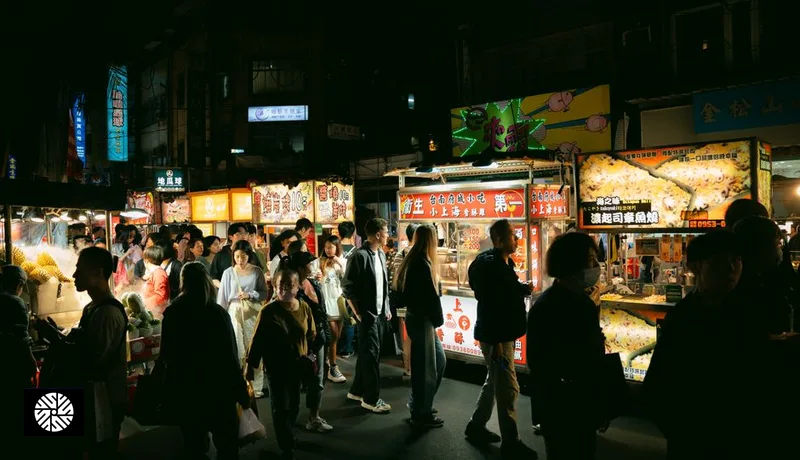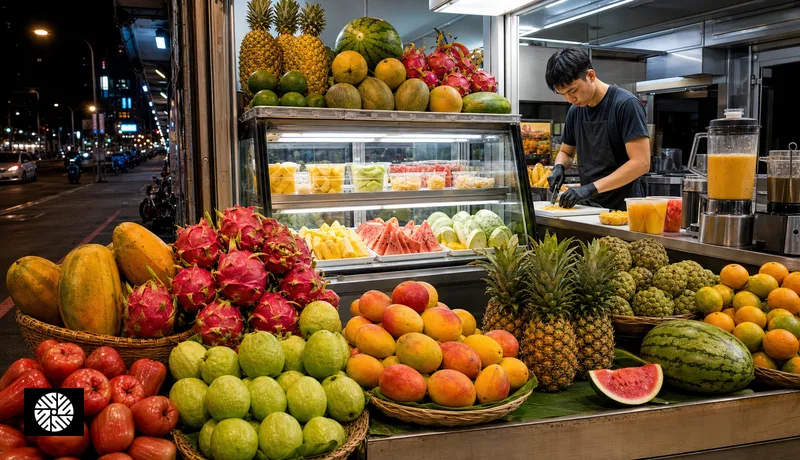

It is after midnight in Taipei. The restaurants are closing, the last MRT is approaching, and one neighborhood shop is still glowing like a tropical jewel box. Mangoes sit in careful pyramids. Pineapples, guavas, wax apples, dragon fruit, papayas, and melons fill the open storefront. Behind the counter, somebody is peeling a pineapple for a customer who does not own a knife.
This is one of Taiwan's most charming pieces of everyday infrastructure: the dedicated fruit shop. Many stay open late, some operate 24 hours, and plenty will peel and cut your purchase on request. Others keep refrigerated cups of ready-to-eat fruit or run a blender counter for fresh juice and fruit milk. In a city where convenience stores solve almost every other problem, fruit has built its own convenience culture.
Visitors tend to arrive looking for bubble tea and night-market snacks. The better surprise is that ripe local fruit can be an ordinary breakfast, an after-dinner stop, a hospital gift, a temple offering, or a 1 a.m. snack. Here is how Taiwan's “fruit kingdom” works — what to eat by season, how to order it, where to buy it, and how to avoid paying tourist-stall prices for a box you did not mean to buy.
Why Taiwan Can Grow Almost Everything
Taiwan's fruit abundance begins with geography. The island stretches across tropical and subtropical climates, while its central mountains create cooler elevations where temperate crops can grow. According to Taiwan's Agriculture and Food Agency, more than 30 fruit varieties are cultivated across roughly 180,000 hectares. Tropical mangoes and pineapples, subtropical guavas and wax apples, mountain pears, persimmons, citrus, grapes, and strawberries can all be domestic products.
Agricultural technique extends the calendar further. Different cultivars ripen at different times, orchards sit at different elevations, and farmers use careful pruning, bagging, and production timing to bring fruit to market well outside a simple one-month season. That is why bananas, papayas, guavas, and pineapples seem to be available whenever you visit, even though each still has a best moment.
The practical lesson: buy what looks abundant, fragrant, and reasonably priced that week. A perfect local mango in June is more memorable than an imported strawberry in August, and it will usually cost less.
The Late-Night Fruit Shop
A Taiwanese fruit shop — 水果店 (shuǐguǒ diàn) — is usually more specialized than a supermarket produce aisle. Fruit is stacked by variety and grade, often with handwritten signs showing the price. Shop staff know what is ready tonight, what needs two days on a hotel desk, and which box is presentable enough to give as a gift.
Why do some stay open all night? Partly because Taiwan's dense urban neighborhoods support small shops at almost every hour, and partly because the product demands work outside conventional retail time. Deliveries arrive, displays need restocking, and fruit cannot simply bake on an outdoor stand until the next afternoon. The result is a type of shop that is useful to shift workers, families, restaurant buyers, late arrivals, and jet-lagged travelers alike.
Not every shop is open 24 hours, so do not build a cross-city expedition around the assumption. Search Google Maps for 24小時水果 or 水果行, then check the latest hours. In most central neighborhoods, finding a shop open well into the evening is easy.
Whole, Fresh-Cut, or Blended?
Taiwan makes fruit available at three levels of effort:
- Whole fruit. Cheapest in most cases and the best choice when you have a knife, a refrigerator, and more than one person. Ask the shop to help choose when you plan to eat it.
- Fresh-cut fruit. Look for 現切水果 (xiàn qiē shuǐguǒ), meaning fruit cut fresh. Some shops cut your selected mango, pineapple, guava, or papaya to order; convenience stores and supermarkets also sell sealed refrigerated cups.
- Fresh juice or fruit milk. A juice counter may advertise 現打果汁 (xiàn dǎ guǒzhī), blended or juiced to order. Papaya milk, watermelon juice, avocado milk, pineapple juice, and mixed fruit-and-vegetable blends are common.
Fresh-cut service is the traveler sweet spot. You can point to the exact fruit, have it peeled and boxed, and eat it in a park or hotel without turning the room into a mango crime scene. Confirm the price first, especially if the fruit is sold by weight.
How Prices Work — and the 600-Gram Detail
Many market signs quote a price per 斤 (jīn), the traditional unit still used for produce in Taiwan. One Taiwanese jin equals 600 grams, or about 1.32 pounds. A sign reading “$80/斤” therefore does not mean NT$80 for the entire pile or for one fruit; it means NT$80 per 600 grams.
Some premium fruit is priced per piece, per box, or by a different weight shown on the label. Fresh-cut stalls may price by 100 grams. Before anyone starts cutting, ask:
這個怎麼賣?
Zhège zěnme mài?
How is this priced?
At night markets and famous tourist streets, never assume a tray is a flat price just because the fruit is already in a box. Point, confirm the total, and only then say yes. Neighborhood fruit shops, traditional morning markets, supermarkets, and farmers' markets are generally better places for ordinary shopping than cut-fruit stands positioned for one-time visitors.
What to Eat, Season by Season
Weather and cultivar shift the exact weeks, but this is a useful traveler's calendar:
| When you visit | Fruit to look for | What makes it special |
|---|---|---|
| December–February | Strawberries, citrus, wax apples, jujubes, sugar apples | Winter strawberries are grown in places such as Dahu; crisp Taiwanese jujubes are eaten fresh, not dried. |
| March–April | Pineapple, loquat, mulberry, green plum | Golden Diamond pineapple moves into peak season and is famously sweet with a tender core. |
| May–July | Mango, lychee, watermelon, pineapple, peach, plum | This is the dramatic summer window: Irwin mangoes, short-season lychees, and enormous watermelons. |
| August–September | Dragon fruit, passion fruit, pear, pomelo, late mango | Pomelo is closely associated with the Mid-Autumn Festival; mountain pears bring a crisp contrast to tropical fruit. |
| October–November | Persimmon, citrus, guava, grape, starfruit | Cooler weather brings orange persimmons, fragrant citrus, crisp guava, and translucent slices of starfruit. |
| Almost year-round | Banana, papaya, guava, pineapple | Availability is broad, but flavor and price still rise and fall with regional harvests. |
If you only learn six Taiwan fruit names, make them these:
- 愛文芒果 — Irwin mango. Red-skinned, intensely fragrant, orange-fleshed, and the star of summer mango shaved ice.
- 金鑽鳳梨 — Golden Diamond pineapple. Sweet, low-acid, and tender enough that locals often eat most of the core.
- 芭樂 — guava. Crisp rather than soft, often sliced and eaten as an everyday snack; some vendors offer sour plum powder on the side.
- 蓮霧 — wax apple. Bell-shaped, glossy red, watery-crisp, and refreshing rather than aggressively sweet.
- 釋迦 — sugar apple. Knobbly green skin hiding soft, custard-like flesh and large black seeds; Taitung is especially famous for it.
- 台灣大棗 — Taiwanese jujube. A fresh winter fruit with the crunch of an apple, very different from the dried red date many visitors expect.
What to Order at a Juice Counter
The Taiwanese fruit drink most worth starting with is 木瓜牛奶 (mùguā niúnǎi), papaya milk. It is thick, mellow, and so common that dedicated stands exist around it. 西瓜汁 (watermelon juice) is the purest answer to a humid summer night. Avocado milk is richer and often sweetened; mixed vegetable-fruit juice can range from refreshing to unmistakably medicinal.
A few phrases give you control over the blender:
- 不要加糖 — bú yào jiā táng — no added sugar
- 半糖 — bàn táng — half sugar
- 少冰 — shǎo bīng — less ice
- 去冰 — qù bīng — no ice
- 不要加水 — bú yào jiā shuǐ — do not add water
- 請幫我切 — qǐng bāng wǒ qiē — please cut it for me
“No added sugar” does not make a large juice nutritionally identical to whole fruit. The World Health Organization classifies the sugars naturally present in fruit juice as free sugars and recommends limiting them; whole fruit also retains its fiber and is generally more filling. Enjoy the juice as a Taiwan food experience, not as a magic health drink. If you want fruit every day, make most of it whole or freshly cut and treat the blender as the fun variation.
Fresh-Cut Fruit Safety Without Paranoia
Taiwan has modern food-safety rules and a strong culture of frequent shopping. Still, cut fruit is perishable — especially in summer heat. Taiwan Food and Drug Administration research summarizes good fresh-cut handling as clean, cold, and current: hygienic preparation, reliable refrigeration, and fresh stock.
Use this quick visual check:
- Choose fruit that is cut to order or kept in a genuinely cold refrigerated case.
- Look for a clean cutting board, knife, counter, and hands or gloves.
- Avoid cups sitting warm in direct sun, leaking liquid, or showing dried edges.
- Eat freshly cut fruit promptly; refrigerate it if you are saving it.
- For pregnant travelers, young children, older adults, or anyone immunocompromised, whole fruit you wash and peel yourself is the lower-risk choice, and pasteurized juice is safer than unpasteurized fresh juice.
This is practical caution, not a reason to miss the experience. A busy neighborhood shop cutting a pineapple in front of you is usually an easy decision.
Fruit as Gift, Hospitality, and Everyday Care
Fruit in Taiwan is not only food. A carefully arranged box can be a host gift, a holiday present, or something carried when visiting a friend, elder, or patient. Premium fruit is selected for symmetry, color, size, and presentation; the price may reflect beauty as much as flavor. Temple altars and family tables use fruit to express offering and abundance. At the other end of the spectrum, a bag of sliced guava is simply what someone eats while watching television.
That range is the culture in miniature: fruit can be ceremonial, luxurious, medicinal in reputation, or completely ordinary. The same pineapple appears in a gift box, a cup beside the road, a glass of juice, a shaved-ice dessert, and the filling of Taiwan's best-known souvenir cake.
One Important Note for Health-Screening Mornings
If you are fitting a health screening into your Taiwan trip, fresh juice still counts as food. Many blood tests, abdominal ultrasounds, sedated endoscopies, and imaging protocols require fasting. Follow the preparation instructions from your coordinator and save the mango, papaya milk, and juice for after the appointment. A “healthy” drink can still invalidate a fasting result or interfere with a procedure.
Once the fast is over, however, a fruit shop makes an excellent re-entry to the city: hydrating, local, open when jet lag is hungry, and available in exactly the amount you want.
The Fruit-Shop Starter Plan
On your first evening, skip the tourist-market tray and search for a neighborhood 水果行. Ask what is best today. Buy one fruit you recognize and one you do not. Have the difficult one cut fresh. Confirm the price before the knife comes out. If it is summer, add watermelon juice or papaya milk; if it is winter, choose wax apples, jujubes, or sugar apple.
Then do it again in the next city. Taiwan's fruit map changes from Taipei to Tainan, from the western plains to Taitung, and from one month to the next. It is one of the cheapest and easiest ways to taste the island's geography — and one of the few great travel experiences still available at one in the morning.
Sources & Further Reading
- Taiwan Agriculture and Food Agency — Taiwan Fruits
- Agriculture and Food Agency — Taiwan crop origin and harvest-season search
- Agriculture and Food Agency — Golden Diamond pineapple peak season
- Taiwan FDA — Study on Safety Management of Fresh-Cut Vegetables and Fruits
- US CDC Yellow Book — Food and water precautions for travelers
- World Health Organization — Healthy diet and fruit-juice guidance
This article is general travel and food information, not individual medical advice. Harvest dates, shop hours, and prices change; verify current details locally. Follow your clinic's fasting and preparation instructions before any medical appointment.