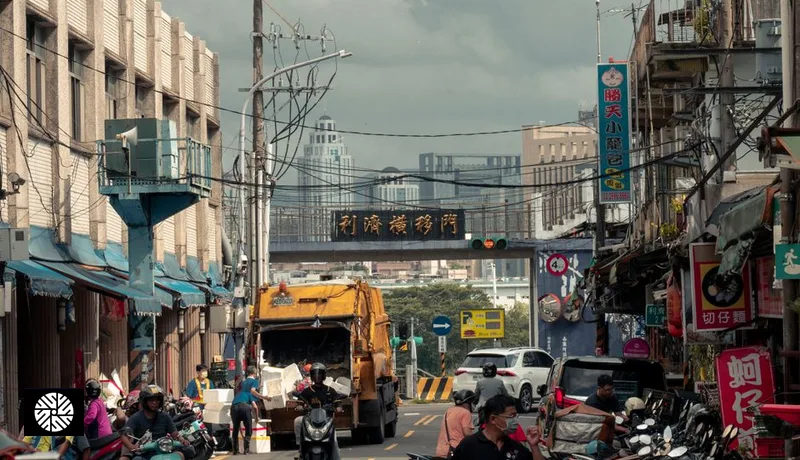

It is a little after eight in the evening and somewhere down the block, a truck is playing Beethoven's "Für Elise" on a loudspeaker. Doors open along the street. People walk out carrying bags — some in their pajamas, some still holding chopsticks — and gather at the corner. A yellow truck arrives. They throw their bags in, chat for thirty seconds, and go home.
Visitors almost universally assume it is an ice cream truck. It is the garbage truck, and watching an entire neighborhood come out to meet it is one of the most quietly astonishing things about daily life in Taiwan.
The other thing visitors notice, usually within an hour of landing, is that they cannot find a trash can anywhere. These two facts are the same fact.
Why There Are No Public Trash Cans
Taiwan removed most street bins deliberately. Public cans invited household and business waste to be dumped into them, which meant overflow, smell, pests, and collection costs — so the policy went the other direction: if the bins are gone, waste goes home with whoever created it, and it enters the system in a bag that was paid for.
The result feels backwards for about a day. You buy a drink, finish it, and carry the empty cup for an hour. Then you realize the streets are remarkably clean anyway, and that you are carrying the cup precisely because there is nowhere convenient to abandon it.
"Garbage Does Not Touch the Ground"
The system's Chinese name is 垃圾不落地 — literally "garbage does not touch the ground." Instead of leaving bags on the curb for collection, residents hand them directly to the truck at a scheduled time and place.
Trucks run fixed routes on fixed nights, announcing themselves with one of two classical pieces: Beethoven's "Für Elise" or Tekla Bądarzewska-Baranowska's "A Maiden's Prayer." Adults who grew up here can identify the tune from three blocks away and calculate exactly how long they have to get downstairs.
Behind the general-waste truck usually comes a second vehicle for recyclables, staffed by workers who sort material into compartments as you hand it over, plus a bucket for kitchen waste. Missing your truck means storing the bag until the next scheduled run — which is a real incentive to produce less of it.
You Pay by the Bag
The financial engine of the system is per-bag pricing. In Taipei, general waste must go out in official municipal bags, priced by volume — roughly NT$0.36 per liter, so a small 3-liter bag costs about NT$1 and the largest sizes run into the tens of NT dollars. You buy them at convenience stores and supermarkets.
Recycling and food waste, by contrast, are collected free and need no special bag.
That asymmetry is the whole policy in one line: every item you fail to sort out of the general-waste bag costs you money, and every item you do sort costs you nothing. It converts an abstract environmental instruction into a household budget decision made several times a day.
Did It Work?
Taiwan was called "Garbage Island" in the 1980s and early 1990s, with overflowing landfills and street protests over waste siting. The turnaround is one of the more remarkable environmental case studies of the last thirty years.
- Daily household waste per person fell from about 1.14 kg to 0.43 kg as per-bag pricing and mandatory sorting spread.
- Municipal solid waste generation dropped sharply through the same period despite rising consumption.
- Taipei's resource-recycling rate rose past 60%, placing Taiwan among the world's leading recycling systems.
None of this came from a technology breakthrough. It came from making sorting free, making not-sorting expensive, and turning collection into a scheduled neighborhood event that is socially visible.
What Visitors Should Actually Do
You will not be chasing a truck. Your job is simpler:
| Where you are | What to do with trash |
|---|---|
| Hotel or serviced apartment | Use the in-room bin. Staff handle sorting and the municipal bags. |
| Convenience store | Bins are usually inside or just outside, intended for items bought there. Drink cups often go in a separate liquid-and-cup station. |
| MRT stations | Bins exist near entrances and restrooms. Eating and drinking inside the paid area is prohibited, so finish before you enter. |
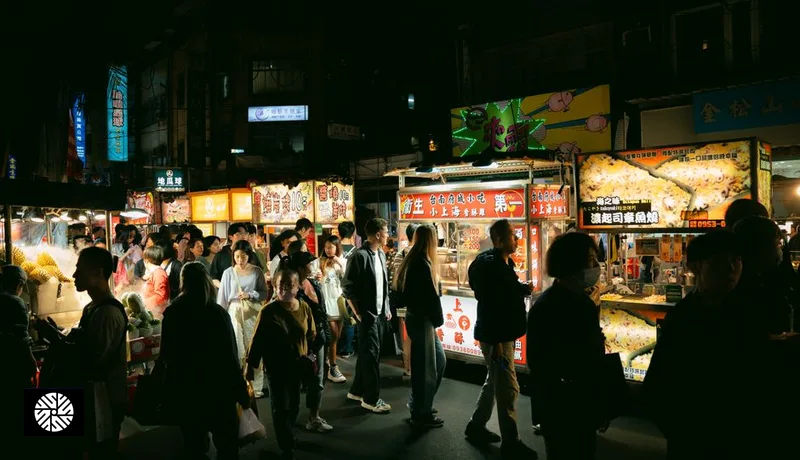
| Night markets and food courts | Vendors and food courts maintain their own bins and tray-return stations. Return the bowl or skewer to the stall that gave it to you. |
| Parks and streets | Assume nothing. Carry a small plastic bag and dispose at your hotel. |
Two things to avoid: do not stuff a hotel-sized bag of accumulated trash into a convenience-store bin, and do not leave bags on a curb hoping they will be collected. Neither is anonymous, and both are exactly what the system was built to stop.
The Sorting Logic You Will See Everywhere
Once you know the categories, you start noticing them in every building in the country — offices, temples, train stations, hospitals:
- 一般垃圾 — general waste, the only category that requires a paid bag
- 資源回收 — recyclables: paper, plastics, metal, glass, cartons, electronics, batteries
- 廚餘 — kitchen waste, historically split into pig-feed and compost streams
Plastic bottles are emptied and often crushed. Drink cups are separated into liquid, ice, cup, and lid at the better-organized stations. Batteries and small electronics go back to convenience stores, which accept them.
What to Do With Leftover Medication
Taiwan's Food and Drug Administration publishes specific guidance here, and it is not the "take everything back to a pharmacy" rule many visitors assume.
- Ordinary tablets and capsules: remove them from their packaging, seal them in a plastic bag, and put the bag in general waste for incineration.
- Liquid medicines and syrups: put an absorbent material — used coffee grounds, tea leaves, or tissue — into a sealable bag, pour the liquid in, seal it, and dispose of it in general waste.
- Higher-risk drugs must go back to a medical facility or pharmacy: chemotherapy agents, antibiotics, hormone preparations, controlled substances, and anything involving needles or sharps.
- Never flush medication down a toilet or sink — the FDA guidance is explicit about the environmental contamination risk.
If you are visiting for a health screening or a follow-up procedure and are unsure which category something falls into, ask the dispensing pharmacy or your coordinator rather than guessing. Sharps always require a proper container and always go back to a medical facility.
The same sorting discipline runs inside clinics and screening centers, which is part of why Taiwanese medical facilities feel as orderly as they do. The habit is national, not sectoral.
The Part That Stays With You
Most environmental policy is invisible to the people it governs. Taiwan's is the opposite: it happens at 8 p.m. on a street corner, in public, with music, several times a week, involving your neighbors.
That visibility is probably why it worked. It is also why "the garbage truck plays classical music" ends up on nearly every visitor's list of things they did not expect — and why the streets stay clean in a country that took away the trash cans.
Sources & Further Reading
- Department of Environmental Protection, Taipei City Government — Municipal waste management
- Ministry of Environment, Taiwan — policy and waste statistics
- Taiwan Business TOPICS (AmCham) — From "Garbage Island" to a Model of Recycling
- Taiwan Panorama — Taipei's per-bag garbage fee initiative
- Recycling in Taiwan — overview, collection rates, and truck music
- Taiwan Food and Drug Administration — how to store and dispose of household medicines (Chinese)
- Ministry of Health and Welfare — correct disposal of waste medication (Chinese)
This article is general travel and cultural information. Collection schedules, bag prices, and sorting rules vary by city and change over time; check your local district office or ask your accommodation.
Frequently asked
Why are there no public trash cans in Taiwan?
Taiwan removed most street bins deliberately. Public cans attracted household and business waste, causing overflow, odor, pests, and collection costs. Under the 垃圾不落地 ("garbage does not touch the ground") policy, waste goes home with whoever created it and enters the system in a paid municipal bag. The counterintuitive result is that streets stay notably clean precisely because there is nowhere convenient to abandon rubbish.
Why do Taiwan garbage trucks play classical music?
Because residents hand their bags directly to the truck rather than leaving them on a curb, the truck must announce its arrival. Taiwanese garbage trucks play one of two pieces — Beethoven's "Für Elise" or Tekla Bądarzewska-Baranowska's "A Maiden's Prayer" — on fixed routes at fixed times. Locals can identify the tune blocks away and calculate how long they have to get downstairs. Visitors almost universally mistake it for an ice cream truck.
Where can tourists throw away trash in Taiwan?
Use your hotel room bin — staff handle the sorting and municipal bags. Convenience stores have bins intended for items bought there, often with a separate station for drink cups and liquid. MRT stations have bins near entrances and restrooms, but eating and drinking inside the paid area is prohibited. Night markets and food courts maintain their own bins and tray returns. On streets and in parks, assume nothing: carry a small bag and dispose at your accommodation. Do not stuff a hotel-sized bag of accumulated trash into a convenience-store bin.
How does Taiwan's per-bag trash fee work?
General waste must go out in official municipal bags priced by volume — in Taipei roughly NT$0.36 per liter, so a 3-liter bag costs about NT$1. You buy them at convenience stores and supermarkets. Recycling and food waste are collected free and need no special bag. That asymmetry is the entire policy: anything you fail to sort out of general waste costs money, anything you do sort costs nothing. Daily household waste per person fell from about 1.14 kg to 0.43 kg as the system spread.
How do I dispose of leftover medication in Taiwan?
Taiwan's Food and Drug Administration guidance is more specific than "take it back to a pharmacy." Ordinary tablets and capsules: remove from packaging, seal in a plastic bag, and put in general waste for incineration. Liquid medicines: put absorbent material such as used coffee grounds or tissue in a sealable bag, pour the liquid in, seal, and dispose in general waste. Higher-risk drugs must go back to a medical facility or pharmacy — chemotherapy agents, antibiotics, hormone preparations, controlled substances, and anything involving needles or sharps. Never flush medication down a toilet or sink.