What are urine and stool tests?
Urine and stool tests are simple, non-invasive laboratory tests run on two everyday samples you provide yourself — no imaging, no needles, and for most of them almost no preparation. A urinalysis examines the urine; a stool test examines a small sample of stool. Of the two, the stool test for hidden blood is the one with an established screening role, for colorectal cancer.
The H. pylori stool test is the exception. Acid-suppressing medicines, antibiotics and bismuth can cause a false negative, so ask the clinician which to pause, and for how long, before the test.
How these tests work
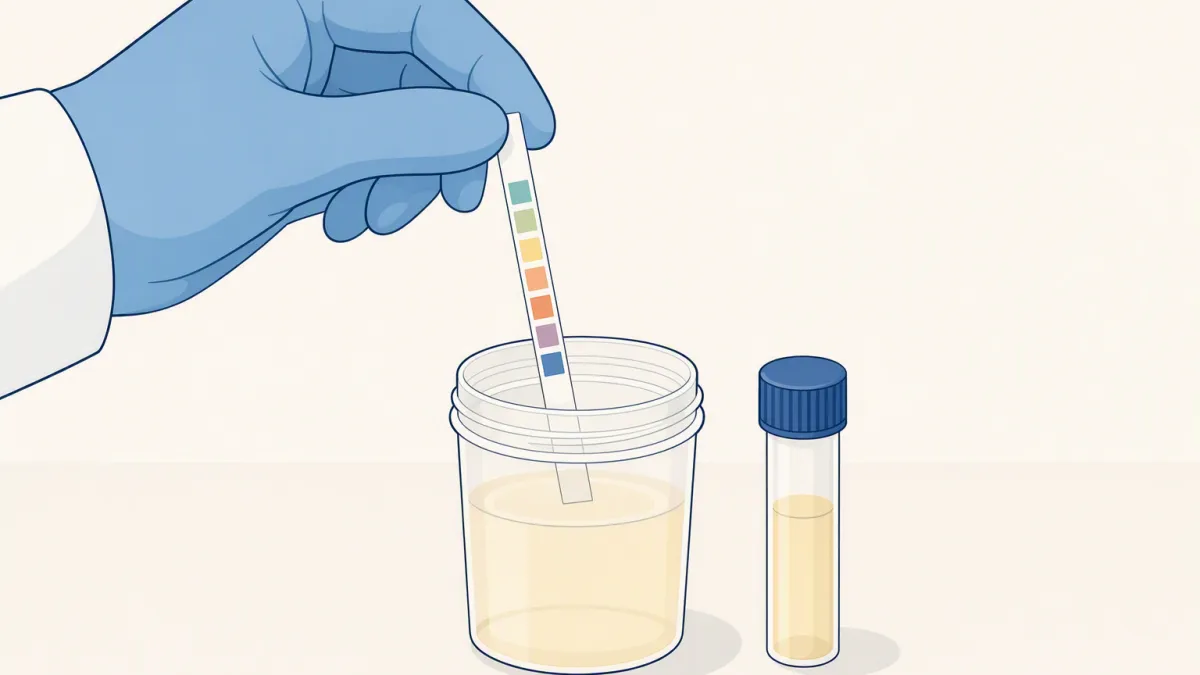
A urine dipstick is a plastic strip with a row of small chemical pads along it. Each pad is loaded with reagents chosen to react with one thing only, and each changes color when that thing is present. Dip the strip, and every pad answers its own question at the same time: is there protein here? glucose? blood? The shade tells you roughly how much — roughly being the honest word, because this is a screen. A dipstick sorts "worth a closer look" from "nothing to see", and confirming what an abnormal pad means usually takes blood chemistry or a repeat sample.
The microscope check answers what no chemical pad can. A sample is spun so that anything solid settles out, and someone looks at what collected: red cells, white cells, bacteria, crystals. The dipstick can say blood is present; only the microscope can say the sample is full of red blood cells, or of crystals that point somewhere else entirely.
The stool test, and why diet no longer matters
The modern stool test — the fecal immunochemical test (FIT) — runs on antibodies. An antibody is an immune protein shaped to latch onto one specific molecule and ignore everything else. The antibodies in a FIT are made to bind human hemoglobin, the protein that carries oxygen in red blood cells. If hemoglobin from your own blood is in the sample, the antibodies bind it and produce a measurable signal. That is why a FIT does not react to what you ate.
| Test | What it detects | Diet before the test |
|---|---|---|
| FIT (immunochemical) | Human hemoglobin, recognized by antibodies | Many FIT kits need no diet changes |
| Guaiac (gFOBT) | A chemical activity of heme (the iron-carrying part of hemoglobin) that is not unique to human blood | Some foods and medicines may need to be avoided first |
Follow the instructions that come with your own kit; some guaiac tests list foods, supplements and medicines to avoid first.
What they screen for
A urinalysis can flag findings that need a closer look. Protein or blood can point to a kidney problem, glucose to diabetes, and white cells or nitrites (chemicals some bacteria make) to a urinary tract infection. Stool tests have defined screening programs in Taiwan:
| Test | What it looks for | Who Taiwan funds |
|---|---|---|
| FIT | Hidden blood that colorectal polyps or cancer can shed | Ages 45–74 every 2 years; ages 40–44 every 2 years if a parent, child or sibling has had colorectal cancer |
| H. pylori stool antigen | The stomach infection linked to gastric cancer | One test at ages 45–74, nationwide from 2026 |
Taiwan's funded tests are for people with National Health Insurance who meet the criteria. In the US, the US Preventive Services Task Force (2021) recommends colorectal screening at 45–75, with a yearly FIT as one option.
- Kidney and metabolic signals in urine — protein, blood, glucose
- Urinary tract infection — white cells and nitrites
- Hidden colon bleeding — the FIT colorectal screen
- Confirming kidney function — a job for a comprehensive blood panel (creatinine and eGFR, an estimate of how well the kidneys filter)
- Locating the source of stool blood — a job for a colonoscopy
- The stomach lining itself — an H. pylori test finds the infection, and a gastroscopy looks at the lining when a doctor advises it
What a positive result actually means
A positive result is a signal to investigate, not a diagnosis. A positive stool blood test tells you blood is present somewhere in the digestive tract — not what is bleeding or why. A urine dipstick abnormality works the same way.
Where they fit in a screening
Urine and stool tests are most useful when they match a screening program you are eligible for, symptoms, or a specific clinical question. Collection problems, false positives and false negatives can all occur, so a test belongs in a screening plan because of who you are, not added automatically. What happens after a result:
- A negative FIT — repeat on the program's schedule; one negative result does not cover the years after it.
- A positive FIT — a positive result needs a colonoscopy, arranged as the program or your clinician advises.
- A positive H. pylori test — whether and how to treat the infection is discussed with a doctor. After treatment, a repeat test confirms whether it has cleared.