What is a comprehensive blood panel?
A comprehensive blood panel is a single blood draw that runs many laboratory tests at once. A screening panel checks several systems together — blood, metabolism, blood fats, organ function and hormones — in someone who feels well.
Some common conditions, such as prediabetes, an underactive thyroid or early kidney strain, can be silent for years. They may first show up as a number drifting outside its reference range.
What it measures
Exact tests vary by package; the listing further down shows each one. A panel usually draws from these groups:
| Group | What it measures | The question it answers |
|---|---|---|
| Complete blood count (CBC) | Red cells, white cells and platelets | Anemia, infection, some blood disorders |
| Metabolic markers | Fasting glucose and HbA1c | Diabetes and prediabetes |
| Lipid panel | Cholesterol (including LDL) and triglycerides | Cardiovascular risk |
| Liver and kidney function | Liver enzymes; creatinine and filtration markers | How those organs are coping |
| Thyroid hormones (when there is a reason) | TSH and related levels | An over- or underactive thyroid |
| Tumor markers (some packages) | Such as AFP, CEA, CA 19-9, CA-125 and PSA | Not a cancer screen — see below |
Reading your results, marker by marker
A blood panel is not one test. It is many tests printed on the same page, and most of the page is unexplained. Below are the markers that drive decisions, and what a number outside its range does and does not mean.
Metabolic — HbA1c
Fasting glucose shows what your blood sugar was doing at the moment of the draw. HbA1c is not a snapshot. Glucose in your blood sticks to the hemoglobin inside red blood cells, and it keeps sticking for as long as those cells circulate. So the share of hemoglobin carrying sugar reports your average blood sugar over about the past three months. You cannot fast your way to a good HbA1c the night before.
The American Diabetes Association uses these bands:
A ladder like this is the general pattern, not a rule your case must obey. Reporting conventions differ between hospitals, and two experienced clinicians can read the same finding and reasonably advise differently. Where your report or your doctor differs from this table, go with them — they are looking at your actual result.
- HbA1c can mislead in some people. NIDDK notes that iron-deficiency anemia, recent blood loss, kidney or liver disease, and hemoglobin variants such as thalassemia trait can make it read falsely high or low. A clinician may then rely on glucose tests instead.
- Prediabetes is a window, not a verdict. In the US Diabetes Prevention Program trial, people with raised blood sugar who made structured lifestyle changes cut their rate of developing diabetes by 58% over about three years.
Liver — ALT and AST
ALT and AST are enzymes that live inside liver cells. They appear in the blood in quantity when liver cells are stressed or inflamed and leak their contents. So a raised ALT measures leakage, a sign of irritation somewhere in the liver, not damage directly. The cut-off for "high" varies by laboratory and by sex.
In people without symptoms, the American Academy of Family Physicians lists fatty liver disease as the most common cause of a mildly raised ALT. Other causes to rule out:
- Alcohol
- Medicines and supplements that stress the liver
- Viral hepatitis, including hepatitis B and C
Blood work can raise the suspicion of fatty liver disease, but it cannot see fat. If a clinician wants to look, an abdominal ultrasound images the liver directly. A markedly raised ALT, or one climbing across repeat draws, belongs with a physician.
Cardiovascular — the lipid panel
A lipid panel reports total cholesterol, HDL, triglycerides and LDL, and LDL is the number that drives decisions. A 2017 European Atherosclerosis Society consensus treats LDL as a cause of heart disease, not just a marker. LDL particles physically enter the artery wall and are the raw material plaque is built from. That is why lowering LDL lowers heart attacks rather than merely improving a number.
Tumor markers — CEA, CA-125, AFP, PSA
Tumor markers are substances, mostly proteins, that some tumors release into the blood — and that healthy or irritated tissue releases too. CEA is linked with colorectal and some other cancers, CA-125 with ovarian cancer, AFP with liver cancer, and PSA is made by the prostate.
The false alarms are common, not theoretical. Benign reasons for a raised marker include:
- CEA: smoking, which raises CEA levels, and inflammation of the gut, liver or lungs
- CA-125: a menstrual period, pregnancy, endometriosis, fibroids, pelvic inflammatory disease and liver disease
- Each false alarm costs something: a period of fear and follow-up tests, some with their own risks
This is why major guideline bodies do not recommend tumor markers for cancer screening in the general population, and they say it separately:
| Body | Position |
|---|---|
| US National Cancer Institute | Circulating tumor markers have generally not worked well for screening |
| US Preventive Services Task Force | Recommends against ovarian cancer screening in women without symptoms, CA-125 included |
| ASCO (2006) | Does not recommend CEA as a screening test for colorectal cancer |
PSA is the exception worth stating separately. Rather than a flat recommendation against, the USPSTF frames PSA screening for men aged 55–69 as an individual decision made after discussing benefits and harms with a clinician. It recommends against it for men aged 70 and over.
That reflects the Task Force's 2018 statement, which is currently under review — worth checking for an update if you are weighing this.
- Where markers do earn their place: monitoring a known cancer during and after treatment, under a specialist.
- One high-risk exception: AASLD guidance uses AFP with ultrasound to watch people with cirrhosis or some cases of chronic hepatitis B — a specialist's surveillance plan, not a general screen.
- If your panel includes them anyway, a single value means little on its own. Ask a physician to interpret any raised result before acting on it.
Thyroid — TSH
TSH is the pituitary gland's instruction to the thyroid, and it moves the opposite way you might expect. A high TSH usually means the pituitary is shouting because the thyroid is under-producing; a low TSH often means the reverse. That sensitivity is why it is the standard first-line thyroid test.
What it can't tell you
- Blood sugar, blood fats and blood count against a laboratory range
- Signs that the liver, kidneys or thyroid are under strain
- Change over time, when the same tests are repeated
- Screen for cancer. Tumor markers miss cancers and flag people without one. Proven cancer screening is test-specific, such as stool testing or colonoscopy for colorectal cancer.
- Show what an organ looks like. A raised liver enzyme hints at a problem; an abdominal ultrasound looks at the liver when a clinician asks.
- Show plaque in the arteries. Cholesterol is the raw material; a calcium score measures calcified plaque, selectively.
- Diagnose from one value. A single out-of-range result is a question. Many are repeated, or followed by your own doctor's targeted tests, before anything is decided.
Who it helps — and who it does not
Which tests make sense depends on age, history, symptoms and risk, not on the size of the panel. It tends to help:
- Adults who have not had basic checks such as blood sugar and cholesterol for some years
- People with a family history of diabetes or early heart disease, or a known thyroid condition
It adds less in these situations:
- You want a cancer check. A blood panel is not one; ask about the screening tests recommended for your age.
- You are already under care for diabetes, liver, kidney or thyroid disease. Your own doctor's tests come first.
- You have symptoms. They need a doctor's assessment, not a screening panel.
Before your blood draw
-
1Check whether you need to fastFasting is test-specific. A fasting glucose needs at least 8 hours without food. HbA1c does not need fasting. US cholesterol guidance (ACC/AHA 2026) accepts a non-fasting lipid panel for most people, with a repeat fasting sample when non-fasting triglycerides are above 400 mg/dL. Plain water is usually fine — your coordinator confirms the rules for your tests when you book.
-
2Medicines and fastingIf you take insulin or other diabetes medicines, ask before fasting how to adjust them. Mention biotin supplements too, because they can distort some lab tests. Any other test-specific rules, such as not smoking before a CEA test, your coordinator confirms when you book.
-
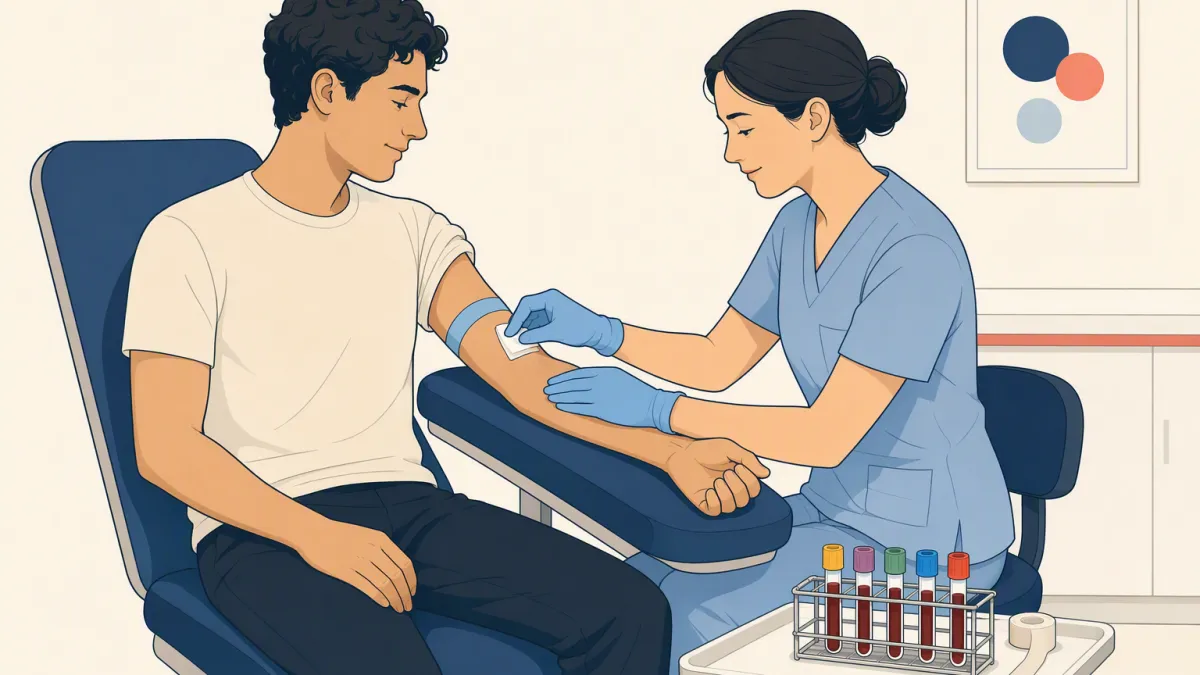
3The draw itselfA nurse fills a few small tubes from a vein in your arm. It takes only a few minutes.
-
4Eat and carry onThere is no recovery time. Have breakfast and continue with your day.
Cost and coverage
The live price further down this page is the booking price at New Dawn Health; anything billed separately — such as biopsy or pathology where it applies — is confirmed when you book. What happens after that depends on where your coverage comes from:
- In Taiwan, screening is paid for by the visitor. Short-term visitors are not covered by Taiwan's National Health Insurance, so screening is self-funded.
- Reimbursement at home is a question for your insurer. Ask them before you book, and ask which documents they need.
- The exact test list varies by package. Check the listing below before you book.
Results & follow-up
- A report listing each value next to its reference range. Which tests, the report language and turnaround are confirmed when you book.
- Out-of-range results are a question, not an answer. The usual next step is a repeat test, a targeted test, or taking the result to your own doctor.
- Keep your results. Trends across years say more than any single draw.