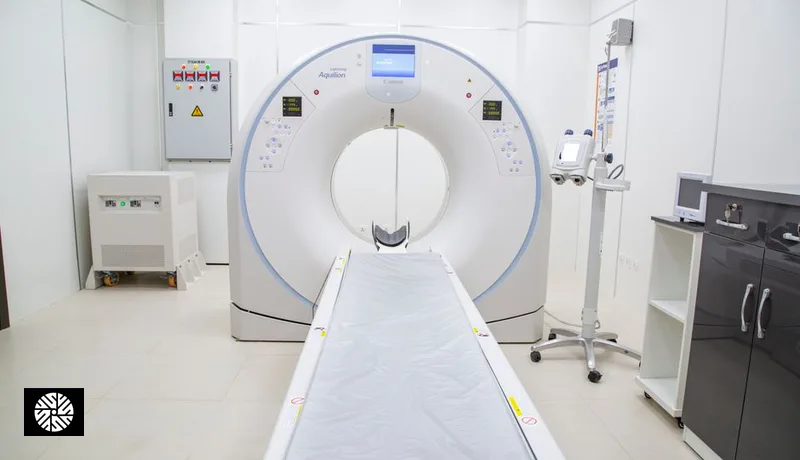

A CT of the abdomen and pelvis delivers about 7.7 millisieverts, which RadiologyInfo puts at roughly 2.6 years of natural background radiation. A chest x-ray is 0.1 mSv, about ten days.
Whether that matters depends almost entirely on why you are having the scan. The same dose is a bargain when a physician is answering a question and a poor trade when nobody asked one.
How much radiation is in the scans you might actually be offered?
Here are the published figures, with natural background as the reference row. Effective dose in millisieverts is the standard unit for comparing exposures across different body parts.
| Exam | Typical effective dose (mSv) | Equal to natural background for | Source |
|---|---|---|---|
| Natural background, US average | 3.1 per year | 1 year | Health Physics Society |
| Bone densitometry (DEXA) | 0.001 | 3 hours | RadiologyInfo |
| Chest x-ray | 0.1 | 10 days | RadiologyInfo |
| Screening digital mammogram | 0.28 | 34 days | RadiologyInfo |
| Low-dose lung cancer screening CT | 1.5 | 6 months | RadiologyInfo |
| Cardiac CT calcium scoring | 1.7 | 6 months | RadiologyInfo |
| CT chest | 6.1 | 2 years | RadiologyInfo |
| CT abdomen and pelvis | 7.7 | 2.6 years | RadiologyInfo |
| Coronary CT angiography | 8.7 | 3 years | RadiologyInfo |
| CT abdomen and pelvis, with and without contrast | 15.4 | 5.1 years | RadiologyInfo |
RadiologyInfo is published jointly by the Radiological Society of North America and the American College of Radiology. The background figure comes from the Health Physics Society, drawing on NCRP Report No. 160.
Every row in that table is a typical effective dose for a protocol. It is a population figure, not a measurement of any one person.
Your own exposure depends on the scanner, the protocol chosen on the day, and your body. Nobody can read an individual dose off a published table.
Notice the spread. A DEXA scan and a contrast CT of the abdomen differ by a factor of roughly fifteen thousand.
How does a scan compare with the radiation you get anyway?
Everyone is irradiated continuously, and medical imaging is now about half of the American total. The EPA puts the average annual dose per person in the US at 6.2 mSv, and states that 48 percent of it comes from medical procedures.
The Health Physics Society gives the natural share as about 3 mSv per year. It also notes that a person accumulates roughly 50 mSv from background in their first seventeen years and about 250 mSv across an eighty-year life.
Against that, a single chest CT at 6.1 mSv is about two years of background. That is a real addition. It is not a category apart from ordinary life.
What did the 2025 projection actually claim?
It claimed a modelled estimate, not a count of dead people. Smith-Bindman and colleagues published it in JAMA Internal Medicine in 2025, and the method is a risk model applied to national CT volume.
The inputs were prospectively collected CT examination data from 2018 to 2020, projected onto 2023 practice. The authors estimate that 61,510,000 patients underwent 93,000,000 CT examinations in 2023.
| What the 2025 model reports | Figure |
|---|---|
| CT examinations modelled, 2023 | 93,000,000 |
| Patients | 61,510,000 |
| Projected radiation-induced cancers | about 103,000 |
| 90% uncertainty limit | 96,400 to 109,500 |
| Share from abdomen and pelvis CT | 37% |
| Share from chest CT | 21% |
The authors' framing is that "if current practices persist, CT-associated cancer could eventually account for 5% of all new cancer diagnoses annually."
Read that as a statement about national practice, which is what it is. It is an argument for scanning fewer people and at lower doses. It is not a prediction about you.
Why does the same named scan give a different dose?
Because "CT chest" names a body part, not a protocol. Machine, settings, number of passes and operator all move the number, and the spread between hospitals is large.
Smith-Bindman and colleagues measured it in 2009 across four institutions. They found a mean 13-fold variation between the highest and lowest dose for each study type, with median effective doses running from 2 mSv for a head CT to 31 mSv for a multiphase abdomen and pelvis CT.
You can see the same disagreement between two current reference tables. Both are published by credible bodies, and neither is wrong.
| Exam | FDA table (mSv) | RadiologyInfo (mSv) |
|---|---|---|
| Chest x-ray | 0.02 | 0.1 |
| CT chest | 7 | 6.1 |
| Coronary artery calcium CT | 3 | 1.7 |
| Coronary CT angiogram | 16 | 8.7 |
The coronary CT angiogram row differs by nearly a factor of two between two reputable sources. Any single figure you are quoted is a typical value, not a measurement of your scan.
The practical consequence: a dose number is worth asking about at the facility that will actually scan you, not looking up in advance.
Is a screening CT the same decision as a diagnostic CT?
No, and the difference is not the radiation. It is what is on the other side of the scale.
| Question | Diagnostic CT for a symptom | Screening CT with no symptoms |
|---|---|---|
| Who decides it is needed | A physician answering a question | Often the buyer, self-referred |
| Chance of finding the target | Raised by the symptom | Population baseline |
| What is gained | An answer that changes management | Reassurance, or a finding to chase |
| FDA on whole-body CT screening | Not what that statement addresses | No evidence of more benefit than harm |
The FDA is blunt about one kind of scan in that second column. It states it "knows of no scientific evidence demonstrating that whole-body scanning of individuals without symptoms provides more benefit than harm to people being screened."
It goes further than an opinion. The agency "prohibits manufacturers of CT systems to promote their use for whole-body screening of asymptomatic people."
Check the scope of that statement before you carry it further. The FDA page it comes from addresses whole-body CT of people without symptoms. It is not a finding about every CT used for screening.
One targeted screening CT has demonstrated benefit. The USPSTF gives annual low-dose CT a grade B for adults aged 50 to 80 with a 20 pack-year smoking history who currently smoke or quit within the past 15 years.
That is what a screening CT with demonstrated benefit looks like: a defined population, a defined interval, and a stopping rule. Whole-body screening of healthy adults has none of those.
Which scans use no ionizing radiation at all?
MRI and ultrasound. Neither uses x-rays, so neither contributes to the dose table above.
- MRI: the National Institute of Biomedical Imaging and Bioengineering states these "differ from computed tomography (CT), in that they do not use the damaging ionizing radiation of x-rays."
- Ultrasound: the FDA states "there is no ionizing radiation exposure associated with ultrasound imaging."
- Both still carry other considerations. NIBIB notes MRI "does employ a strong magnetic field", which is why implants and metal are screened for before a scan.
Zero radiation is not the same as zero harm. An MRI that finds something incidental starts the same chain of follow-up tests as a CT that does, which we covered in what happens when a scan finds something.
How solid is the model these projections rest on?
Less solid than the confident headlines suggest, and this is a genuine scientific argument rather than a fringe complaint.
Every projection of cancers from low doses uses the linear no-threshold model. The FDA describes it as "a conservative approach", assuming risk is proportional to dose and "that there is no amount of radiation that is completely without risk."
| Body | Position on low-dose risk estimates | Year |
|---|---|---|
| FDA | Uses the linear no-threshold model as a conservative assumption | 2017 |
| Health Physics Society | Advises against estimating risk near background levels | 2019 |
| Smith-Bindman et al., JAMA Internal Medicine | Applies the model to project about 103,000 cancers | 2025 |
The Health Physics Society position statement PS010-4 is worth reading in full. It states that "below levels of about 100 mSv above background from all sources combined, the observed radiation effects in people are not statistically different from zero."
It objects specifically to the arithmetic that produces headline numbers. Multiplying "small risk coefficients by large population numbers leads inevitably to unsupportable claims of cancer risk from ionizing radiation", the statement says.
Neither side disputes the doses. They dispute whether a per-person risk that has never been measured at these levels should be multiplied by 62 million people. A reasonable reader can hold both: the doses are real, and the body count is a model output.
Which New Dawn Health items use ionizing radiation?
Of the standalone imaging items below, five are x-ray based and six are not. The list is read from the catalogue, and where a record carries no description we say so instead of guessing.
| Item | Price | Ionizing radiation |
|---|---|---|
| DEXA Scan | $109 | Yes, x-ray based |
| Beitou Mammogram | $108 | Yes, x-ray based |
| Heart Calcium Score CT Scan | $209 | Yes, x-ray based |
| Single Region CT Scan | $210 | Yes, x-ray based |
| Coronary CT | $899 | Yes, x-ray based |
| iHope Clinic Abdomen Ultrasound | $95 | No |
| Heart Ultrasound | $209 | No |
| Single Region MRI Scan, no contrast | $310 | No |
| Single Region MRI Scan, with contrast | $550 | No |
| Whole Spine MRI | $699 | No |
| Brain MRA | $699 | No |
| Liver Fibrosis Scan | $120 | Record does not specify |
Several of those records carry no description at all: Single Region CT Scan, Single Region MRI with contrast, Whole Spine MRI, Beitou Mammogram, the abdomen ultrasound and the Liver Fibrosis Scan. For those, the catalogue gives a title, a price and an appointment length, and we will not invent a protocol on top of them.
The screening packages mix both. Our Light package at $1,399 is built on a radiation-free full body MRI and also includes a low-dose lung CT and two ultrasounds. Complete at $1,699 adds DEXA and a calcium score, both x-ray based.
Plus at $3,099 adds CT angiography, a brain MRA and a carotid ultrasound. Current prices for every item are on the packages page, and we cover one of them in detail in what a calcium score test costs.
What should you ask before agreeing to a scan?
Ask the questions that change the answer, not the ones that produce a number to worry about.
- What question is this scan meant to answer, and what happens to my care if the answer is normal?
- Is there a version of this test without ionizing radiation that answers the same question?
- What is the typical effective dose on this machine for this protocol?
- Is contrast needed, or is this a single-phase study? The published dose roughly doubles for a with-and-without abdomen CT.
- How many scans of this region have I had, and is the prior study available instead of a repeat?
Question one carries most of the weight. A scan that cannot change what anyone does is the one where the dose has no counterweight.
The bottom line
The doses are published, modest per scan, and cumulative. A typical chest CT is about two years of background radiation.
Keep the two abdominal studies apart. A single CT of the abdomen and pelvis is 7.7 mSv, about 2.6 years of background. The same region done with and without contrast is 15.4 mSv, about 5.1 years.
For a scan a physician ordered to answer a question, that is almost always a good trade. For a whole-body scan bought without symptoms, the FDA says it knows of no evidence that the trade is favorable at all.
The 103,000 figure is a model of national practice under a contested assumption, not a forecast for any individual. Treat it as an argument for fewer unnecessary scans, which is the same conclusion the dose table supports.
What any specific scan is worth in your case is a decision for you and your physician.
Sources
- RadiologyInfo.org (RSNA and ACR) - Radiation Dose in X-Ray and CT Exams (accessed 2026-09-09)
- US Food and Drug Administration - What are the Radiation Risks from CT? (accessed 2026-09-09)
- US Food and Drug Administration - Full-Body CT Scans: What You Need to Know (accessed 2026-09-09)
- PubMed - Smith-Bindman et al., Projected Lifetime Cancer Risks From Current Computed Tomography Imaging, JAMA Internal Medicine 2025 (accessed 2026-09-09)
- PubMed - Smith-Bindman et al., Radiation dose associated with common CT examinations, Archives of Internal Medicine 2009 (accessed 2026-09-09)
- Health Physics Society - Radiation Risk in Perspective, Position Statement PS010-4, February 2019 (accessed 2026-09-09)
- US Environmental Protection Agency - Radiation Sources and Doses (accessed 2026-09-09)
- US Food and Drug Administration - Ultrasound Imaging (accessed 2026-09-09)
- National Institute of Biomedical Imaging and Bioengineering - Magnetic Resonance Imaging (MRI) (accessed 2026-09-09)
- US Preventive Services Task Force - Lung Cancer: Screening, 2021 (accessed 2026-09-09)