A coronary artery calcium (CAC) score is one of the strongest single predictors of heart-attack risk medicine has — and in the US it is one you will almost certainly pay for out of pocket, because the US Preventive Services Task Force grades it "I" (insufficient evidence) and plans are not obliged to cover an I-graded screening test.
This guide covers what the test is, what the score means, why US insurance won't pay, what the scan can and cannot see, and how travelers fold it into a broader screening day in Taiwan — where New Dawn Health books the Heart Calcium Score CT at $209 on its own, or inside full-day packages that already include it.
What Is a Calcium Score Test?
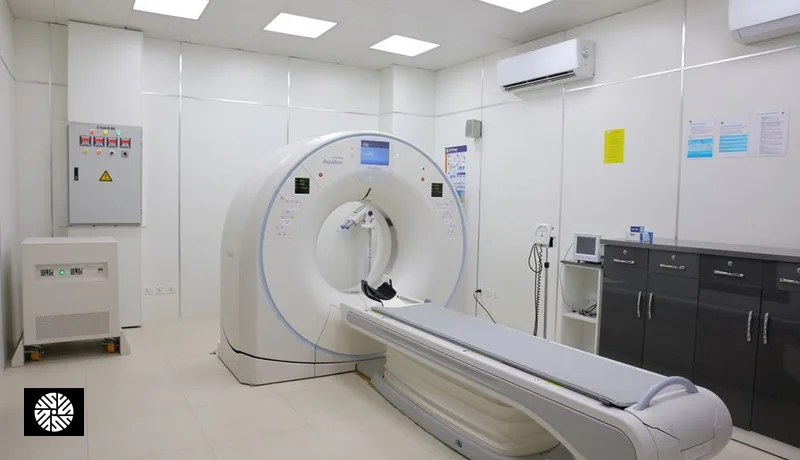
A calcium score test — also called a coronary artery calcium scan, CAC scan, or heart scan — is a specialized CT scan of the heart that measures calcified plaque in the walls of your coronary arteries. Calcium shows up bright white on CT, and its presence in coronary arteries means atherosclerosis has already begun, often years or decades before any symptom.
It is about as easy as advanced imaging gets:
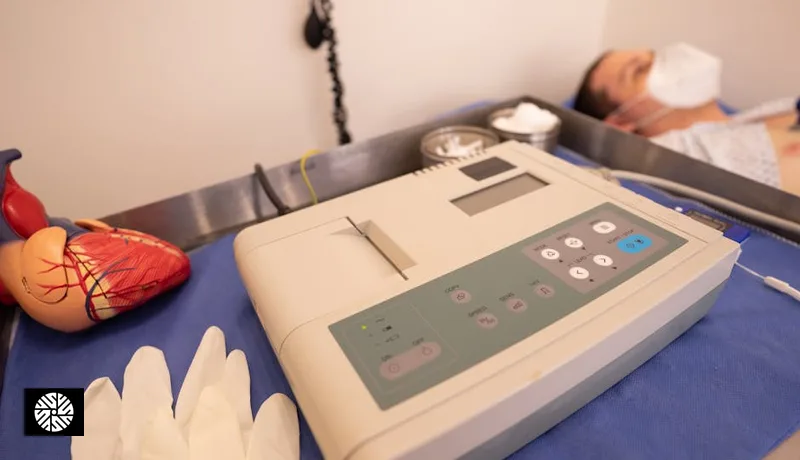
- No needles, no contrast dye, no medication. You lie on the CT table with ECG leads on your chest so the scanner can time images between heartbeats. The image acquisition is a few breath-holds; New Dawn Health books the whole visit as a 30-minute appointment.
- Radiation dose is modest for a CT. The US FDA lists the typical effective dose for a coronary artery calcification CT as 3 mSv — against 16 mSv for a coronary CT angiogram and 0.02 mSv for a chest X-ray in the same table.
- The output is a single number, your Agatston score, calculated from the area and density of every calcified spot the software finds. Higher score, more calcified plaque, higher risk.
CAC scoring is now a mainstream risk tool rather than a research one: a 2018 Journal of the American College of Cardiology review describes it as a widely available, consistent and reproducible way to assess cardiovascular risk in asymptomatic people planning primary prevention, and finds it cost effective across a broad range of baseline risk.
What Does Your Calcium Score Mean?
Agatston scores run from 0 into the thousands. Your own physician interprets your result in the context of age, sex and overall risk profile, but the 2018 ACC/AHA blood cholesterol guideline turns the score into three decision bands — for adults 40 to 75 without diabetes, with LDL-C of 70–189 mg/dL and a 10-year cardiovascular risk of 7.5%–19.9%, where the statin decision is otherwise uncertain:
| Agatston score | What it indicates | What the ACC/AHA guideline says |
|---|
| 0 | No detectable calcified plaque | Statin therapy "may be withheld or delayed" — except in cigarette smokers, people with diabetes, and those with a strong family history of premature cardiovascular disease |
| 1–99 | Mild calcified plaque | "Favors statin therapy, especially in those ≥55 years of age" |
| 100+ (or ≥75th percentile for your age and sex) | Moderate to extensive plaque burden | "Statin therapy is indicated unless otherwise deferred by the outcome of clinician–patient risk discussion" |
How Much Does a Calcium Score Test Cost in the US?
There is no honest single answer, because there is no covered price. Each imaging center sets its own cash price — usually advertised as a flat fee for CT calcium scoring, covering the scan, the read and the report — and no official US source publishes a national range, so we do not quote one here. What is certain is who pays: you. Ask each center for its flat fee against the billing code below and compare like for like.
The reason is a single letter. The USPSTF concluded in 2018 that "the current evidence is insufficient to assess the balance of benefits and harms of adding the ABI, hsCRP level, or CAC score to traditional risk assessment for CVD in asymptomatic adults to prevent CVD events. (I statement)". US plans must cover a defined list of preventive services at no cost to the patient; a test the Task Force declined to recommend either way is not on that list, and most commercial plans and traditional Medicare do not cover the scan for screening.
Three practical notes for US readers:
- The billing code to ask about is CPT 75571 — "CT heart w/o contrast, w/quantitative eval of coronary calcium". Asking each center for its cash price against that code is the fastest way to comparison-shop.
- Because it is a legitimate medical expense, the scan is generally HSA/FSA-eligible under the IRS Publication 502 definition of medical care — confirm with your plan administrator.
- Some states mandate coverage for cardiac screening scans and some Medicare Advantage plans include them as extras — worth a phone call, but don't expect it.
The irony is real: the test many preventive cardiologists consider the single most useful risk-refinement tool is the one your premium dollars won't touch.
What Does a Calcium Score Actually Change?
A screening test is only worth doing if the result changes something. The CAC score earns its keep in three ways:
- Statin decisions. This is the headline use, and it is written into the ACC/AHA guideline above: a score of 0 supports safely deferring the drug, a score of 100 or more indicates it. One scan can settle a question that would otherwise mean decades of medication taken — or skipped — on a guess.
- Motivation. Cholesterol numbers are abstractions. A picture of calcium in your own coronary arteries is not.
- A baseline for progression. A score today gives future scans something to compare against, and progression is itself a signal your physician can act on.
What Can a Calcium Score Not See?
A CAC scan sees calcified plaque only. Early-stage, soft, non-calcified plaque — the kind that can rupture and cause a heart attack in a person with a low or even zero score — is invisible to it. A score of 0 lowers the odds of a near-term event, but it is not a guarantee, especially in younger patients and smokers, whose plaque is more likely to be soft.
The test that does see soft plaque is a coronary CT angiogram (CCTA): a contrast-enhanced CT that images the artery channels themselves, showing both plaque types and any narrowing. It is a bigger test — IV contrast, and the FDA's 16 mSv typical effective dose against 3 mSv for the calcium scan. At New Dawn Health's partner hospitals in Taiwan it is available a la carte for $899 (see the coronary CT angiogram overview). The usual sequence is calcium score first; your physician escalates to CCTA only if the score, your symptoms, or your risk profile justify it.
How Much Does a Calcium Score Cost in Taiwan?
New Dawn Health books the Heart Calcium Score CT for $209 as a 30-minute appointment, with the English report of results available in 7–10 business days (details in the calcium score exam guide). A coordinator confirms preparation and visit specifics when you book.
Book the Heart Calcium Score CT — $209, a 30-minute slot, English report in 7–10 business days →
Read plainly: nobody flies across the Pacific for a single low-cost scan. The arithmetic works differently — the calcium score is a line item you fold into a screening day:
- The Premium ($1,699) and Advanced ($3,499) full-day holistic packages both include the Heart Calcium Score alongside a full-body MRI and a gastroscopy and colonoscopy. Advanced also includes the coronary CT angiography described above.
- The Full-Body MRI Light package ($1,399) — head, neck, abdomen, pelvis and whole spine MRI, plus thyroid and abdominal ultrasound — offers the Heart Calcium Score CT as an add-on, so one visit covers both the MRI's soft-tissue survey and the CT's coronary calcium check. (MRI doesn't image coronary calcium; the two tests answer different questions.)
- Every package includes a physician consultation, so your score comes with an actual conversation, not a PDF.
This bundling logic is the same reason Americans have started flying to Taiwan for full-body MRIs: a single scheduled day replaces months of separate US appointments, referrals and facility fees. The full lineup is on the packages page.
Who Should Consider a Calcium Score?
The ACC/AHA pathway targets adults 40 to 75 years old without diabetes, with LDL-C between 70 and 189 mg/dL and a 10-year cardiovascular risk of 7.5% to 19.9%, where the statin decision is uncertain — the zone where risk calculators are least decisive and the score adds the most information. It is particularly worth discussing with your physician if you have:
- A family history of premature cardiovascular disease — the guideline defines that as a male relative before 55 or a female relative before 65
- Borderline or conflicting numbers — say, high LDL but otherwise healthy, or good cholesterol with other risk factors
- Statin ambivalence — you have been advised to start one and want harder evidence either way
It is generally not the right test for people already known to have coronary disease (the answer is known), for adults outside that 40-to-75 window, or as a substitute for evaluation if you have chest pain or other symptoms — symptoms need diagnosis, not screening.
The Bottom Line — and What to Do Next
The calcium score test is a rare thing in preventive medicine: fast, needle-free, and genuinely decision-changing. In the US it is a cash expense whatever your plan, and the honest advice is simple — if you are in the target age and risk range, ask your physician about it, whether you get it at a local imaging center or abroad.
If you are already weighing a comprehensive screening trip, the calculation shifts: fold the $209 Heart Calcium Score CT into a Premium or Advanced package day, or add it to a Full-Body MRI visit, and the coronary check becomes one line in a much bigger picture. Start with the US travelers' guide to health screening in Taiwan for the logistics, compare options on the packages page, and bring your risk-factor history — your reviewing physician will put the score where it belongs: in context.
Sources
 Blog
Blog