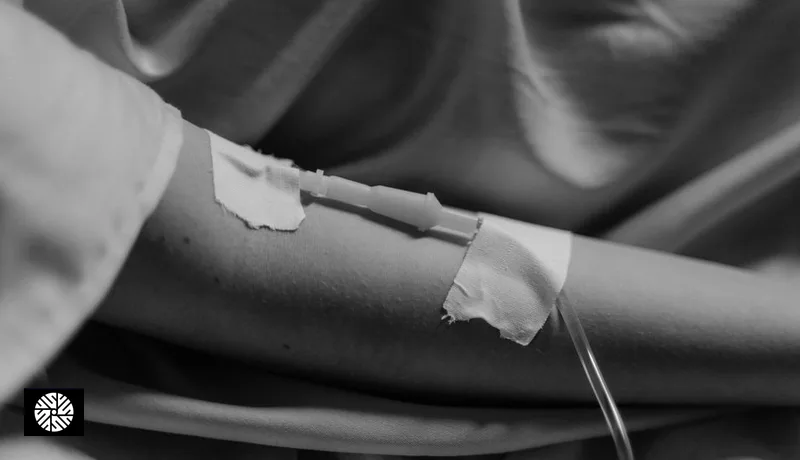
Contrast is a drug injected to make one thing on the image stand out from everything around it. Two different drugs are meant when people say the word: gadolinium for MRI, iodine for CT. Screening studies often use neither, and the ACR reports severe reactions to iodinated contrast at about 0.04%.
What is contrast, and what does it do to the picture?
It changes how the scanner sees one tissue relative to its neighbors. RSNA and the ACR describe contrast materials as agents that "make certain structures or tissues in the body appear different on the images."
The agent is chosen by the machine, not by the disease. An MRI scanner reads magnetic behavior, so it needs an agent that changes magnetic behavior. A CT scanner reads X-ray absorption, so it needs an agent that absorbs X-rays.
| Agent | Used with | What it changes |
|---|
| Gadolinium-based | MRI | Magnetic properties of water molecules |
| Iodine-based | CT, X-ray, angiography | Blocks X-rays |
| Barium sulfate | X-ray, CT of the gut | Limits X-ray passage |
| Microbubbles | Ultrasound | Reflects sound waves |
What is gadolinium, and why is it wrapped in something?
Gadolinium is a heavy metal ion, and it is never injected bare. Every approved agent binds it inside an organic ligand.
The ACR and ASNR describe that structure directly. All gadolinium-based contrast agents "share a common structure of an organic ligand that tightly binds to and improves the stability, solubility, and safety of the central gadolinium heavy metal ion."
The chelate is mostly cleared by the kidneys, with some liver excretion for a few agents. That is why kidney function keeps appearing in every guideline about it.
Scale matters when you read the safety literature. The ACR-ASNR statement puts worldwide use since FDA approval in 1988 at more than 300 million patients.
What was nephrogenic systemic fibrosis, and what changed after it?
NSF is a rare fibrosing disease of the skin and other tissues that occurs in people with severely impaired kidneys. Its link to gadolinium agents was identified in 2006.
The ACR notes that almost all unconfounded cases followed exposure to three specific agents, and that some agents have been associated with few confirmed cases, if any.
What followed was a practice change, not a withdrawal. Radiologists began withholding some agents when estimated GFR is below 30 mL/min/1.73 m2, and the number of cases fell sharply.
The ACR now classifies agents into groups by NSF association. The numbers below are the ACR's own estimates.
| Group and population | Reported NSF risk | Renal testing before the scan |
|---|
| Group I agents, CKD 4 or 5 | 1% to 7% after one or more exposures | Screen |
| Group II agents, standard dose | "Sufficiently low or possibly nonexistent" | Optional |
| Group III agents | Insufficient real-life data | Screen at-risk patients |
ESUR reaches a similar place from the European side. For its lowest-risk agents it states that laboratory testing of renal function "is not mandatory."
Is gadolinium retained in the body, and does that matter?
Retention is established. Harm from it has not been demonstrated, and the regulators say so in almost the same words.
The EMA's wording is the flattest of the three. There is, it states, "no evidence that gadolinium deposition in the brain has caused any harm to patients."
| Body and year | Action taken | Stated finding on harm |
|---|
| EMA, July 2017 | Suspended three linear IV agents; restricted two to liver imaging | No evidence of harm from brain deposition |
| FDA, 2018 | New class warning and Medication Guide; required further studies | "Studies have not found harmful effects in patients with normal kidneys" |
| ACR and ASNR | Record the agent and dose after every administration | No reports suggesting neurotoxicity to date |
The FDA Medication Guide language is unusually plain. Small amounts can stay in the body, including brain, bones and skin, for several months to years, and how that may affect a person is not known.
The same guide names who may be at increased risk: people receiving many doses, pregnant women and young children. It asks clinicians to minimize repetitive and closely spaced administrations.
Retention also differs by agent. The FDA states gadolinium stays in the body least after Dotarem, Gadavist or ProHance, and most after Omniscan or Optimark.
This is a genuinely unsettled area, and the ACR says as much. It calls for more research into the mechanisms of deposition and their "theoretical toxic potential."
How often do people react to contrast?
Uncommonly, and severe reactions are rarer still. These are the ACR's figures, and they are worth reading as rates rather than as reassurance or alarm.
| Agent | Allergic-like reactions | Severe reactions |
|---|
| Iodinated contrast | 0.6% aggregate | 0.04% |
| Gadolinium-based contrast | 0.01% to 0.22% aggregate | 0.008% |
Most gadolinium reactions are not allergic at all. The ACR lists coldness, warmth or pain at the injection site, nausea, headache and dizziness, with an overall adverse event rate of 0.07% to 2.4% at clinical doses.
Life-threatening anaphylactic reactions to gadolinium agents do occur. The ACR calls them exceedingly rare, at 0.001% to 0.01%.
One caution from ESUR belongs next to all of these numbers. Retrospective incidence studies "suffer from considerable under-reporting and are therefore unreliable."
Who should raise a question before a contrast study?
Five situations appear in the guidance by name. Raising the question is the point. The answer is a clinical decision, and it is not one this page can make for anyone.
| Situation | What the guidance says | Source |
|---|
| Reduced kidney function | Caution below eGFR 30; screening optional for group II agents | ACR 2026, ESUR 10.0 |
| Previous moderate or severe reaction | Named risk factor for acute reactions | ESUR 10.0 |
| Asthma or atopy requiring treatment | Named risk factor for acute reactions | ESUR 10.0 |
| Pregnancy | Gadolinium only if considered critical; documented and consented | ACR 2026 |
| Breastfeeding | Stopping for 24 hours is not required | ACR 2026, ESUR 10.0 |
The breastfeeding row surprises people, so here are the numbers behind it. The ACR estimates the systemic dose an infant absorbs from breast milk at under 0.0004% of the maternal dose for gadolinium, and under 0.01% for iodinated contrast.
On kidneys and CT the picture has also moved. The ACR states that in patients with a stable baseline eGFR of 45 or above, intravenous iodinated contrast is not an independent nephrotoxic risk factor.
Why do screening scans often skip contrast?
Because a contrast injection is a drug administration, and a guideline only supports it where the image cannot answer the question without it.
The ACR-ASNR position is a benefit-and-risk sentence, not a ban. Each time an enhanced MRI is considered, weigh the diagnostic benefit "against the unknown potential risk of gadolinium deposition in the brain for each individual patient."
Modern sequences also close part of the gap. RSNA notes that even without contrast, MR angiography "can provide useful high-quality images of many blood vessels."
CT angiography is the opposite case. It is built around an iodinated injection timed to the arteries, which is why it is not offered as a non-contrast study. Our piece on when to consider a CT scan covers that family of exams.
Which of our scans use contrast, and which do not?
Only the titles tell you reliably, and most of these records do not state it at all. Where a record is silent we say so rather than guess.
| Item | Price | What our record says about contrast |
|---|
| Single Region MRI Scan w/ no contrast | $310 | Title states no contrast |
| Single Region MRI Scan w/ contrast | $550 | Title states contrast; no description |
| Single Region CT Scan | $210 | Does not specify |
| Whole Spine MRI | $699 | Does not specify |
| Brain MRA | $699 | Recorded as MR angiography; does not specify |
| Coronary CT | $899 | Recorded as CT angiography; does not specify |
| Heart Calcium Score CT Scan | $209 | Described as an X-ray calcium score; contrast not mentioned |
| Comprehensive Breast Imaging | $619 | Breast MRI, mammogram and ultrasound; does not specify |
The first two rows are the useful ones, because they are the same exam on the same region. The difference between them is $240.
That gap is the concrete version of the whole question. It is what a contrast-enhanced study costs over the plain one here, and the full list sits on our packages page.
Whether your study needs contrast is decided by the radiologist and the referring physician on the day, from the clinical question. If you want the answer before you fly, ask for it in writing at booking, along with our guide to what MRI field strength does and does not buy.
What should you ask before a contrast study?
Six questions, and every one of them has a documented answer at the imaging department. None of them requires you to know any radiology.
- Is contrast part of this protocol, or optional for it?
- Which agent, and which ACR group does it belong to?
- Will kidney function be checked first, and how?
- What do you need to know about previous reactions, asthma or atopy?
- What is the plan if I am pregnant, or think I might be?
- Will the agent and dose be recorded in my report?
The last one matters more than it looks. The ACR asks that the identity and dose of the agent be recorded after every intravenous administration, and that record travels with you.
The bottom line
Contrast is a real drug with real, small, well-measured risks, and it is the reason some scans answer a question that a plain scan cannot.
The unsettled part is gadolinium retention. Regulators agree it happens, agree no harm has been shown, and have not closed the file.
For a screening scan, the honest default is to ask whether the enhanced study changes what anyone would do next. That question belongs to you and the physician reading your images, not to a price list. Our comparison of brain MRI costs covers where contrast sits in a US quote.
Sources
- American College of Radiology — ACR Manual on Contrast Media, 2026 edition (accessed 2026-09-09)
- U.S. Food and Drug Administration — Update on FDA approach to safety issue of gadolinium retention, Pediatric Advisory Committee, 20 September 2018 (accessed 2026-09-09)
- European Medicines Agency — Gadolinium-containing contrast agents, referral outcome, 2017 (accessed 2026-09-09)
- European Society of Urogenital Radiology — ESUR Guidelines on Contrast Agents, version 10.0 (accessed 2026-09-09)
- European Society of Urogenital Radiology — ESUR guidelines on contrast agents, index page (accessed 2026-09-09)
- RadiologyInfo.org (RSNA and ACR) — Patient Safety: Contrast Material, reviewed 25 August 2024 (accessed 2026-09-09)
- RadiologyInfo.org (RSNA and ACR) — Magnetic Resonance Imaging (MRI) of the Body, reviewed 15 June 2026 (accessed 2026-09-09)
- RadiologyInfo.org (RSNA and ACR) — Magnetic Resonance Angiography (MRA), reviewed 15 June 2026 (accessed 2026-09-09)
- RadiologyInfo.org (RSNA and ACR) — Computed Tomography (CT) Angiography, reviewed 15 June 2026 (accessed 2026-09-09)
 Blog
Blog