
Nobody plans an emergency room visit into their Taiwan itinerary. But appendicitis doesn't check your travel dates, a scooter doesn't care that you only rented it for the afternoon, and that street-food stall you couldn't resist sometimes has the last word at 2 a.m. The reassuring part: Taiwan's emergency system is fast, affordable, and competent, and it is widely regarded as one of the best-value healthcare systems anywhere. The catch is that almost nobody explains how it works to a foreigner before they're standing in a hospital lobby holding their abdomen. That's what this guide is for.
This is the "something went wrong" companion to our complete guide to seeing a doctor in Taiwan, which covers the calmer side of care — clinics, family medicine, pharmacies, specialists. Here we zoom in on the part you hope you'll never need: the emergency room. What counts as a real emergency, how to call an ambulance, what triage feels like, what it actually costs when you don't have National Health Insurance, which hospitals speak English, and how to turn the receipt into a travel-insurance reimbursement.
First: is this actually an emergency?
Taiwanese hospitals divide unscheduled care into two lanes, and choosing the right one saves you time, money, and a long wait behind sicker patients.
Go to the emergency room (急診, jí zhěn) for anything that is genuinely time-sensitive or dangerous: chest pain, difficulty breathing, severe or worsening abdominal pain, a head injury, heavy bleeding, a suspected fracture, a serious allergic reaction, signs of stroke (face drooping, arm weakness, slurred speech), high fever with confusion, or any situation where you genuinely think "this could get bad fast." Major hospital ERs run 24 hours, every day.
Use a walk-in clinic or urgent care instead for the non-dangerous stuff that simply can't wait for a scheduled appointment: a nasty cold, mild food poisoning that's keeping fluids down, a sprained ankle you can still walk on, a urinary tract infection, an ear infection, a minor cut. Clinics are dramatically cheaper and faster than an ER for these — we cover them in detail in the see-a-doctor guide. The rule of thumb: if it would send you to an American ER, it sends you to a Taiwanese one; if it's a "should I see someone tomorrow?" problem, a clinic is the right call.
Calling 119 — ambulances in Taiwan (not 911)
If you grew up on American television, your instinct will be to dial 911. In Taiwan that number does nothing useful. The number you want is 119 — it reaches the fire department, which also dispatches ambulances and paramedics, exactly like calling for an ambulance back home. Two more numbers worth memorizing: 110 for the police, and 112, the international mobile emergency number that works from any phone, even one with no SIM or no signal lock, and routes you to help.
When you call 119, an operator will ask where you are and what's wrong. Many dispatch centers have some English capability, but it is not guaranteed, so have your location ready in any form you can — a building name, an intersection, a landmark, or the address showing on your phone's map. If your Mandarin fails completely, the single most useful phrase is your location plus the word 救護車 (jiù hù chē, ambulance). Hotel front desks, restaurant staff, and passers-by will almost always help you place the call; Taiwan's culture of helpfulness toward visitors is real and it shows up most when you need it.
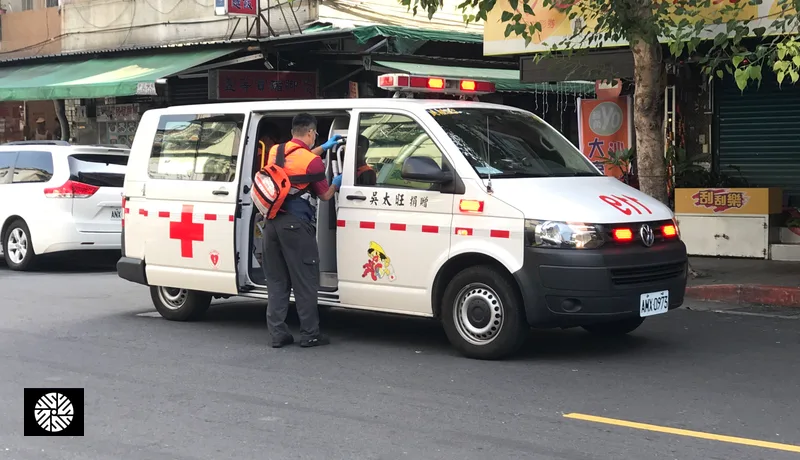
Ambulances in Taiwan are run by the public fire service and are inexpensive or effectively free at the point of use — you are not going to receive the kind of four-figure ambulance bill that makes headlines in the United States. And don't let Taiwan's busy traffic worry you: by law, an ambulance running its lights and siren has the right of way, and every vehicle and pedestrian is required to yield to it — failing to pull over carries heavy fines and licence revocation — so it moves through traffic fast. Here's the part to genuinely stop worrying about: paramedics take you to the nearest appropriate emergency department, and in a real emergency that is exactly the right outcome. Don't agonize over which hospital — getting treated quickly at the closest capable ER matters far more than picking a particular one.
Going directly to the ER yourself
For situations that are urgent but not "call an ambulance" urgent — a deep cut, a likely broken wrist, a kidney-stone level of pain, a fever that won't break — most travelers simply take a taxi to the nearest hospital with a 24-hour emergency department. Just say 急診 (jí zhěn, emergency) to the driver, or show a nearby major hospital pinned on your phone's map. Taxis are plentiful, cheap, and a faster bet than waiting for a ride-share late at night. One important line, though: a taxi is only for problems that are stable enough to sit through the ride. If it's a true emergency — anything on the list above — don't downgrade yourself to a taxi to save a little money or time; call 119.
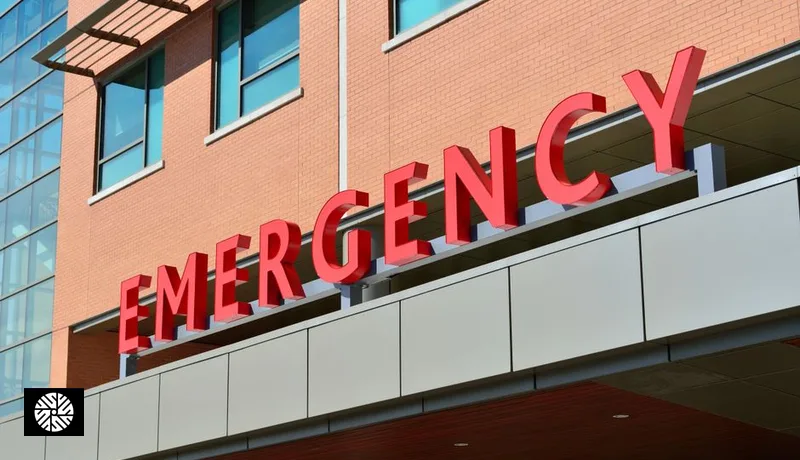
You walk in, go to the emergency registration desk (it's signposted, and "Emergency" appears in English at major hospitals), and tell them you need to be seen. You do not need a referral, an appointment, or a local ID to be treated. Bring your passport — they'll need it for registration and it's what your insurer will want later.
What happens when you arrive: Taiwan's 5-level triage
Taiwan uses a formal five-level triage system (the Taiwan Triage and Acuity Scale) to decide who gets seen first. It's the same logic used in Canada and Australia, and it means the order of treatment is based on how sick you are, not how long you've waited.
- Level 1 — Resuscitation: immediately life-threatening (cardiac arrest, major trauma). Seen instantly.
- Level 2 — Emergent: high-risk and time-critical (chest pain, stroke signs, severe breathing trouble). Seen within minutes.
- Level 3 — Urgent: serious but stable (moderate injuries, significant pain, high fever). Most travelers land here.
- Level 4 — Less urgent: minor injuries and illnesses that nonetheless brought you in.
- Level 5 — Non-urgent: problems that really belonged in a clinic.
A nurse takes your vital signs, asks what's wrong, and assigns your level. If you're a Level 1 or 2, everything moves fast and nobody will ask about payment first. If you're a Level 4 or 5, expect to wait while genuinely sicker patients go ahead of you — that wait is the system working correctly, not failing you.
What an ER visit costs without National Health Insurance
This is the question every traveler actually wants answered, and the honest version is: far less than you fear, but it genuinely varies — and there is no single published "foreigner ER price" to quote. Taiwan's National Health Insurance covers residents and Alien Resident Certificate (ARC) holders; as a short-term visitor you pay out of pocket as a self-pay (自費) patient. What you pay is the hospital's own self-pay schedule — a registration fee, the emergency physician's fee, plus whatever tests and treatment you actually need — and hospitals commonly bill a foreigner without NHI at roughly 1.3 times the standard local self-pay rate (and somewhat more if you go through a dedicated international medical service). Even so, the numbers stay a fraction of American ones.
So treat the following as rough, approximate ranges rather than quotes — the only reliable figure is the one the hospital's cashier gives you, so confirm on site:
- Something minor — a quick assessment and some oral medication — can be genuinely cheap; self-pay care for a small problem has been reported as low as a few hundred NT dollars.
- A straightforward ER assessment — registration, an emergency doctor, basic observation — typically runs into the low thousands of NT dollars.
- Add imaging or labs — X-rays, blood work, an ultrasound, and especially a CT scan — and the total climbs from there.
- Admission or surgery (say, appendicitis) is where bills reach the tens of thousands of NT dollars and up — still routinely a fraction of the equivalent US charge, and exactly the scenario travel insurance exists for.
Most ERs expect payment at discharge, by cash or card. Keep every receipt and every itemized document — your travel insurer will want them, and Taiwanese hospitals are used to producing English-friendly paperwork for exactly this purpose.
English support — and why not to worry about it in an emergency
Here's the reassuring truth for a real emergency: don't agonize over which hospital. Call 119, or get to the nearest 24-hour ER, and let the system take you to the closest appropriate emergency department — being treated fast at the nearest capable hospital matters far more than picking a particular one. Taiwan's major medical centers all run 24-hour emergency departments staffed to handle anything, regional hospitals cover the gaps, and emergency teams are thoroughly used to foreign patients.
On language: English isn't universal at the bedside, but at a major medical center you can almost always find someone — a younger doctor, a nurse, or the hospital's International Medical Service / International Patient Center — who can communicate, and Taiwanese physicians train heavily in English-language medicine. The distinction worth remembering: for non-emergency or planned care you have the luxury of seeking out a hospital with a strong international patient desk, but in a real emergency you don't need to — the nearest ER is the right call, and a translation app plus your passport will carry you through the rest.
What to bring and what to say
Grab these on the way out the door if you can: your passport, your travel-insurance card or policy number, a credit card and some cash, a list of any medications and allergies (a photo of the labels works), and your phone with a translation app. If you take regular prescriptions, a photo of the packaging helps the doctor match the local equivalent.
A few phrases that carry a lot of weight:
- 急診 — jí zhěn — emergency room
- 救護車 — jiù hù chē — ambulance
- 我需要看醫生 — wǒ xū yào kàn yī shēng — "I need to see a doctor"
- 我會痛 — wǒ huì tòng — "I'm in pain" (point to where)
- 我對…過敏 — wǒ duì… guò mǐn — "I'm allergic to…"
- 自費 — zì fèi — self-pay (no NHI)
When in doubt, lead with your translation app and your passport. Staff have seen plenty of foreign patients and will meet you halfway.
Common traveler emergencies and what to do
Food poisoning / severe stomach upset. If you can keep some fluids down and you're not getting worse, a walk-in clinic the next morning is usually enough. Go to the ER if you have relentless vomiting, signs of dehydration, blood in vomit or stool, high fever, or pain that keeps escalating — those can signal something past a bad meal.
Scooter or traffic injury. Taiwan's most common traveler injury. Any head impact, loss of consciousness, an obviously deformed or unusable limb, or a wound that won't stop bleeding is an ER trip — by ambulance if it's serious. Road-rash and minor sprains can often wait for a clinic.
Allergic reaction. Hives or mild itching can wait for a clinic or pharmacy. Any swelling of the lips, tongue, or throat, or any trouble breathing, is a call-119 emergency — don't drive yourself.
High fever. A fever alone, in an otherwise functional adult, is often a clinic visit. A fever with confusion, a stiff neck, a spreading rash, or breathing difficulty is an ER visit.
Kidney stones, dental abscess, or sudden severe pain. The ER will get you assessed and managed overnight; follow-up then moves to the appropriate specialist, who in Taiwan you can usually see directly without a referral.
After-hours pharmacies
Not everything that goes wrong at night needs an ER. Taiwan's convenience stores stock basic supplies, and larger cities have late-night and 24-hour pharmacies for fever reducers, rehydration salts, antihistamines, and the like. Anything stronger requires a prescription, which is one more reason a clinic or ER visit can be worth it — you leave with the medication you actually need rather than guessing in a pharmacy aisle.
Travel insurance and getting reimbursed
Because you'll pay out of pocket, travel medical insurance is what turns a stressful bill into a refunded receipt. Before you travel, confirm your policy covers emergency treatment and, ideally, medical evacuation. After an ER visit, collect the itemized bill, the official receipt, and a medical report or diagnosis — Taiwanese hospitals will provide these, and major centers can often produce them in English on request. Submit promptly; most insurers have filing windows. Keep digital copies of everything before you leave the country.
If you're the kind of traveler who'd rather have the whole healthcare side handled in advance, that's the model we built New Dawn Health around — concierge coordination for planned screening and care, with English-speaking support and pricing settled up front. The ER is the unplanned end of the spectrum; our medical tourism guide covers the planned end.
After the ER: follow-up care
Taiwan makes the next step unusually easy. Unlike the referral-gated systems many travelers come from, you can typically book a relevant specialist directly — orthopedics after a fracture, gastroenterology after a stomach scare — often within days, sometimes the same week. If you're staying a while or managing a chronic condition, our guides to seeing a doctor and living in Taiwan walk through the longer game.
Quick reference: the 60-second version
- Ambulance / fire: 119 — ambulances have legal right of way and take you to the nearest appropriate ER; don't worry about choosing a hospital. Police: 110. Any-phone emergency: 112.
- Real emergency (chest pain, stroke signs, heavy bleeding, breathing trouble, head injury, severe allergic reaction): ER or 119, now.
- Urgent but stable (likely fracture, deep cut, severe pain): taxi to a 24-hour ER at a major hospital.
- Not dangerous (cold, mild food poisoning, minor sprain): walk-in clinic, far cheaper and faster.
- Bring: passport, insurance details, card + cash, meds/allergy list, translation app.
- Pay as self-pay at discharge; keep every receipt for your insurer.
- Care is excellent and affordable by Western standards — the system is on your side.
Sources & Further Reading
- National Health Insurance Administration, Ministry of Health and Welfare — coverage and self-pay basics (nhi.gov.tw).
- Ministry of Health and Welfare, Taiwan — hospital and emergency-care information (mohw.gov.tw).
- National Fire Agency — 119 emergency dispatch.
- Road Traffic Management and Penalty Act (道路交通管理處罰條例), Taiwan — all vehicles and pedestrians must yield to emergency vehicles (Laws & Regulations Database of the Republic of China, Taiwan).
- Individual hospital International Medical Service / International Patient Center and charge/payment pages.
- New Dawn Health — How to See a Doctor in Taiwan and Medical Tourism in Taiwan.
This article is general information for travelers, not medical advice. In a real emergency, call 119 or go to the nearest emergency room. Prices are approximate and change; confirm with the hospital and your insurer.
US / UK terms and the closest Taiwan context
Read this first: These are comparison aids, not claims that coverage, credentials, or care pathways are equivalent. Europe is not one health system; UK examples below refer specifically to NHS England.
PCP / primary care provider; GP / general practitioner
- What it means there
- In the US, a primary care provider may provide prevention, common-illness care, and care coordination. In NHS England, a registered GP commonly coordinates access to non-emergency specialist care.
- Closest Taiwan context
- The closest starting point is a community clinic or family medicine department (基層診所/家庭醫學科).
- Do not treat as equivalent
- Taiwan does not use one universal PCP or GP gatekeeping model. NHI promotes community-first, tiered care, but its referral policy does not make a referral a universal prerequisite to every hospital visit.
- What to ask
- Ask whether this visit is the right first contact, whether direct specialist registration is accepted, and whether a referral changes the appointment or NHI copayment.
Referral
- What it means there
- A US plan, especially an HMO, may require a PCP referral for coverage. In NHS England, specialist hospital care is generally accessed through a GP referral.
- Closest Taiwan context
- Taiwan uses a referral form and two-way referral process (轉診/雙向轉診) when clinical needs call for another facility or level of care.
- Do not treat as equivalent
- A US insurance referral, an NHS clinical access route, and a Taiwan NHI referral do not create the same rights or payment result. Taiwan NHI says referral need not proceed one hospital level at a time and does not universally prohibit direct hospital visits.
- What to ask
- Ask who issues the referral, its validity period, the named facility and department, whether registration is arranged, and what happens to the copayment.