
If you're traveling to Taiwan and something goes wrong — a stomach bug, a sprained ankle, an allergic reaction, a tooth that suddenly screams at 11 p.m. — the good news is you've landed somewhere care is fast and easy to reach. Walk-in clinics are on almost every commercial street, hospitals take walk-in foreigners, and you pay at a cashier window before you leave. The bad news is that nobody told you any of this before you got here, so this guide does.
This is the practical "if something happens" companion to our full-body checkup cost guide and our medical tourism overview. Those cover preventive screening — the planned, concierge-handled side of healthcare. This article covers the unplanned side: what to do when you actually need a doctor, where to go, and how English-friendly the experience really is.
How does Taiwan's healthcare system work if you are not a resident?
Taiwan runs a single-payer National Health Insurance (NHI) program that covers residents and Alien Resident Certificate (ARC) holders. The National Health Insurance Administration requires a foreign national holding a valid ARC to enrol after six months of continuous residence in Taiwan (one trip abroad of up to 30 days may be deducted); ARC holders employed in Taiwan are enrolled by their employer from day one instead.
So as a short-term visitor, you are almost certainly not on NHI — and that is less of a problem than it sounds, because every hospital and clinic also runs a self-pay tier. Under the Medical Care Act, the fee standard a medical institution charges is approved by the municipal or county health authority, and the institution must issue you a receipt clearly stating each item and its fee. Your price is a published, approved rate, not a number invented at the counter — and the receipt it comes with is what your travel insurer will want.
There is also a third tier worth knowing about: premium private clinics and "international medical centers" inside major hospitals, which serve both wealthy locals and foreigners who want a Western-style experience. Higher registration rates, full English, shorter waits, fewer language hiccups. For most travelers, this is the sweet spot.
When should you call 119 instead of going to the ER yourself?
Taiwan's emergency number is 119 — the National Fire Agency's round-the-clock line for fires and emergency rescue, and the number that sends an ambulance; 110 reaches the police. Call 119 if someone is unconscious, having chest pain, struggling to breathe, bleeding heavily, or showing signs of a stroke. If the operator's English is limited, say "English please" and wait — a translator is usually patched in.
Here's the counterintuitive part: if you're mobile and able to move, going directly to the ER by taxi is often faster than waiting for an ambulance. Taipei traffic is dense, and ambulances don't get the kind of clear-the-road priority you'd expect in the US. If it isn't a "can't move" emergency, grab a cab.
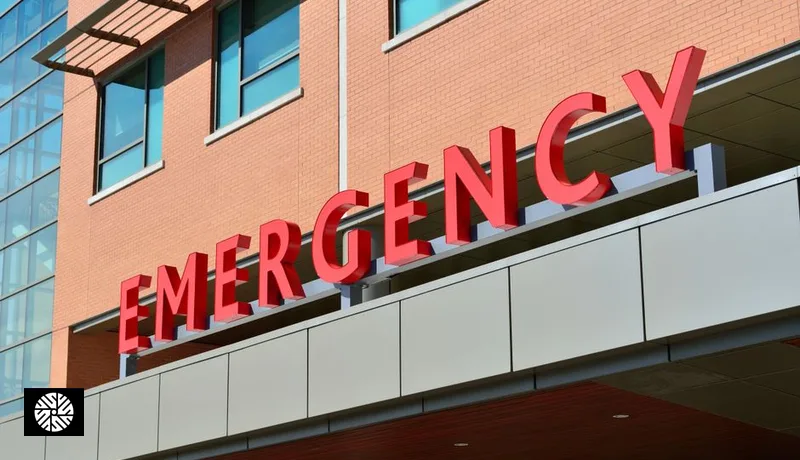
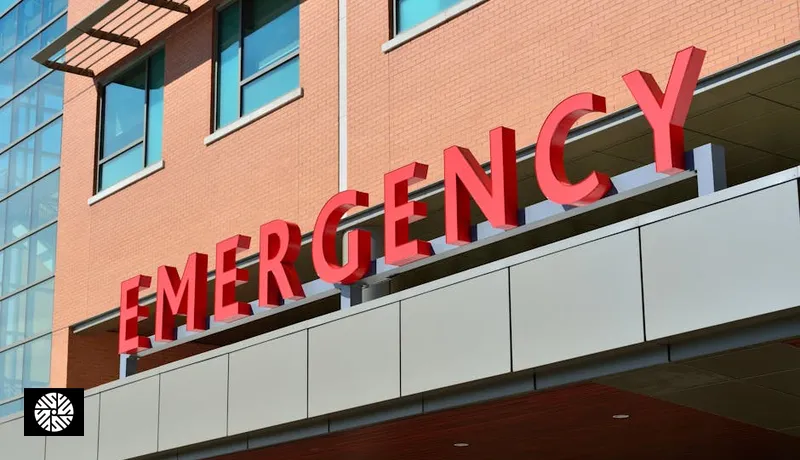
Major Taipei hospitals take walk-in foreign patients at the ER. Bring your passport, a credit card, and your travel insurance card if you have one.
| Hospital | Area | Foreign-Patient Service |
|---|---|---|
| National Taiwan University Hospital (NTUH) | Zhongzheng (central) | International Medical Center (full English) |
| Mackay Memorial Hospital | Zhongshan | English support, missionary heritage |
| Cathay General Hospital | Da'an | International Medical Service Center |
| Far Eastern Memorial Hospital | Banqiao (New Taipei) | Foreign Medical Center |
| Taipei Veterans General Hospital | Beitou (north) | English-capable on request |
If you're staying in Beitou for hot springs and screening, Veterans General is closest. From central Taipei, NTUH and Cathay are both a short taxi ride away.
Where do you go for urgent, non-emergency care?
For things that aren't life-threatening but you don't want to sit on until tomorrow — a fever that won't quit, a UTI, a cut that probably needs stitches, an ear infection — Taiwan's neighborhood clinics are extraordinary. They're everywhere. A single residential street often has several within a short walk: an internal medicine clinic, an ENT, a pediatric clinic, a dermatologist, all in ground-floor storefronts.
Walk-in is the default: you show up, take a number, and wait your turn. Dental urgent care follows the same pattern, and pediatric clinics often run late evening hours because parents come after work.
For after-hours dental emergencies, a few large dental groups in Taipei keep one branch open late or operate on-call lines. Hotels and concierge services like New Dawn Health can route you to one quickly.
What is Taiwan's equivalent of a GP visit?
The closest thing to a UK GP or US primary care physician is a 家醫科 (jiā yī kē) — a family medicine clinic. They handle the full general range: cold and flu, blood pressure checks, basic blood work, vaccinations, follow-up on chronic conditions. Most major hospitals have a family medicine department, and stand-alone family medicine clinics exist in every district.
If labs are ordered, the clinic quotes you the self-pay price up front — there is none of the surprise-billing-six-weeks-later you might be used to, because the charge has to come off an approved fee schedule and be itemised on your receipt. Prescriptions are dispensed on-site or filled at a pharmacy across the street.
What family medicine clinics in Taiwan won't usually do is act as a gatekeeper. You don't need a referral to see a specialist, so a family doctor here functions less as a triage layer and more as the generalist option for "I'm not sure what kind of doctor I need."
Do you need a referral to see a specialist in Taiwan?
No — and this surprises a lot of foreigners. Want to see a cardiologist about chest pain? A dermatologist about a rash? A gastroenterologist about persistent reflux? Register for that department directly, or have your hotel call. No referral letter required. NHI doesn't enforce gatekeeping the way US insurance or the UK NHS does, so the cultural expectation is direct access.
The downside of direct access: you have to know roughly which specialty fits your problem. If you're not sure, start at family medicine or at an international medical center where coordinators will route you. New Dawn Health's provider directory lists English-friendly specialists by category to make this easier.
When is a full check-up a better use of your money than a clinic visit?
A walk-in clinic answers one question: what is wrong with me today. It doesn't tell you what your blood chemistry, heart rhythm, or organs look like. If the reason you want to see a doctor is "something feels off" rather than one acute problem, a scheduled screening covers far more ground in a single morning than a queue of separate clinic visits would.
Our entry-level holistic exam, Convenient, is US$299 and includes biometrics, physical examination, blood analysis (advanced organ function and tumor markers), urine analysis, ECG, hearing and eye exams, chest X-rays, body composition, and an abdominal ultrasound — one appointment, English throughout. See our screening packages for the full range.
When you need one specific doctor rather than a whole screen, we book the appointment directly at our partner clinics:
| Appointment | New Dawn Health price (USD) |
|---|---|
| Orthopedic doctor consultation (iHope Clinic) | $75 |
| Abdomen ultrasound (iHope Clinic) | $95 |
| Comprehensive dental check & teeth cleaning | $130 |
| Clinical dermatologist appointment | $150 |
| Gynecological consultation & ultrasound | $190 |
| Cardiologist appointment (Taiwan Adventist Hospital) | $380 |
Those are our prices, booked and coordinated in English. Walking into a clinic yourself is the other route — cheaper on paper for a trivial complaint, slower and blinder if you don't know which department you need.
What can you buy at a Taiwan pharmacy, and can you refill a foreign prescription?
Taiwan has two kinds of pharmacies you'll encounter. Chain drugstores like Watsons (屈臣氏) and Cosmed (康是美) carry over-the-counter medications, vitamins, skincare, and basic medical supplies — every shopping district has them. Neighborhood pharmacies (藥局) handle prescription dispensing and tend to be smaller, family-run, often attached to or across from a clinic.
OTC availability covers most common needs: paracetamol/acetaminophen, ibuprofen, antihistamines, loperamide for diarrhea, electrolyte replacement, cold and flu remedies, antiseptics, bandages. Pharmacists usually speak limited English but will work with you through a translation app.
What decides whether you can just buy something is the medicine's class. Taiwan's Food and Drug Administration sorts medicines into three: prescription drugs (處方藥), which a pharmacy may supply only against a physician's prescription; pharmacist-guided drugs (指示藥), which need no prescription but are taken on the direction of a doctor, pharmacist or pharmacy technician; and general-sale medicines (成藥), which need neither. That is why the answer to "can I buy this?" is a conversation at the counter rather than a shelf you help yourself from — and why a chain drugstore without a pharmacist on duty may not be able to sell you what you came for. Look for the word 藥局 and a prescription counter, and ask whether the pharmacist is in.
Bring the original box or a photo of its ingredient panel: brand names change between countries, active ingredients do not. Show everything you are already taking, including supplements — two multi-symptom cold remedies can repeat the same acetaminophen or antihistamine. For a child, give the exact age and weight rather than asking for "half an adult dose."
Three phrases that do most of the work:
- 請問藥師在嗎? (Qǐngwèn yàoshī zài ma?) — Is the pharmacist here?
- 我有這個症狀,可以請藥師幫我看一下嗎? (Wǒ yǒu zhège zhèngzhuàng, kěyǐ qǐng yàoshī bāng wǒ kàn yíxià ma?) — I have this symptom; could the pharmacist advise me?
- 24小時藥局 (èrshísì xiǎoshí yàojú) — type this into Google Maps to find a 24-hour pharmacy, then phone before a late-night trip, because listed hours drift.
The catch: Taiwan pharmacies don't fill foreign prescriptions. If you brought a US, UK, or EU prescription expecting a refill, that won't work directly. The workaround is simple — book a short consultation with a Taiwan physician, show the original labelled bottle and any records, and they can write a Taiwan-equivalent prescription.
Which hospitals have English-speaking doctors?
The realistic expectation: at major Taipei hospitals and premium private clinics, you'll find good-to-excellent English. At neighborhood walk-in clinics it's hit-or-miss, but staff are patient and translation apps work fine. At family-run pharmacies and small clinics outside Taipei, prepare to use Google Translate and gestures — you'll still get care.
International medical centers offer English coordination, but language availability, hours, fees, and specialty access vary. Confirm support directly before traveling:
- NTUH International Medical Center — gold-standard public-hospital experience with Western-trained staff and full English coordination.
- Far Eastern Memorial Foreign Medical Center — modern facility in Banqiao, particularly strong for cardiac and oncology cases.
- Cathay General International Medical Service Center — central Da'an location, a common choice for expats and short-term visitors.
- Mackay Memorial — long history of serving foreign patients dating back to its missionary founding.
- Premium private network — clinics like the providers listed in our services directory are designed end-to-end for international patients.
Many Taiwan physicians did residencies or fellowships in the US, UK, Japan, or Germany, and English is often stronger at the senior physician level than at front-desk reception. If the receptionist's English is shaky, push through to the doctor.
How do you claim a Taiwan medical visit on travel insurance?
Most travel medical plans — TIC, Allianz Travel, World Nomads, Cigna Global, IMG, GeoBlue — reimburse Taiwan medical visits with proper documentation. Taiwan's self-pay system makes this easier than billing-heavy countries, because the Medical Care Act requires the clinic or hospital to hand you a receipt listing every item and its fee at the time you pay.
What you'll need for reimbursement:
- Itemized receipt (收據) from the clinic or hospital, showing services and amounts.
- Diagnosis statement (診斷證明書) — request this at checkout; there is a separate fee on the hospital's schedule, and most insurers require the document.
- Prescription copy if medications were dispensed.
- Translation — premium hospitals provide English documentation by default; smaller clinics may need a translation, which the international medical center at any major hospital can produce for a fee.
Submit inside your insurer's claim window, which is printed in your policy — check it before you travel, not after you get sick. Some insurers offer direct billing at partner hospitals; call your insurance hotline before you go to the ER to check.
What happens, step by step, at a Taiwan clinic or hospital?
- Register (掛號). Every facility keeps its own records, so the first time you visit any given place you register there. Look for the 掛號 (guà hào) counter or kiosk — at a clinic it's one desk, at a hospital a registration hall with staffed windows and self-service machines. Tell them which department you want, hand over your passport for a short first-timer form, and you'll be given a registration number for that doctor. Unsure which department fits? Say so — at a hospital you can ask for the International Medical Service desk by name.
- Take your number and wait. Watch the digital display board outside the doctor's room: it shows the number being seen now and where yours sits in the queue. Numbers are called aloud in Mandarin, but the board is what you rely on, so you don't need to follow the announcements.
- See the doctor. Consultations are efficient and often short — focused minutes, not a long chat. The doctor asks what's wrong, examines you, and decides on tests, medication, or a referral. Be direct and specific about symptoms; it's the fastest way through a fast system.
- Do the tests, if any are ordered. Blood work, X-ray, ultrasound and similar are usually done during the same visit — you carry the order to the lab or imaging counter, have it done, and often get results back within the same appointment. This one-stop rhythm is a big part of why care here feels fast.
- Pay at the cashier (批價). The reversal that trips people up: you pay after seeing the doctor, not before. Take your paperwork to the 批價 (pī jià) window and pay by cash or card. Without an NHI card you are charged the facility's approved self-pay rate, and an international medical service desk carries its own higher registration rate. Keep the itemized receipt — it's what turns this into an insurance reimbursement.
- Collect your medication (領藥). You don't leave the consulting room with medicine; you take the prescription slip to the 領藥 (lǐng yào) pharmacy window. At a hospital that's a separate counter, at a clinic it's usually right there. Hand over the slip, wait for your number, collect clearly labelled medication.
What should you do for a common travel illness or injury?
| Scenario | Where to Go |
|---|---|
| Stomach upset / mild food reaction | Watsons or Cosmed for OTC; family medicine clinic if it persists past a day |
| Traveler's diarrhea | Family medicine or internal medicine clinic |
| Allergic reaction (mild) | Walk-in clinic; ER if breathing is affected |
| Sprained ankle / minor injury | Orthopedic walk-in or hospital outpatient |
| Dental emergency (pain, broken tooth) | Dental clinic walk-in; late-hours dental groups at night |
| Urinary symptoms (UTI) | Family medicine or urology clinic |
| Skin rash / minor infection | Dermatology walk-in clinic |
| Chest pain, breathing trouble, fainting | ER directly — call 119 or take a taxi |
One pattern: when in doubt for non-emergencies, a family medicine clinic is the safest first stop. They will either treat you or point you at the right specialist within minutes.
What if you take medication for a chronic condition?
If you take regular medication — blood pressure, diabetes, thyroid, asthma, cholesterol, mental health — the US CDC's advice for travel to Taiwan is to bring all the medicines you might need, including extra in case of travel delays, and to check with Taiwan's representative office that each of your prescriptions is legal to bring in. Keep them in the original labelled bottles in your carry-on, and pack a printed list of generic names (Lipitor in the US is "atorvastatin" globally), doses, and your prescribing doctor's contact.
If the trip outlasts your supply, or a bag goes missing, the path is straightforward: book a family medicine or specialist appointment at one of the international medical centers, bring the bottles and any records, and the physician can write a Taiwan-equivalent prescription.
For controlled substances (ADHD medication, stronger pain medication, certain anxiety medications), Taiwan regulates tightly — bring documentation from your home physician and expect a hospital outpatient department rather than a walk-in clinic. Some controlled substances common abroad are restricted or unavailable here, so confirm before departure if you depend on one.
What should you remember if you get sick in Taiwan?
Most foreigners who get sick in Taiwan walk away surprised by two things: how fast they were seen, and how ordinary the bill looked. Language gaps exist, some forms are still only in Chinese, and nobody hands you a map of the system — but the fundamentals are strong. Care is dense, the fee schedule is approved and posted, and the self-pay tier means you don't need to be on NHI to be treated well.
If you're in Taiwan for a planned health screening, that's already handled — see our full-body checkup cost guide and our medical tourism overview for the concierge side. If you're here for tourism, business, or a longer stay, bookmark this article. And if you want help with the unplanned side, New Dawn Health coordinates English-speaking medical visits across Taipei — from a walk-in clinic for a stubborn cold to a specialist consultation for something more serious. For broader trip planning, see our Taiwan travel guide and Taiwan overview.
Sources
- National Health Insurance Administration, MOHW — Foreign Nationals who Reside in Taiwan with an Alien Resident Certificate (ARC): six-month enrollment rule (accessed 2026-09-08)
- Laws & Regulations Database of the Republic of China (Taiwan), Ministry of Justice — Medical Care Act, Articles 21–22: fee standards approved by the local competent authority; itemized receipts (accessed 2026-09-08)
- National Fire Agency, Ministry of the Interior (Taiwan) — 119報案:119、112: 119 is the fire agency’s emergency reporting line for fires and rescue and runs 24 hours; 112 transfers callers to 110 (police) or 119 (fire) (accessed 2026-09-08)
- US Centers for Disease Control and Prevention — Taiwan Traveler View: vaccines and medicines guidance (accessed 2026-09-08)
- Taiwan Food and Drug Administration — 藥品分為處方藥、指示藥、成藥: prescription, pharmacist-guided and general-sale medicines (accessed 2026-10-14)
- Taiwan Food and Drug Administration — Pharmaceutical Affairs Act (accessed 2026-10-14)
US / UK terms and the closest Taiwan context
Read this first: These are comparison aids, not claims that coverage, credentials, or care pathways are equivalent. Europe is not one health system; UK examples below refer specifically to NHS England.
PCP / primary care provider; GP / general practitioner
- What it means there
- In the US, a primary care provider may provide prevention, common-illness care, and care coordination. In NHS England, a registered GP commonly coordinates access to non-emergency specialist care.
- Closest Taiwan context
- The closest starting point is a community clinic or family medicine department (基層診所/家庭醫學科).
- Do not treat as equivalent
- Taiwan does not use one universal PCP or GP gatekeeping model. NHI promotes community-first, tiered care, but its referral policy does not make a referral a universal prerequisite to every hospital visit.
- What to ask
- Ask whether this visit is the right first contact, whether direct specialist registration is accepted, and whether a referral changes the appointment or NHI copayment.
Referral
- What it means there
- A US plan, especially an HMO, may require a PCP referral for coverage. In NHS England, specialist hospital care is generally accessed through a GP referral.
- Closest Taiwan context
- Taiwan uses a referral form and two-way referral process (轉診/雙向轉診) when clinical needs call for another facility or level of care.
- Do not treat as equivalent
- A US insurance referral, an NHS clinical access route, and a Taiwan NHI referral do not create the same rights or payment result. Taiwan NHI says referral need not proceed one hospital level at a time and does not universally prohibit direct hospital visits.
- What to ask
- Ask who issues the referral, its validity period, the named facility and department, whether registration is arranged, and what happens to the copayment.
Frequently asked
Do I need a referral to see a specialist in Taiwan?
No. Unlike the US (PCP gatekeeping) or the UK (GP referral required), Taiwan allows direct walk-in or direct booking with most specialists — cardiologist, dermatologist, gastroenterologist, ENT, etc. NHI doesn't enforce gatekeeping, and the cultural expectation is direct access. As a cash-pay foreigner you have the same access. The only catch: you need to know roughly which specialty fits your issue, or start at family medicine and let them route you.
Will my US/UK travel insurance reimburse Taiwan medical visits?
Most travel medical plans (TIC, Allianz Travel, World Nomads, Cigna Global, IMG, GeoBlue) reimburse Taiwan medical care with proper documentation. You'll need an itemized receipt (收據), a diagnosis statement (診斷證明書 — request it at checkout; the fee is on the hospital's schedule), and prescription copies. Premium hospitals issue English documentation by default; smaller clinics may need translation, which any major hospital's international medical center can produce. Submit inside the claim window printed in your policy. Some insurers offer direct billing at partner hospitals — call your insurance hotline before going to the ER.
Where do I go for a 24/7 dental emergency in Taipei?
Standard dental clinics close in the evening, but a few large dental groups in Taipei keep one branch open until midnight or operate 24-hour on-call lines for emergencies — broken teeth, abscesses, trauma. Hotel concierge services or New Dawn Health can route you to one quickly. For severe facial trauma or infection that's spreading, go to a major hospital ER instead — NTUH, Cathay General, Mackay, Far Eastern Memorial, or Veterans General all have on-call oral surgery.
Can I refill my prescription medications in Taiwan?
Not directly with a foreign prescription — Taiwan pharmacies don't fill US, UK, or EU prescriptions. The workaround is simple: book a brief consultation with a Taiwan physician, bring your medication bottle and any medical records, and they'll write an equivalent Taiwan prescription. Generics are widely available and often a small fraction of US prices. For controlled substances (ADHD meds, stronger pain or anxiety medications) you'll need stricter documentation and may need to go through a hospital outpatient department rather than a walk-in clinic.
How fluent are Taiwan doctors in English?
Better than most travelers expect, especially at the senior physician level. Many Taiwan doctors completed residencies or fellowships in the US, UK, Japan, or Germany, and read medical literature in English daily. Front-desk staff at smaller clinics can be hit-or-miss, but at major hospitals (NTUH, Mackay, Cathay General, Far Eastern Memorial, Veterans General) and at dedicated international medical centers, you'll find full English coordination from registration through discharge. Premium private clinics in the New Dawn Health network are designed end-to-end for international patients.
Should I call 119 for an ambulance or take a taxi to the ER?
Call 119 (Taiwan's emergency number) for true emergencies — unconscious patient, chest pain, suspected stroke, severe breathing difficulty, heavy bleeding. If you're mobile and can move, going directly to the ER by taxi is often faster than waiting for an ambulance because Taipei traffic is dense and ambulances don't have the kind of clear-the-road priority you'd expect in the US. ER physicians often advise: if it's not a "can't move" emergency, grab a cab. Bring your passport, a credit card, and your travel insurance card.
Can a Taiwan pharmacist give me medicine without a prescription?
For many minor problems, yes. Taiwan sorts medicines into three classes: general-sale medicines (成藥) need no prescription or professional direction; pharmacist-guided drugs (指示藥) need no prescription but are taken on the direction of a pharmacist or doctor; prescription drugs (處方藥) can be supplied only against a physician's prescription. Go to a 藥局 with a pharmacist on duty, bring the box or ingredient name of anything you already take, and expect to be sent to a clinic for antibiotics, controlled medicines or anything that needs a diagnosis.