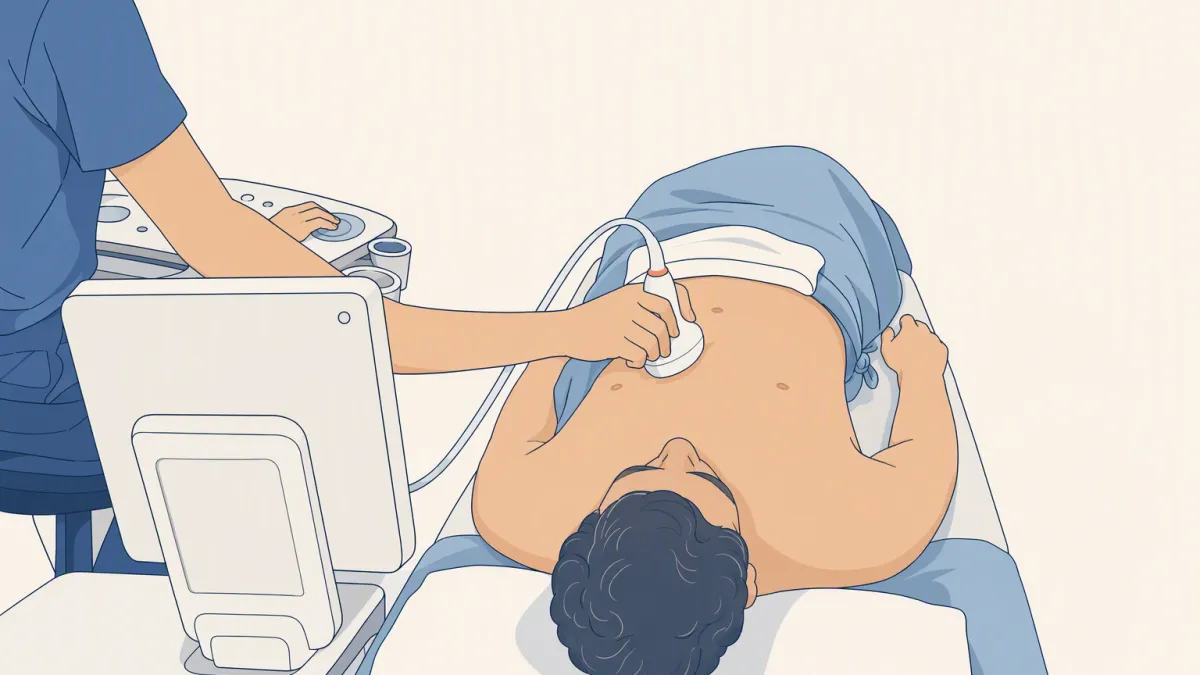
A common, usually silent buildup of fat in the liver. An ultrasound often finds it; the question that matters is whether scarring has started.
Last updated October 2026 · New Dawn Health editorial team
How common
An estimated 25–30% of adults (AASLD)
Symptoms
Usually none until it is advanced
First-line test
Abdominal ultrasound, plus blood tests
Key modifiable factor
Weight, diet, and blood sugar
What is fatty liver disease?
Fatty liver disease is a buildup of excess fat inside liver cells. This page covers the kind linked
to weight, blood sugar and cholesterol, now called metabolic dysfunction-associated
steatotic liver disease (MASLD). Its older name was non-alcoholic fatty liver disease (NAFLD).
Alcohol causes fatty liver too, and the two causes can overlap. US liver specialists (AASLD) estimate
that 25–30% of adults have the metabolic kind.
Fatty liver is often first seen on an abdominal ultrasound done for another reason.
Why scarring is what matters
In many people the fat stays mild. In some, it drives inflammation, called MASH.
Over years, that inflammation can scar the liver (fibrosis), and heavy scarring becomes cirrhosis.
Scarring, not the amount of fat, is what predicts serious liver problems.
✓
Fat without much scarring
Often improves with weight, diet and blood-sugar control
Still worth a scarring check, because fat alone does not show it
!
When scarring builds
Needs closer monitoring, usually by a liver specialist
Elastography, an ultrasound-based stiffness test, measures how far it has gone
Why it usually has no symptoms
Fatty liver usually causes no symptoms, so it is far more often found by a scan than by how you feel.
Some people notice vague tiredness or a dull ache under the right ribs.
Yellowing of the skin or eyes, or a swollen belly or legs: see a doctor promptly. These can be signs of advanced disease.
Fat found on a scan, no symptoms: ask for a FIB-4 score from your blood results.
Who is at risk
The strongest links are metabolic:
Overweight or obesity, especially weight around the middle
Type 2 diabetes or prediabetes
High triglycerides, low HDL cholesterol, or high blood pressure
A family history of cirrhosis, which AASLD treats as high risk
Lean people can develop it too, so a normal weight does not rule it out.
How it is found and treated
The tests used for fatty liver, and what each can and cannot show.
Liver enzymes and metabolic markers; the inputs for FIB-4
Enzymes can be normal even when fat is present
FIB-4 score
Whether advanced scarring is unlikely
A score that is not low needs a second test
Elastography
Liver stiffness, a measure of scarring
A separate test, usually after FIB-4
MRI fat measurement
The amount of liver fat, precisely
Needs a specific MRI technique (PDFF) that a general survey scan may not include
Lifestyle change is the first treatment at every stage. In the US, two medicines are approved for
MASH with moderate-to-advanced scarring: resmetirom (2024, only without cirrhosis) and semaglutide (2025). Whether either is available or suitable in Taiwan is a question for your doctor.
New Dawn Health offers abdominal ultrasound and blood tests in Taipei. Whether elastography or an MRI
fat measurement is available with a booking is confirmed when you book.
For many people it stays mild. In some, the fat drives inflammation (MASH) that can slowly scar the liver. That is why a fatty-liver finding should come with a check of scarring risk, starting with the FIB-4 blood-test score.
Can fatty liver be reversed?
+
Often, especially early. Weight loss and better diet, activity and blood-sugar control are the first treatment. In the US, two medicines are approved for MASH with moderate-to-advanced scarring: resmetirom (2024, only without cirrhosis) and semaglutide (2025). Availability in Taiwan is a question for your doctor.
How is fatty liver diagnosed?
+
Usually on an abdominal ultrasound, which can miss milder fat. Liver enzymes can be normal even when fat is present. Measuring fat precisely needs a specific MRI technique. Scarring is checked with FIB-4, and with elastography if FIB-4 is not low.
Do I need symptoms to have fatty liver?
+
No. It is usually silent and often found on a scan done for another reason. Yellowing of the skin or eyes, or a swollen belly or legs, can be signs of advanced liver disease and need a doctor promptly.
Compare screening packages, see exactly what each one includes, or talk to a coordinator
about fitting Fatty Liver Disease screening into your visit to Taiwan.