What is an abdominal ultrasound?
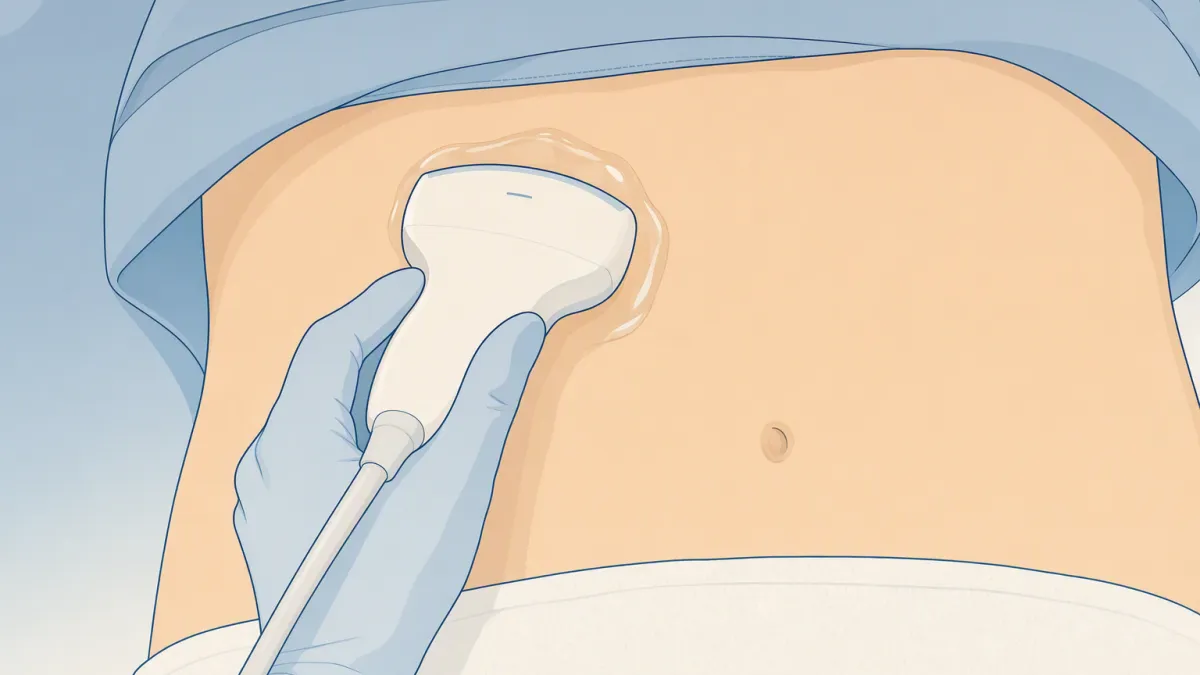
An abdominal ultrasound is a real-time, radiation-free scan of the organs in your upper abdomen: the liver, gallbladder, bile ducts, spleen, kidneys and, when bowel gas allows, the pancreas. A small handheld probe sends sound waves into the body and builds a live picture from the echoes.
It is usually ordered to answer a question, such as abdominal pain or an abnormal liver blood test. The upper abdomen and kidneys and urinary tract pages show the same organs region by region.
How does the scan work?
The probe sends out short pulses of sound and listens for the echoes. Fluid lets sound pass straight through, so a simple cyst looks dark. Fat and dense tissue send more sound back, so a fatty liver looks brighter than a healthy one. Air scatters sound almost completely, which is why gas in the bowel can hide what lies behind it.
What can it find?
Fatty liver is a common finding. A 2011 meta-analysis found ultrasound detects moderate-to-severe fatty liver with about 85% sensitivity; milder fat is harder to see. Other common findings are gallstones and simple cysts in the liver or kidneys.
- Fatty liver, when the fat is moderate or severe
- Gallstones and gallbladder changes
- Liver and kidney cysts, and some solid masses
- Enlargement of the liver, spleen or kidneys
- The pancreas and deep structures — bowel gas and body size can hide them. If a clinician needs that answer, they order a dedicated CT or MRI.
- The digestive tract lining — ultrasound reads solid organs, not the stomach or colon wall. That needs gastroscopy & colonoscopy.
- How much liver scarring there is — fat on ultrasound does not measure fibrosis. Elastography (such as FibroScan) and blood fibrosis scores do; the fatty liver page covers the blood scores and tests a doctor uses.
- What a mass is — ultrasound can show that something is there, not confirm what it is. A CT, an MRI or a biopsy answers that.
Who it helps — and who it does not
There is no recommendation to scan every adult without symptoms. It tends to help when there is a question to answer:
- Upper-abdominal pain or bloating that a doctor wants explained — after a doctor's assessment
- Abnormal liver blood tests, where fatty liver or gallstones are on the list of causes
- A defined screening use: the US Preventive Services Task Force recommends one-time screening for abdominal aortic aneurysm in men aged 65–75 who have ever smoked
That aortic screen is a specific look at the aorta, and not every abdominal protocol includes it. Ask when you book. It adds less in these situations:
- You want a cancer check. A normal scan does not exclude abdominal cancer or digestive-tract disease.
- You feel well and have no risk factors. Incidental findings, such as small cysts or nodules, can lead to further imaging that may not have been needed.
Cost and coverage
The live price further down this page is the booking price at New Dawn Health; anything billed separately — such as biopsy or pathology where it applies — is confirmed when you book. What happens after that depends on where your coverage comes from:
- In Taiwan, screening is paid for by the visitor. Short-term visitors are not covered by Taiwan's National Health Insurance, so screening is self-funded.
- Reimbursement at home is a question for your insurer. Whether a scan with or without symptoms is covered depends on the plan. Ask them before you book, and ask which documents they need.
- It can be booked on its own or inside a package. Both are listed below.
What to expect on scan day
-
1Before you arriveMany clinics ask you to fast for several hours so the gallbladder fills and the bowel holds less gas. Water and essential medicines are often allowed — your coordinator confirms the exact instructions when you book.
-
2On the tableYou lie on your back. Gel goes on your abdomen, and the probe is pressed from several angles. You may be asked to hold your breath or roll onto your side.
-
3AfterwardsNo needles, no dye and no recovery time — you wipe off the gel and carry on. A radiologist reads the images and issues a written report; who explains the findings, and when, is confirmed when you book.
Results and what happens next
- A normal scan describes the organs it could see. It does not exclude abdominal cancer or disease in the digestive tract.
- A common, harmless-looking finding, such as a simple kidney cyst, usually needs nothing more than a note in your records.
- Fatty liver or gallstones lead to a conversation with a doctor about blood tests, risk factors and whether symptoms fit.
- An uncertain finding, such as a solid nodule or something the scan could not see clearly, may lead to a CT, an MRI or a repeat scan. Some of that follow-up turns out not to have been needed.