Hardened deposits in the gallbladder — common, usually silent, and seen well on a radiation-free ultrasound. Quiet gallbladder stones usually need no treatment.
Last updated October 2026 · New Dawn Health editorial team
How common
Common — often found by chance on a scan
Who's at risk
Higher in women, with age, and with excess weight
Usually silent?
Yes — most never cause symptoms
First test
Abdominal ultrasound — no radiation
What are gallstones?
Gallstones are hardened deposits, most often made of cholesterol, that form in the gallbladder. The
gallbladder is the small pouch under the liver that stores bile. Gallstones are common, and most
cause no trouble at all.
Problems start when a stone moves and blocks one of the ducts that carry bile. Even then, the picture
ranges from a passing ache to an emergency.
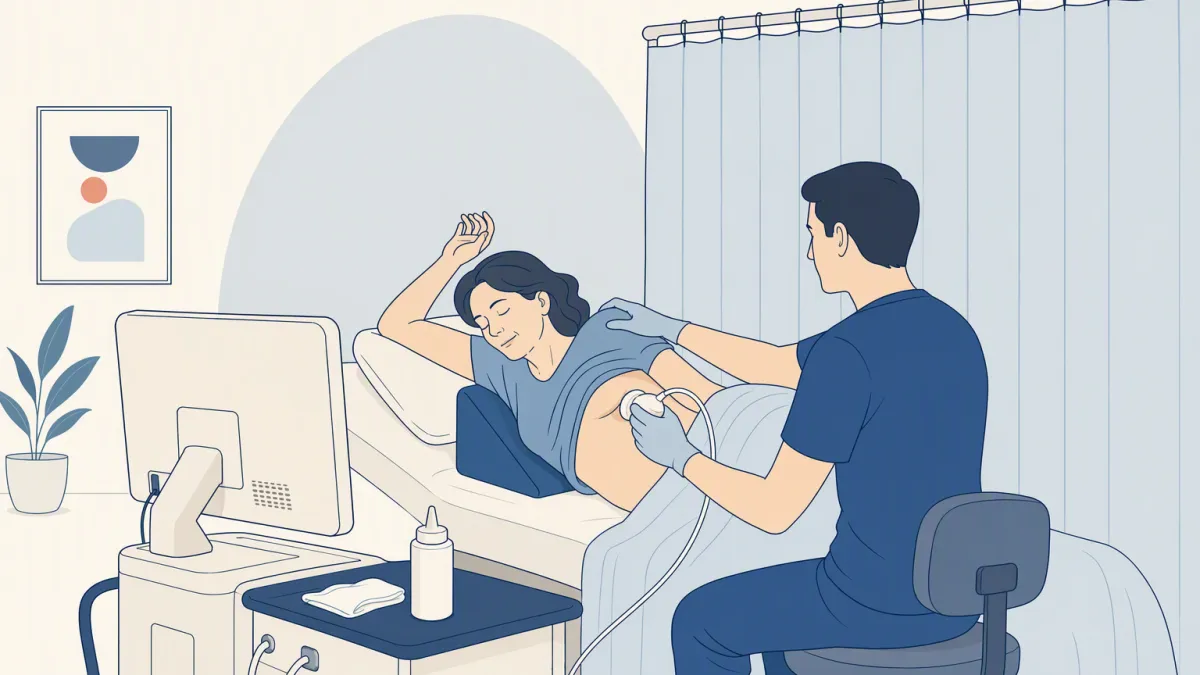
The raised arm spreads the lower ribs, clearing the probe's view of the gallbladder.
Silent stones versus symptomatic stones
When a stone blocks the flow of bile, the classic sign is a gallbladder attack:
steady, gripping pain in the upper-right abdomen, often after a fatty meal. Less often, a trapped
stone inflames the gallbladder, blocks the pancreas (pancreatitis), or causes yellowing of the skin
and eyes (jaundice).
Who is most likely to get gallstones?
NIDDK lists these as raising the odds:
Being a woman, especially with pregnancy, hormone replacement therapy or birth control pills
Older age — the chance rises as you get older
Overweight, and rapid weight loss, including after crash diets or weight-loss surgery
A family history of gallstones
None of these makes a stone certain. Steady, gradual weight management lowers the risk more safely
than a crash diet.
How gallstones are found
An abdominal ultrasound is the
standard first test. It is fast, painless and uses no radiation. Because it is so routine, gallstones
are often found by chance on a scan done for something else.
✓
What ultrasound shows well
Stones inside the gallbladder
A thickened, inflamed gallbladder wall
!
What it may miss
Stones in the bile ducts. A dedicated MRI of the ducts, called MRCP, shows them; a general MRI survey is not the same test.
Whether the stones are causing your symptoms. A doctor judges that from the pain pattern and blood tests.
Who needs treatment — and who doesn't
NIDDK advises that gallstones causing no symptoms probably need no treatment. Stones that cause
repeated pain or complications are usually treated by removing the gallbladder, an operation called
cholecystectomy. Stones in the bile ducts are managed differently.
Severe pain with fever or yellowing: call 119 in Taiwan, as in the box above.
Repeated upper-right pain after meals: see a doctor soon; an ultrasound is the usual first step.
Stones found by chance, no symptoms: usually nothing to do now. Tell a doctor if pain starts later.
Usually not. Most are silent and never cause a problem. They matter when a stone blocks a duct, causing pain or, less often, inflammation, pancreatitis or jaundice. Severe upper-right pain with fever or yellowing skin is an emergency. In Taiwan call 119 (the local equivalent of 911).
Do gallstones need to be removed?
+
Silent gallbladder stones usually do not. When stones cause repeated pain or complications, the usual treatment is removing the gallbladder (cholecystectomy). A doctor may advise otherwise in particular situations, and stones in the bile ducts are managed differently.
How are gallstones detected?
+
With an abdominal ultrasound, which shows gallbladder stones well, uses no radiation and is often the only scan needed. Stones in the bile ducts are harder to see; a dedicated MRI of the ducts (MRCP) is used when a doctor suspects them.
Can I prevent gallstones?
+
You can lower the odds, though not guarantee it. Keeping a steady, healthy weight and avoiding crash diets are the most useful steps, since fast weight loss is a known trigger. Family history and age you cannot change.