What is a coronary artery calcium score?
Heart attacks are usually caused by plaque that builds silently in the coronary arteries for decades. As plaque matures, part of it calcifies — and calcium is something a CT scanner can measure. That measurement is the Agatston score: one number that large population studies such as MESA have linked closely to the chance of a future heart attack.
Understanding your score
Scores are grouped into bands. Lower is better, and zero is genuinely special:
A ladder like this is the general pattern, not a rule your case must obey. Reporting conventions differ between hospitals, and two experienced clinicians can read the same finding and reasonably advise differently. Where your report or your doctor differs from this table, go with them — they are looking at your actual result.
What else goes into reading the number
Calcium is cumulative: arteries collect it over decades, so the same score is read differently depending on who it belongs to. Age context comes from population data — the Multi-Ethnic Study of Atherosclerosis (MESA) enrolled 6,814 adults aged 45 to 84 across four ethnic groups, none with known heart disease. Its free online tool turns a score into a percentile: the share of people of your age, sex and ethnicity whose score is lower than yours.
| Factor | Why it changes the reading |
|---|---|
| Age | Calcium builds with time, so a given score is more unusual at 45 than at 75 |
| Sex and ethnicity | MESA percentiles are calculated separately for men and women and for each ethnic group |
| Other risk factors | Blood pressure, cholesterol, diabetes, smoking and family history are weighed alongside the score |
| Current treatment | Statins can make existing plaque denser and more calcified, which can raise the score |
The percentile contextualizes; it does not replace the absolute score. US treatment guidance still keys off the raw number first. The 2018 ACC/AHA cholesterol guideline treated a score of 100 or more as favoring a statin. It treated a score at or above the 75th percentile — higher than three in four comparable people — the same way. Its 2026 update goes further: any detectable calcium supports a lower cholesterol target.
Who it helps — and who it does not
It is most useful when your risk is genuinely uncertain and the result would change a decision. US guidance (ACC/AHA, 2026) suggests it selectively for men from 40 and women from 45 whose estimated risk is borderline or intermediate. It tends to help:
- A family history of early heart disease
- Borderline cholesterol, where the statin decision is a real coin-flip
- Past smoking, high blood pressure, or metabolic risk factors
It adds little in two situations:
- You already have diagnosed coronary disease or a stent. Your cardiologist has better tools.
- You would make the same decision whatever the number. If the result would not change your treatment, the scan adds little.
What the score can't tell you
- Calcified plaque in the coronary arteries, as one number
- Whether your risk is higher or lower than a calculator estimate suggested
- Soft, non-calcified plaque. Younger adults in particular can carry it, which is why a score of zero is reassuring but not a guarantee. A coronary CT angiogram images the artery channels directly, when a clinician needs that answer.
- How narrow an artery is. Calcium shows plaque is present, not whether it blocks flow. A coronary CT angiogram or a cardiologist's own tests answer that.
- Whether you will have a heart attack. It sharpens a risk estimate; it does not predict an event.
What to expect on scan day
-
1Before you arriveTell the team if you could be pregnant: CT is generally avoided in pregnancy unless medically necessary. Some centers ask you to skip caffeine, smoking or food for a few hours first — your coordinator confirms when you book.
-
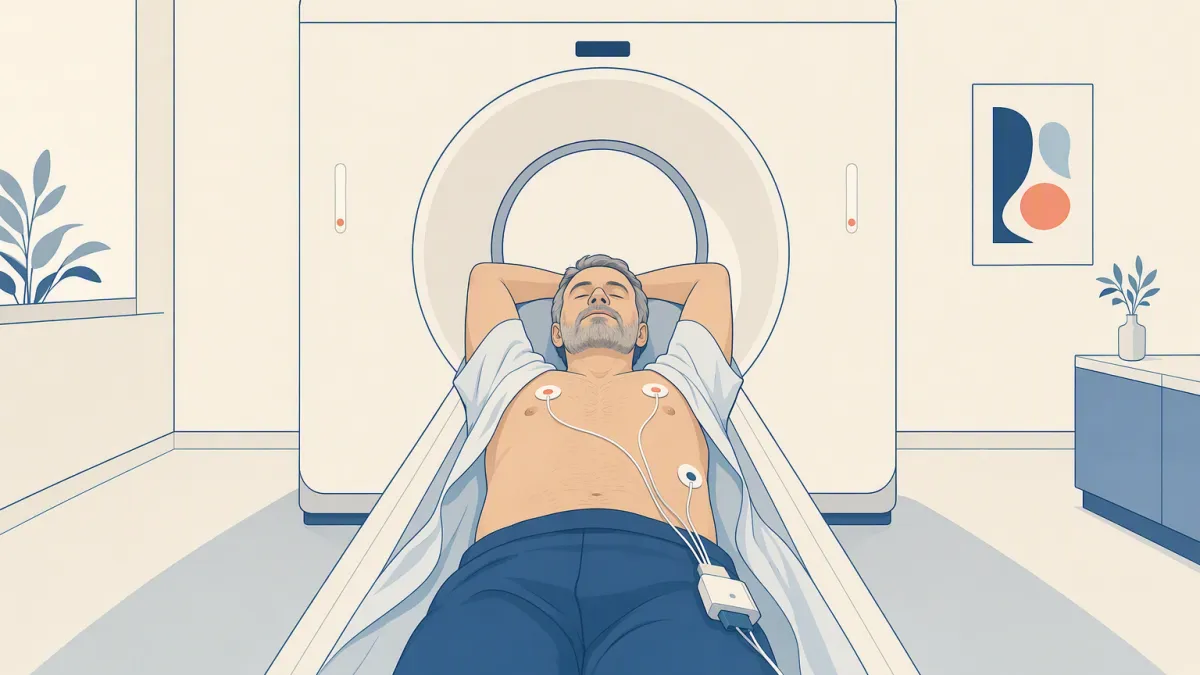
2Lie down, electrodes onSmall ECG pads are placed on your chest so the scanner can time its images between heartbeats.
-
3A few short breath-holdsThe scanner captures the heart in a handful of breath-holds. No needles, no contrast injection.
-
4DoneThe scan itself takes minutes; your coordinator confirms the total time on the day. RadiologyInfo estimates the dose at about 1.7 mSv — roughly six months of the average US background radiation. The actual dose varies with the scanner and your body size.
Cost and coverage
The live price further down this page is the booking price at New Dawn Health; anything billed separately — such as biopsy or pathology where it applies — is confirmed when you book. What happens after that depends on where your coverage comes from:
- In Taiwan, screening is paid for by the visitor. Short-term visitors are not covered by Taiwan's National Health Insurance, so screening is self-funded.
- Reimbursement at home is a question for your insurer. Whether a foreign insurance plan or health savings account pays any of it back depends on that plan. Ask them before you book, and ask which documents they need.
Results and follow-up
- A number and a written report — your Agatston score, in a document you keep. Report language and format are confirmed when you book.
- A conversation, not a verdict. Where relevant it covers what the score suggests about medication, follow-up, or whether a coronary CT angiogram is worth considering.
- Repeat scans are selective. A clinician decides whether one is useful, and when. A rising score on a statin does not by itself mean the treatment is failing, because statins can calcify existing plaque.