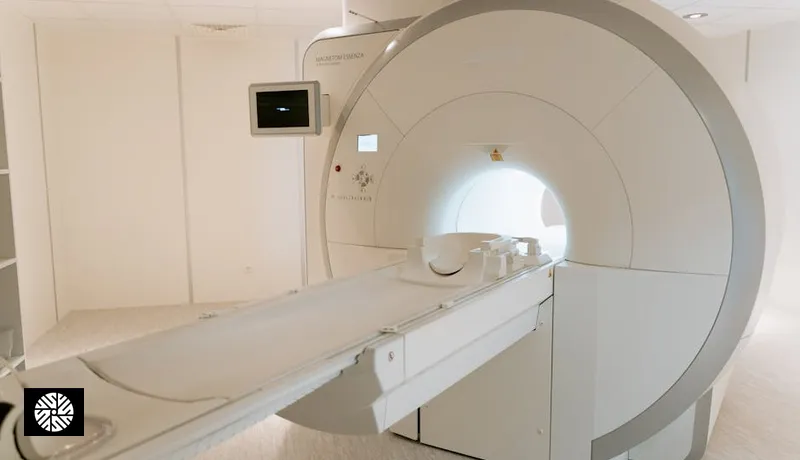
The Canadian Institute for Health Information (CIHI) tracks median wait times across provinces, and the numbers are not improving. As of the most recent reporting period published on the CIHI Wait Times tool (cihi.ca/en/wait-times-and-wait-time-trends), the median wait for a non-urgent (Priority 4) MRI in Ontario is roughly 16 weeks; in British Columbia, closer to 20 weeks; in Saskatchewan and Manitoba, longer still. For asymptomatic preventive screening — which falls outside the priority queue entirely — the practical wait is functionally infinite. Most provinces simply do not fund preventive full-body MRI under the public plan, and the legal architecture that produces this outcome is older than most patients realise.
Canadians who want answers this year, not next, are increasingly buying time at private clinics in Vancouver and Calgary (CAD $700–$1,500 for an MRI of a single body region) or flying to Taiwan for a structured screening that includes the imaging plus blood work and physician interpretation in a single morning. This guide unpacks the regulatory mechanics, the actual provincial wait data, the named private clinics most patients consider first, and the tax and insurance levers that change the real cost of the trip.
What "medically necessary" means under the Canada Health Act
The phrase Canadians hear most often — "covered if it's medically necessary" — is not a casual standard. It is the operative test under sections 2 and 12 of the Canada Health Act (CHA), and provincial plans build their fee schedules around it. The CHA preamble references "physical and mental well-being" as a national goal, but the funded benefit is narrower: a medical service ordered by a physician for the diagnosis, treatment, or rehabilitation of a documented illness or injury.
That single legal phrase is why preventive whole-body MRI sits structurally outside public coverage. There is no symptom, no working diagnosis, no treatment pathway being investigated — so the request fails the "medically necessary" gate before it ever reaches the wait list. Provincial bodies (HIROC and the OMA in Ontario, MSP fee committee in BC) have been explicit on this point for two decades.
CIHI categorises diagnostic imaging requests on a four-tier priority scale. Priority 1 is emergent (24 hours), P2 urgent (7 days), P3 semi-urgent (30 days), and P4 non-urgent (within 60 days, target). The published median waits cited above are P4 numbers — and even P4 is reserved for symptomatic patients whose physician has documented a clinical question. Asymptomatic preventive imaging is not a fifth priority; it is simply not queued at all.
Ontario adds a second layer: the province's anti-extra-billing provisions under the Commitment to the Future of Medicare Act (2004) prohibit physicians who bill OHIP from also charging patients privately for the same insured service. The practical consequence is that Ontario private MRI clinics must operate as clinic-direct entities — separately licensed, never billing OHIP, with radiologists who work outside the public schedule for that visit. This is what people mean by "two-tier" being blocked: not that private MRI is illegal in Ontario, but that the parallel public/private mixing common in Quebec and BC is forbidden.
Provincial wait time comparison — actual CIHI numbers
The numbers below are drawn from the CIHI Wait Times tool, reflecting Priority 4 (non-urgent) MRI medians in the most recently reported year. They reflect symptomatic patients in the queue — preventive screening is, again, not queued.
| Province | P4 MRI median wait | Notes |
|---|
| Alberta (AHS) | ~10 weeks | Among the shortest in Canada; AHCIP funds more public MRI hours per capita |
| Ontario | ~16 weeks | Wide regional variation; LHIN catchments around Toronto worse than rural ON |
| Quebec | ~14–18 weeks | RAMQ permits private cash-pay MRI in Montreal/Quebec City; results integrate to CLSC |
| British Columbia | ~20 weeks | MSP imaging funded but limited capacity; private alternatives most developed in BC |
| Manitoba | ~22 weeks | Winnipeg HSC handles bulk of cases; rural patients face additional travel |
| Saskatchewan | ~24+ weeks | Saskatoon and Regina hubs; private MRI legal but limited supply |
| Nova Scotia | ~26+ weeks | Maritimes among the longest waits nationally |
| New Brunswick | ~28+ weeks | Cross-border travel to Maine private clinics historically common |
Three observations matter for screening-minded patients. First, Alberta's relative efficiency does not extend to preventive imaging — AHCIP excludes asymptomatic screening just as MSP and OHIP do. Second, the Maritimes' wait crisis is being managed, in part, by patients flying to private clinics in central Canada or the U.S. — Taiwan is simply a longer leg with a richer service bundle. Third, Quebec's RAMQ permits a model closer to BC than to Ontario: private MRI clinics can co-exist with public billing, which is why Mediscan in Montreal has operated for years with relatively transparent cash pricing.
Canadian private clinic landscape
The named private MRI providers most Canadians compare against a Taiwan trip include:
- Mayfair Diagnostics (BC and AB) — the largest private network in western Canada. Single-region MRI typically CAD $895–$1,295. Limited full-body protocol availability; mostly orthopaedic and neurological imaging.
- MedRay Imaging (BC, multiple Lower Mainland sites) — single-region MRI from CAD $850. Same-week scheduling common. Reports delivered to your GP via fax/secure email within 5–7 business days.
- Canada Diagnostic Centres (BC, AB) — pricing similar to Mayfair. Stronger on cardiac MRI and 3T sequences.
- HealthView Medical (Ontario) — operates within the Ontario clinic-direct model. Single-region MRI CAD $950–$1,400. No full-body whole-MRI screening offered domestically.
- Mediscan (Quebec) — Montreal-based; multi-region packages (brain plus spine plus abdomen) from CAD $1,800. Closest Canadian approximation to a screening MRI, but still without the bundled biomarker panel.
Where these clinics are exceptional is in symptomatic imaging at speed: a torn meniscus, a suspicious lump, a neurology consult that needs a brain MRI before next week's specialist appointment. They are constrained, by design and by provincial regulation, from offering the screening package most international wellness clinics provide. Ontario's restrictions on physician dual-billing in particular mean a HealthView radiologist cannot moonlight at OHIP rates — every patient pays the full clinic fee.
METC mechanics — does foreign medical care actually qualify?
The Medical Expense Tax Credit (METC) is a federal non-refundable credit administered by the Canada Revenue Agency (CRA). The legal scaffolding sits in section 118.2 of the Income Tax Act, with detailed interpretation in Income Tax Folio S1-F1-C1 (which superseded the older IT-519R2 bulletin). For 2024 returns, the threshold to claim is the lesser of 3% of net income or CAD $2,759 — meaning eligible expenses above that floor reduce federal tax owing at 15% (plus a provincial top-up).
For foreign medical services, two provisions matter. The first is paragraph 118.2(2)(g), which permits claiming travel expenses (including airfare) when the patient must travel at least 80 km because the medical service is "not available in the locality." The second, applied by CRA to international care, requires that the service be "not reasonably available in Canada within a reasonable time." This is not a defined statutory phrase — it has been built up through Tax Court of Canada decisions, where preventive whole-body MRI screening, performed abroad because no Canadian public option exists and waits at private clinics for limited multi-region protocols stretch into months, has been accepted in some cases.
To support a METC claim for a Taiwan screening, expect to retain:
- Itemised receipts in English (or with a notarised translation), ideally referencing CPT-equivalent codes so a Canadian tax preparer can map the charges
- A referral or recommendation letter from your Canadian GP, on letterhead, noting that the equivalent service is not reasonably accessible domestically within an acceptable timeframe
- Written evidence of the Canadian wait — a screenshot of your provincial wait time portal, or a letter from a Canadian private clinic noting the soonest available slot
- Boarding passes and accommodation receipts for the travel-component claim under 118.2(2)(g)
This is not tax advice. The eligibility determination is fact-specific and CRA reviews are common for cross-border claims. A Canadian tax professional with cross-border medical experience is the right voice on whether your particular situation will hold up.
Cross-border insurance considerations
Canadian travel medical policies — including TIC Travel Insurance Coordinators, Travelers Plus, RBC Avion travel benefits, Manulife CoverMe, Sun Life travel add-ons, and Blue Cross provincial plans — are designed for emergencies during travel, not for elective procedures planned in advance. The standard policy wording explicitly excludes "treatment, surgery, or services that are the reason for the trip." A planned screening MRI in Taipei is by definition the reason for the trip and falls outside coverage.
What these policies do still cover, and worth keeping active during the trip, is anything unrelated: a slip on a wet hotel floor, food-borne illness, a cardiac event during the flight. Some employer extended health benefits (Manulife, Sun Life, Canada Life) include foreign care reimbursement for services that would otherwise be insured at home — but again, preventive screening usually falls outside the "would otherwise be insured" definition. Check your specific policy booklet, particularly any "Out of Country" or "Wellness Benefit" sections.
For Canadians who carry private supplementary plans through a professional association (CMA Insurance, OBA, BC Lawyers' Insurance, engineers' associations), wellness-imaging riders are slightly more common. These are the policies most worth a phone call to the insurer before booking, because partial reimbursement does occasionally appear under the diagnostic-imaging clause when a Canadian referral letter accompanies the claim.
Patient personas: the BC retiree, the Ontario executive, the Quebec couple
The BC retiree. 68, retired Vancouver-based engineer, family history of pancreatic cancer. MSP covers his GP visits and any symptomatic imaging, but his GP has been clear: "We don't have a screening pathway for asymptomatic pancreatic surveillance under MSP, and a private MRI of the abdomen at Mayfair is CAD $1,200 with no biomarker context." For him, the Taiwan trip pencils because the package includes the abdominal MRI, a CA 19-9 panel, lipid and HbA1c, and a 30-minute physician debrief — for less than the Mayfair scan alone. He flies AC15 YVR-TPE in premium economy (~12.5 hours, daily service), his wife joins him, and they make it a 7-day visit including time in Taipei. METC claim covers most of the imaging cost above the 3% threshold.
The Ontario executive. 52, Toronto-based, dual-income household, no symptoms but father had a heart attack at 58. OHIP will not fund a coronary calcium score, an exercise echo, or any cardiac MRI in the absence of symptoms. HealthView quoted CAD $1,400 for a cardiac MRI alone. She books a Taiwan package that includes calcium scoring, cardiac MRI, vascular ultrasound, full lipid subfractions, hs-CRP, and a cardiology debrief — total cost less than two HealthView visits. She flies YYZ-TPE via YVR on EVA Air codeshare, takes Friday and Monday off, and is back at her desk Tuesday afternoon.
The Quebec couple. Both 45, Montreal-based, cancer-conscious after a family loss. Mediscan offers a multi-region MRI package at CAD $1,800 each — but no biomarker work, no DEXA, and limited debrief. Together that's CAD $3,600 for imaging only. They book Taiwan as a couple, fly Air Canada YUL-YVR-TPE, screen on the same morning, share the debrief block, and the all-in cost (including premium economy and four hotel nights) lands close to what Mediscan alone would have charged. The METC threshold is per-spouse, so each can claim the portion above 3% of net income.
Records integration with provincial GP
The single biggest concern Canadian patients raise is whether a Taiwan report will be useful at home. The answer is yes, with specifics worth knowing. Reports are delivered in two formats:
- PDF clinical report in English — written to the same conventions a Canadian radiologist would recognise (impression, findings, comparison priors, recommendations). Importable to PrescribeIT-connected GP EMRs (TELUS PS Suite, Accuro, OSCAR), Plexia (Quebec), and the Cerner deployments at major provincial hospitals (UHN, VGH, Foothills).
- DICOM imaging files — the international standard for medical images. Your GP can review them in any DICOM viewer (Horos on Mac, RadiAnt on Windows are common free options) or upload them to the provincial PACS for radiologist review if a finding warrants it.
If any clinical note is in Mandarin (rare in our concierge workflow, but possible for ad-hoc consultations), the New Dawn team translates and re-formats it free of charge before delivery. A short referral letter to your Canadian GP is included with every report, summarising findings and any recommended Canadian-side follow-up — useful for your GP to attach to the file in case a downstream specialist needs context.
The flight: shorter than you think
Vancouver to Taipei is among the shortest North America-to-Asia flights — Air Canada's AC15 YVR-TPE operates daily, scheduled at roughly 12.5 hours westbound. Premium economy in shoulder seasons routinely lists CAD $1,400–$1,800 round trip; lie-flat business runs CAD $4,500+ but is less relevant for most screening trips. EVA Air offers daily YYZ-TPE service via YVR on Star Alliance codeshare with Air Canada, with a short Vancouver layover. China Airlines also serves YVR-TPE daily.
"My BC referral list put me 5 months out for an MRI my doctor said was 'probably nothing.' I waited 3 weeks for a Taiwan slot, flew over for a long weekend, came back with a complete report — full-body MRI, calcium score, blood panel — for less than the private clinic in Vancouver wanted just for the MRI." — Sarah K., 47, Vancouver
The private Canadian alternative — and why Taiwan still wins
Cash prices at Canadian private clinics typically run:
| Service | Canada (private) | Taiwan (New Dawn partner) |
|---|
| Single-region MRI (e.g. brain or spine) | CAD $700–$1,500 | Included in package |
| Full-body MRI | CAD $2,500–$3,500 (limited availability) | From CAD $550 |
| 60+ biomarker blood panel | CAD $400–$700 (LifeLabs/private) | Included |
| DEXA scan | CAD $200–$300 | Included |
| Physician debrief | Often extra fee | 30 min, included |
Even after a CAD $1,400–$1,800 round-trip flight on Air Canada or EVA from YVR/YYZ, the all-in cost typically lands below the Canadian private full-body MRI alone — and you get the additional layers of biomarker panel, DEXA, and physician interpretation included. Sister-market patients in the UK have run the same arithmetic and reached the same conclusion (see how UK travellers compare NHS waits to Taiwan screening); American visitors often arrive seeking true wellness recovery beyond imaging alone; and the underlying imaging quality is anchored by Taiwan's 3T MRI standard, which exceeds most Canadian private clinic 1.5T installations.
Pre-trip timeline that actually works
- 6 weeks out: free 15-minute concierge call to confirm fit and choose a package on /services
- 4 weeks out: $100 CAD-equivalent deposit secures slot at a partner hospital
- 2 weeks out: pre-screening instructions, fasting protocol, and Canadian referral letter template delivered
- Travel: arrive Friday/Saturday, screen Monday morning, debrief Tuesday morning, fly home Wednesday — total 5 days door-to-door
For Canadians comparing this against staying home, the question isn't whether the imaging is equivalent — it is, and the 3T scanners deployed at our partner hospitals match or exceed any Canadian private installation. The question is whether the 5-day round trip is worth the time saved (months) and the cost saved (often half), with a tax-deductible expense profile under METC and records that integrate cleanly back to your provincial GP.
Sources & Further Reading
Frequently asked questions
 Blog
Blog