
Here's the thing nobody warns you about before a trip to Taiwan: the riskiest part of your itinerary probably isn't the night market food or the mountain trail — it's the scooter. Renting a 125cc is the most Taiwanese thing you can do, and it's genuinely the best way to see the island. It's also how a huge number of travelers end up needing an orthopedic doctor. A bit of gravel on a wet corner, a foot put down wrong, a low-speed spill in a parking lot — and suddenly you've got a swollen ankle, a wrist that won't bend, or road rash and a real question: do I need a hospital, and how on earth do I get treated here?
Good news first. Taiwan's orthopedic care is excellent, fast, and — even paying out of pocket as a tourist — far cheaper than what you're used to back home. The system is just shaped differently. Nobody hands you a clipboard and a 90-minute wait; you take a number, watch a screen, see the doctor, get an X-ray down the hall, and pay on the way out. Once you understand the flow, getting an injury looked at here is genuinely simpler than a Western urgent-care visit. This guide walks you through the whole thing — when it's a 119 call versus a clinic visit, how imaging works, and what casts, crutches, and rehab look like for someone just passing through.
First, the fork in the road: ER or orthopedic clinic?
This is the one decision that actually matters, so let's settle it up front. Musculoskeletal injuries in Taiwan split into two completely different paths, and picking the right one saves you hours.
Go straight to the ER (急診) — or call 119 — if any of these are true:
- You can't bear any weight on the leg, or the limb looks bent, deformed, or out of place — that's a suspected fracture or dislocation.
- A bone is visibly protruding, or there's heavy bleeding that won't stop with pressure.
- There was any head injury, loss of consciousness, confusion, or vomiting after the fall — even if your helmet was on. Head trauma always overrides the orthopedic question.
- Numbness, a limb that's gone pale or cold, or pain that's wildly out of proportion to what you'd expect.
- It happened on the road and you're not sure how badly you're hurt. When in doubt after a real crash, an ambulance is the safe call.
The emergency number in Taiwan is 119, not 911. 119 covers fire and ambulance; 110 is the police. If your Mandarin is shaky, two backstops exist: the nationwide 24-hour foreigner assistance hotline at 0800-024-111 can interpret and connect you, and 112 works from any mobile phone even with no SIM or no local signal. If you can, have a Chinese speaker — hotel front desk, a bystander, your rental shop — make the 119 call, because dispatcher English varies a lot once you're outside Taipei. For the full emergency-room walkthrough (triage, what to bring, how billing works in the ER), read our companion piece, the emergency room in Taiwan guide for foreigners — bookmark it before you ride.
An orthopedic clinic may be appropriate for a stable musculoskeletal problem, but the correct setting depends on the mechanism, pain, swelling, deformity, ability to bear weight, circulation, sensation, and other symptoms. Emergency assessment may be needed after significant trauma or when red flags are present. Follow-up timing and imaging are individualized.
The orthopedic process, step by step
If you've read any of our other specialist guides — like the GI doctor in Taiwan guide — this spine will feel familiar, because it's the same across nearly every outpatient department. Here's how an orthopedic visit actually runs.
1. Pick the right place. For sprains, suspected hairline fractures, and most sports injuries, a 骨科 clinic or a hospital's orthopedic outpatient department is your target. A standalone neighborhood 診所 (clinic) is fast and cheap and often has its own X-ray machine. A regional or medical-center hospital costs a bit more but has MRI, on-site casting, and a sports-medicine subspecialty if your knee or shoulder needs it. If you're not picky, a mid-tier hospital's orthopedic department is the sweet spot for travelers. (If you want to understand the difference between a 診所 and a medical center, our guide to Taiwan's hospital tiers breaks it down.)
2. Register at the 掛號 (guà hào) counter or kiosk. "掛號" means registration, and it's the front door of every Taiwanese clinic and hospital. As a first-time foreign patient, go to the human counter rather than the touchscreen kiosk — the kiosks mostly serve locals tapping an NHI card, and you don't have one. You'll fill out a short form with your name and passport details, tell them you want 骨科, and they'll register you. Bring your passport, a payment method (card and some cash), and your travel-insurance details. Because you have no National Health Insurance card, you'll be a self-pay (自費, zì fèi) patient — more on what that costs below.
3. Take your number ticket and watch the board. Registration gets you a number. Find your department's waiting area and watch the digital call-up display above the consultation rooms — it shows the number currently being seen and your doctor's room. It's in Mandarin, but it's visual: match your digits, watch them climb. No one calls your name across a crowded room. If you're unsure you're in the right spot, show your registration slip to anyone at the nursing station and they'll point.
4. See the doctor. Taiwanese consultations are efficient — often surprisingly short by Western standards. The orthopedist will ask what happened, press on the painful area, move the joint through its range, and decide whether you need imaging. English varies enormously: many hospital doctors trained partly in the US or Europe and speak it well; a neighborhood clinic doctor might not. Have a translation app open with the mechanism of injury ready to show ("fell off a scooter, landed on my left wrist, can't bear weight"). A photo of the swelling and a note of when it happened helps too. Don't be put off by the brevity — short doesn't mean rushed; the system just moves.
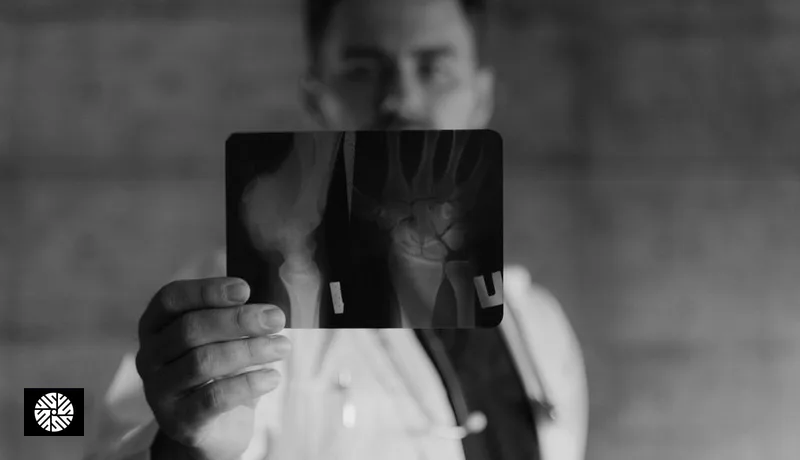
5. Imaging happens the same visit. If the doctor wants an X-ray, you'll usually walk down the hall and get it done within the same appointment — Taiwan doesn't make you book imaging for next week. You'll likely return to the same doctor with the films ready. (More on imaging next.)
6. Pay AFTER at the 批價 (pī jià) cashier, then collect meds at 領藥 (lǐng yào). This is the part that trips up every newcomer: you don't pay before you see the doctor. You see the doctor, do your tests, and only then take your paperwork to the 批價 (billing/cashier) window, where the self-pay total is calculated and you settle up. If you were prescribed anything — painkillers, anti-inflammatories — you collect it at the 領藥 (dispensing pharmacy) window, usually right next to the cashier. Keep every itemized receipt; your travel insurer will want them, and Taiwanese receipts are detailed and reimbursement-friendly.
X-rays, MRIs, and what self-pay imaging actually involves
Imaging is where orthopedics gets real, and the access here is genuinely good. A plain X-ray — the workhorse for ruling out a fracture — is done on-site at most hospitals and many larger clinics, same visit, films back in minutes. For a suspected break, expect at least one.
An MRI (for ligaments, cartilage, a suspected ACL tear, or a stubborn back) is a bigger deal everywhere in the world, Taiwan included. It's available at hospitals rather than small clinics, sometimes same-day and sometimes scheduled, and it costs substantially more out of pocket than an X-ray. Ultrasound is also widely used for soft-tissue and tendon problems and is cheaper and quicker than MRI.
Here's the honest part on cost: imaging prices vary by facility, body part, and whether contrast is used, so rather than quote you a number I can't stand behind, ask for a self-pay estimate (自費估價) at the 掛號 counter or before the scan. Taiwanese hospitals are completely used to this question and will tell you upfront. As a general frame, a self-pay specialist outpatient visit for a foreigner — registration plus consultation, before imaging — typically lands somewhere around NT$1,500 to NT$5,000 (roughly US$45 to US$155) depending on the hospital's tier; a simple sprain check sits at the lower end, while imaging is added on top. These are approximate — always confirm on site. Note that some international medical centers charge foreign self-pay patients a premium over the standard local self-pay rate, so the international desk and the regular outpatient queue can price differently for the same scan.
Casts, crutches, braces, and rehab
If something's broken or badly sprained, the clinic handles the next steps right there. Casting and splinting are done on-site — a confirmed fracture gets cast or splinted in the same building, no separate appointment. For sprains and lower-grade injuries you'll often get a brace, support, or elastic bandage instead, sometimes dispensed at the clinic and sometimes pointed to a nearby medical-supply shop (醫療器材行).
Crutches and walking aids are easy to get — pharmacies and medical-supply stores stock them, and the clinic will tell you where the nearest one is. They're inexpensive to buy outright, which is usually simpler than a rental for a short trip.
Physiotherapy and rehab (復健科, fù jiàn kē) is its own department in Taiwan and it's excellent — heat, ultrasound therapy, electrical stimulation, and guided exercises. For a traveler, a full rehab course rarely fits a short trip, but you can absolutely get an initial session and, more usefully, a printed home-exercise plan and a clear timeline to take back to your own physio at home. Ask the orthopedist to write down the diagnosis in English if they can — it makes the handoff to your doctor back home painless.
One thing that catches people out: Taiwanese pharmacies will not fill a prescription written by a doctor in another country. If you take regular medication, you can't just present a foreign script. A local doctor has to assess you and prescribe here. So if your injury needs ongoing painkillers or anti-inflammatories, get them prescribed during your Taiwan visit — don't assume you can top up a home prescription at a counter.
The scooter reality — and basic first aid before you go anywhere
Let's be straight about the scooter, because it's the single biggest source of orthopedic trouble for visitors. Motorcycles and scooters account for the majority of Taiwan's road-traffic injuries and deaths — by official accounting, well over half — and the patterns that hurt people are predictable: wet roads, gravel, night riding, no helmet, drinking, and unfamiliarity with how Taiwanese traffic actually flows. You can dramatically cut your risk by doing the boring things: wear a proper helmet (it's the law and it's the difference between a headache and a head injury), skip the scooter in heavy rain, never ride after drinking, and give yourself a slow first day to learn the rhythm of the two-wheeler swarm before you trust it.
If you do go down, basic first aid buys time and reduces damage. For a sprain or soft-tissue injury, the standard is RICE — Rest, Ice, Compression, Elevation, recommended by orthopedic authorities worldwide:
- Rest the injury — stop using it, don't "walk it off," don't get back on the bike.
- Ice for about 20 minutes at a time, several times in the first day or two — wrapped in a cloth, never directly on skin.
- Compression with an elastic bandage to limit swelling and support the joint.
- Elevation — keep the injured limb raised above heart level as much as you can for the first 48 hours.
For road rash, rinse the wound with clean water, cover it, and keep it clean — Taiwan's heat and humidity make minor skin wounds prone to infection, so don't leave grazes open and grimy. And the bright line worth repeating: if you genuinely can't put weight on it, or the limb looks deformed, RICE is not the plan — get to the ER.
Common scenarios on your trip
"I dropped the scooter and my ankle is swelling." Do not diagnose a sprain from weight-bearing alone. Seek clinical assessment; urgency depends on deformity, severe pain, inability to bear weight, numbness, color or temperature change, open injury, head or neck injury, and the overall crash. A clinician decides whether X-ray or other imaging is needed.
"I came off harder — I think my wrist is broken." Can't move it, rapid swelling, obvious deformity? That's an ER trip for an X-ray and likely a cast. Splint it as best you can, don't eat or drink in case anything needs setting, and head to 急診. Follow up at a 骨科 clinic a couple of days later for the cast check.
"I hit my head when I fell, even with a helmet." Any head impact with confusion, a headache that worsens, vomiting, or a blackout is an emergency — call 119 or go straight to the ER. The orthopedic stuff waits; the head comes first.
"My old running knee flared up on a hike." No emergency here. Book or walk into an orthopedic or sports-medicine outpatient clinic; you'll get an exam, possibly an ultrasound or MRI, and a rehab plan you can continue at home.
"My lower back seized up after a long bus day." Mechanical back pain without leg numbness or loss of bladder control is a routine 骨科 or 復健科 visit. But back pain with numbness down a leg, weakness, or loss of bladder/bowel control is a red flag — go to the ER.
Whichever scenario you land in, the mechanics are the same ones you now know: register at 掛號, take a number, see the doctor, get imaged, pay at 批價, collect meds at 領藥. For the broader picture of how Taiwan's whole system fits together, start with our complete guide to seeing a doctor in Taiwan, which spells out the generic flow screen by screen. Heal up, ride carefully, and enjoy the island on two wheels — just with the helmet on.
Sources & Further Reading
- National Health Insurance Administration (Taiwan) — official NHI information
- American Institute in Taiwan — list of physicians, hospitals & medical providers
- OrthoInfo (American Academy of Orthopaedic Surgeons) — sprains, strains & RICE
- OrthoInfo (AAOS) — sprained ankle: when to see a doctor
- New Dawn Health — The Emergency Room in Taiwan: A Guide for Foreigners
- New Dawn Health — How to See a Doctor in Taiwan: The Complete Guide for Foreigners
- New Dawn Health — Taiwan's Hospital Tiers: From Clinics to Medical Centers
This article is general information for travelers, not medical advice. Prices are approximate and change; confirm with the facility and your insurer. For a serious injury, head trauma, or inability to bear weight, seek emergency care — call 119.
US / UK terms and the closest Taiwan context
Read this first: These are comparison aids, not claims that coverage, credentials, or care pathways are equivalent. Europe is not one health system; UK examples below refer specifically to NHS England.
PCP / primary care provider; GP / general practitioner
- What it means there
- In the US, a primary care provider may provide prevention, common-illness care, and care coordination. In NHS England, a registered GP commonly coordinates access to non-emergency specialist care.
- Closest Taiwan context
- The closest starting point is a community clinic or family medicine department (基層診所/家庭醫學科).
- Do not treat as equivalent
- Taiwan does not use one universal PCP or GP gatekeeping model. NHI promotes community-first, tiered care, but its referral policy does not make a referral a universal prerequisite to every hospital visit.
- What to ask
- Ask whether this visit is the right first contact, whether direct specialist registration is accepted, and whether a referral changes the appointment or NHI copayment.
Referral
- What it means there
- A US plan, especially an HMO, may require a PCP referral for coverage. In NHS England, specialist hospital care is generally accessed through a GP referral.
- Closest Taiwan context
- Taiwan uses a referral form and two-way referral process (轉診/雙向轉診) when clinical needs call for another facility or level of care.
- Do not treat as equivalent
- A US insurance referral, an NHS clinical access route, and a Taiwan NHI referral do not create the same rights or payment result. Taiwan NHI says referral need not proceed one hospital level at a time and does not universally prohibit direct hospital visits.
- What to ask
- Ask who issues the referral, its validity period, the named facility and department, whether registration is arranged, and what happens to the copayment.