
Orthodontic treatment is one of the longest commitments in dentistry. Unlike a single-visit crown or whitening session, straightening teeth with clear aligners or braces takes months — sometimes years — and traditionally requires regular check-ins every four to eight weeks. That logistical reality has long made orthodontics seem like the last category an international patient would consider doing abroad. Yet Taiwan has quietly become one of the most practical destinations in Asia for adult Invisalign and clear aligner treatment, precisely because the local clinical infrastructure has adapted to a model where patients aren't physically present every month.
This guide walks through the realistic logistics of starting orthodontic treatment in Taiwan as an international patient: the brand landscape, the difference between Invisalign Comprehensive, Lite, and Express tiers, what traditional braces still offer, the standard three-trip workflow, how aligner shipments work between visits, pricing across treatment tiers, and the often-skipped reality of refinement protocols and lifetime retainer wear. The aim is not a sales pitch but a working blueprint for travelers who want to understand what they're actually committing to.
Clear aligners explained — Invisalign vs alternatives
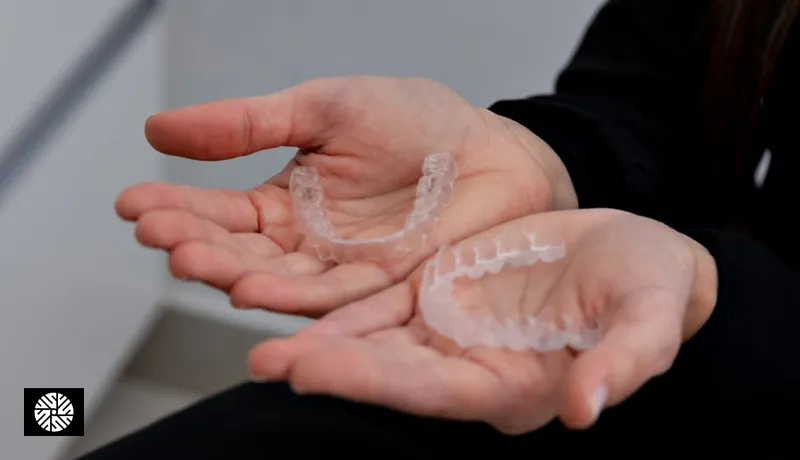
Invisalign, made by Align Technology in the United States, is the global market leader in clear aligner therapy and the brand most international patients arrive in Taiwan asking about. Its strengths are well-known: a mature digital treatment-planning platform (ClinCheck), proprietary SmartTrack material that holds shape better than commodity thermoplastics, and a deep clinical evidence base built over more than two decades. For complex cases involving rotations, extractions, or significant bite correction, Invisalign remains the default for most experienced orthodontists in Taiwan.
It is not the only option, however. SmartSee and other regional brands have grown quickly in Taiwan and offer aligners at meaningfully lower price points, particularly for mild-to-moderate cases. ClearCorrect, also a US brand and now owned by Straumann, is offered by some clinics as a mid-tier alternative. Korean clear aligner systems show up in a handful of practices, often at the lowest end of the price range. The trade-off is generally clinical — fewer auxiliary tools (attachments, elastics, IPR planning), shorter brand track records on complex movements, and less robust software for treatment simulation.
For most international patients, the question is not "Invisalign or nothing." It's whether your case is straightforward enough that a less expensive aligner system can deliver the same outcome, or complex enough that the Invisalign ecosystem's depth is genuinely worth paying for. A good orthodontist will tell you honestly which side of that line you fall on.
Treatment tiers — Comprehensive / Lite / Express
Within the Invisalign system itself, the choice of tier is often more impactful than most patients realize. Align Technology packages Invisalign into product tiers based on the number of aligner stages and the complexity of movements supported, and Taiwan-based providers price each tier separately.
Invisalign Comprehensive is the unlimited tier — your provider can use as many aligner stages as needed, and refinement rounds are typically included for the first several years. This is the right choice for moderate-to-complex cases involving crowding, spacing, rotations, or bite correction, and it's where most adult patients with meaningful alignment goals end up. Treatment time runs roughly 12 to 18 months for typical adult cases.
Invisalign Lite covers up to 14 aligner stages, suitable for mild crowding, minor spacing, or pre-restorative alignment before veneers or crowns. Treatment usually finishes in six to nine months. Many patients who think they need Comprehensive actually qualify for Lite once an experienced clinician reviews their scan.
Invisalign Express is the entry tier with up to seven aligner stages, intended for very minor adjustments — small relapses after previous orthodontic treatment, or fine cosmetic alignment of the front teeth only. Treatment is fast (three to six months) and inexpensive, but the scope is genuinely limited. Express is not a discount path to a full smile transformation.
| Tier | Aligner stages | Treatment time | Taiwan price | Best for |
|---|---|---|---|---|
| Comprehensive | Unlimited | 12-18 months | NT$120,000-200,000 (USD 3,800-6,400) | Moderate-to-complex cases |
| Lite | Up to 14 | 6-9 months | NT$80,000-130,000 (USD 2,500-4,200) | Mild crowding, pre-restorative alignment |
| Express | Up to 7 | 3-6 months | NT$50,000-80,000 (USD 1,600-2,500) | Minor cosmetic adjustments, post-relapse |
Traditional braces — ceramic, lingual, self-ligating
Clear aligners get most of the attention, but fixed braces are still the right tool for a meaningful share of cases — particularly those involving significant skeletal corrections, severe rotations, or patients who simply won't reliably wear aligners 22 hours a day. Taiwan's orthodontic market still offers all the major fixed-appliance options at competitive prices.
Ceramic brackets are tooth-colored and far less visible than traditional metal, making them a popular middle ground for patients who want a more discreet look without the cost of clear aligners. They typically run NT$60,000 to NT$100,000 (USD 1,900-3,200) for a full course. Lingual braces — bonded to the back of the teeth, completely invisible from the front — are the premium fixed option and the most technically demanding for the orthodontist. Pricing in Taiwan is usually NT$150,000 to NT$220,000. Self-ligating brackets (Damon, Empower, and similar systems) use a sliding clip rather than elastic ties, which can shorten treatment time and reduce the number of adjustment visits — useful for international patients trying to minimize trip count.
Traditional braces typically take 18 to 24 months for adult cases, with adjustment visits every four to six weeks. That cadence makes them a harder fit for international patients than aligners — but for the right case, the trade-off is worth it, particularly when self-ligating systems can stretch adjustment intervals out to eight or even ten weeks.
Multi-trip workflow for international patients
A full course of Invisalign treatment for an international patient is typically structured around three trips to Taiwan, spaced over 12 to 18 months. The exact schedule flexes based on case complexity and how well the aligners track to the planned tooth movement, but the standard protocol looks like this.
Trip 1 — consultation, records, and initial fitting (1-2 weeks): Your first visit covers the diagnostic workup — CBCT cone-beam imaging, intraoral 3D scanning (typically with an iTero or Trios scanner), photographs, and a full clinical examination. Your orthodontist designs the treatment plan in ClinCheck or the equivalent software, walks you through the predicted tooth movements, and orders your first batch of aligners. Once the aligners arrive (usually 7-10 days after the scan), you return for fitting, attachment placement (small tooth-colored bumps that help the aligners grip), and detailed instructions on wear schedule, cleaning, and changeovers.
Aligner shipments — every 6-8 weeks: Between trips, your clinic ships subsequent aligner batches to your home address. You change to a new aligner every 7-14 days at home, following the schedule your orthodontist sets.
Trip 2 — mid-treatment refinement (1 week): Roughly six to nine months in, you return for a progress check, fresh intraoral scan, and refinement planning. This is where the orthodontist verifies the teeth are tracking the predicted movement and orders any corrective aligners needed. Around 80-90% of cases need at least one refinement round, so plan for this trip rather than treating it as a contingency.
Trip 3 — completion and retainers (3-5 days): At 12-18 months, you return for the final aligner stage, attachment removal, polish, and retainer fabrication. Both clear plastic retainers (for nighttime wear) and, often, a thin bonded wire on the inside of the front teeth (for permanent stabilization of those high-relapse-risk teeth) are placed during this visit.
| Trip | Timing | Duration | What happens |
|---|---|---|---|
| Trip 1 | Month 0 | 1-2 weeks | CBCT + intraoral scan, treatment plan, attachments, first aligners fitted |
| Between trips | Months 1-9 | Continuous | Aligner shipments every 6-8 weeks; weekly aligner changes at home |
| Trip 2 | Month 6-9 | 1 week | Progress check, refinement scan, additional aligners ordered |
| Trip 3 | Month 12-18 | 3-5 days | Attachment removal, polish, retainers fabricated and fitted |
Aligner shipment logistics — between trips
The mechanics of shipping aligners across borders are straightforward but worth understanding before you commit. Most Taiwan clinics ship in batches of three to five aligner pairs at a time, every six to eight weeks, via international courier (DHL, FedEx, or EMS). Each shipment is timed so a new batch arrives roughly two weeks before you'd run out, providing a buffer against customs delays.
Customs treatment varies by country. In the US, EU, and most of Southeast Asia, custom-fabricated medical devices for personal use clear easily. In a few jurisdictions, you may need a copy of your prescription or a customs declaration the clinic can provide. Shipping cost is sometimes built into your treatment fee and sometimes billed per shipment — clarify this before you sign.
If you change addresses during treatment (move cities or countries), give your clinic at least three weeks of lead time before the next shipment. Lost or damaged shipments are inconvenient but recoverable: clinics can usually re-ship from their stock or order a replacement batch within 7-10 days, though you may be without an aligner for a week, which is brief enough not to compromise treatment.
Taiwan pricing across treatment tiers
Final pricing varies by clinic prestige, orthodontist seniority, and case complexity, but the ranges are reasonably stable across reputable Taipei and Taichung practices. Our regional cost comparison covers this in more detail, but for orthodontics specifically:
- Invisalign Comprehensive: NT$120,000-200,000 (USD 3,800-6,400)
- Invisalign Lite: NT$80,000-130,000 (USD 2,500-4,200)
- Invisalign Express: NT$50,000-80,000 (USD 1,600-2,500)
- Ceramic braces (full course): NT$60,000-100,000 (USD 1,900-3,200)
- Lingual braces: NT$150,000-220,000 (USD 4,800-7,000)
- Self-ligating metal brackets: NT$70,000-110,000 (USD 2,200-3,500)
These quotes typically include the diagnostic workup, attachments, all aligners or wire changes, and a basic set of retainers. Refinement rounds are usually included in Comprehensive but billed separately for Lite and Express. CBCT imaging is sometimes a separate line item (NT$3,000-5,000). Always ask for a written treatment plan with the total fee broken down before paying any deposit.
Vs USA / Korea pricing
The headline savings on Taiwan orthodontics are substantial but smaller in percentage terms than implants or veneers, because aligner manufacturing costs (paid to Align Technology in dollars) are roughly the same worldwide. The clinical labor — consultations, scans, in-clinic fittings — is where Taiwan saves you money.
In the United States, Invisalign Comprehensive typically runs USD 4,500-9,000, with the higher end common in major coastal cities. Traditional braces run USD 3,000-6,000. South Korea is broadly similar to Taiwan or slightly cheaper, with Invisalign Comprehensive often quoted in the USD 3,500-6,000 range. Japan tends to be more expensive than Taiwan, particularly in central Tokyo. Thailand and Vietnam are cheaper still, but the experience and certification depth of Invisalign-credentialed providers in Taiwan is meaningfully higher than most Southeast Asian markets.
The total cost of treatment for a US patient choosing Taiwan should include flights, accommodation across three trips (figure 4-6 weeks of total stay), and incidentals — usually USD 4,000-6,000 added to the clinical fee. For Comprehensive cases, that math still leaves substantial savings; for Express cases, the breakeven is closer and may not justify the trip count unless you're already coming for other treatments.
Refinement protocols — 80-90% need one round
One of the under-discussed realities of clear aligner treatment is that the predicted treatment plan you see in ClinCheck at trip one is almost never the path your teeth actually follow exactly. Tooth movement is biological, and 80-90% of cases need at least one refinement round — a fresh scan and a new sequence of aligners to bring the teeth the rest of the way to the planned end position.
This is not a sign of treatment failure. It is the standard protocol, and Invisalign Comprehensive pricing builds it in. What matters is that international patients plan for it. Trip 2 in the workflow above is specifically structured around the refinement scan, not as a contingency you might skip if "everything looks fine." Even if your teeth are tracking well, the refinement scan provides the data your orthodontist needs to fine-tune the final stages and ensure long-term stability.
In rare cases (typically very complex or previously-treated cases), a second refinement round may be needed, requiring a fourth trip. This is uncommon but not pathological — discuss it as a possibility with your orthodontist before starting, so the budget and travel calendar account for it.
Combining with veneers / implants / whitening
Orthodontics is increasingly the foundation of broader smile makeover treatment, particularly for patients in their 30s and 40s. The general sequencing rule is that orthodontics comes first: aligning the teeth into their target position before any restorative or cosmetic work locks in shapes that wouldn't otherwise fit.
Veneers and crowns are commonly added 4-6 weeks after orthodontic completion, once the teeth have stabilized in their new position. Our veneers and crowns guide covers the specifics. Aligning first means the veneers can be designed for ideal proportions rather than to mask misalignment, which usually produces better aesthetic outcomes and longer-lasting restorations.
Whitening is best timed at the end of orthodontic treatment, ideally just before retainer fitting. Aligners themselves create a slightly drier oral environment that can make whitening trays unnecessary — some orthodontists offer whitening gel that goes inside the final aligner stages.
Implants are the inverse case: the implant position needs to be planned before orthodontics if there's a missing tooth involved, because the orthodontist needs to either close the gap entirely or open it to a precise width that the implant will eventually fill. This requires coordination between the orthodontist and the surgical team from day one. Patients with planned implant work should bring this up at the initial consultation.
Retainer lifetime wear and maintenance
The single most important thing nobody mentions until treatment is almost over: retainers are forever. Teeth have a strong tendency to relapse toward their original positions, particularly in the first one to two years after treatment, but the relapse risk never fully disappears. The current orthodontic standard of care is lifetime nighttime retainer wear — typically 7-9 hours per night, indefinitely.
Most patients in Taiwan receive two types of retainers at the end of treatment: clear plastic Vivera or Essix retainers (worn nightly) and a thin bonded wire on the back of the lower front teeth (permanent, replaced every 5-10 years if it breaks). The clear retainers are typically replaced every two to three years as the plastic wears down — your orthodontist or a coordinating dentist at home can scan and order replacements.
Practical compliance reality: the patients who maintain their results 10 years out are the ones who treat the retainer like a contact lens, not like a temporary phase. Skipping retainers for a few weeks usually results in noticeable relapse that requires another aligner round to correct — at which point you've wasted both your original treatment investment and your time. Build the retainer into your nightly routine from the first night.
How to find the right orthodontist
For international patients, the right provider combines clinical credentials (board-certified orthodontist, Invisalign Diamond or Platinum tier indicating high case volume) with practical experience managing remote patients. Ask specifically: how many international patients have you treated in the past year? What's your protocol for shipping aligners to my country? How do you handle a missed scheduled change or a lost aligner? A clinic that has answered these questions before will respond clearly and quickly. Browse Taiwan-based orthodontists and clinics on our platform, or start with our services overview to see how orthodontics fits with broader treatment planning.
For broader context on why Taiwan's dental market has become a meaningful destination for international care, see our dental cost comparison for Taiwan, the US, Japan and Korea.
Sources & Further Reading
- American Dental Association (ADA)
- FDI World Dental Federation
- Straumann Group — implant systems
- Nobel Biocare — implant systems
- Invisalign — clear aligners
- USPSTF — U.S. Preventive Services Task Force recommendations
Frequently asked
How many trips to Taiwan does a full Invisalign course require?
The standard workflow is three trips over 12-18 months. Trip 1 (1-2 weeks) covers consultation, CBCT and intraoral scanning, treatment planning, and initial aligner fitting. Trip 2 (1 week, around month 6-9) is the mid-treatment refinement scan. Trip 3 (3-5 days, around month 12-18) covers final aligner removal, attachment polishing, and retainer fitting. In rare complex cases, a fourth trip for a second refinement round may be needed, but this is uncommon.
Can I coordinate with my dentist at home between Taiwan trips?
Yes, and many international patients do. Your Taiwan orthodontist remains the primary clinician supervising the treatment plan, but a local dentist can handle issues like a broken attachment, an aligner check during a routine cleaning, or replacement retainer scans years after treatment. Provide your local dentist with the treatment plan summary so they understand the goals. For ongoing aligner progression questions, photo-based remote monitoring through your Taiwan clinic is usually faster than coordinating between two providers.
Is lifetime nighttime retainer wear really required?
Yes. Teeth have a permanent tendency to drift back toward their original positions, and the relapse risk never fully disappears. The current orthodontic standard is 7-9 hours of nightly retainer wear indefinitely. Most patients receive both clear plastic retainers for nighttime use and a thin bonded wire behind the lower front teeth for permanent stabilization. Patients who skip retainers for even a few weeks often see noticeable relapse that requires another aligner round to correct.
What is the difference between adult and teen Invisalign?
Invisalign Teen (for ages 11-16) includes features like compliance indicators (small blue dots that fade with wear time so parents and orthodontists can verify the aligner is being worn the required 22 hours daily) and eruption tabs to accommodate teeth that are still emerging. Treatment timing for teens is also coordinated with growth and remaining tooth eruption, which can extend or shorten treatment compared to a similar adult case. For international families, teen Invisalign in Taiwan follows the same multi-trip workflow but typically requires more frequent monitoring, so check-in apps and photo updates are particularly important.
Can I combine Invisalign with veneers in the same treatment year?
Yes, and this is increasingly common for adult patients seeking a full smile makeover. The standard sequence is orthodontics first, with veneers placed 4-6 weeks after orthodontic completion once the teeth have stabilized in their new position. Aligning the teeth before veneer design means the veneers can be made for ideal proportions rather than to mask misalignment, which produces better long-term aesthetics. Plan for veneers to be coordinated with Trip 3 or a fourth dedicated trip after retainers are placed.
What happens if my treatment slips off-schedule?
Most off-schedule situations are recoverable. If you lose an aligner, your clinic can usually ship a replacement within 7-10 days; in the meantime, wear the previous aligner to hold the position. If teeth are not tracking the predicted movement (a small percentage of cases), the orthodontist will pause progression at the current aligner stage and order a refinement scan earlier than planned, which may require an extra trip. If you skip wear-time and aligners stop fitting, the fix is a fresh scan and refinement aligners. The key in all cases is to contact your clinic immediately rather than skipping ahead and hoping to catch up.
How does Taiwan pricing actually compare to the US?
Invisalign Comprehensive in Taiwan is NT$120,000-200,000 (USD 3,800-6,400), versus USD 4,500-9,000 in the US. Traditional ceramic braces are NT$60,000-100,000 (USD 1,900-3,200) in Taiwan versus USD 3,000-6,000 in the US. After adding flights, accommodation across three trips (4-6 weeks total stay), and incidentals (typically USD 4,000-6,000), the total still represents meaningful savings for Comprehensive cases. For Express tier, the breakeven is much closer and the trip math may not justify going abroad unless you are already coming for other treatments like veneers or implants.