Blog
Blog
Veneers and Crowns in Taiwan: A Complete Guide for Medical Travelers

Veneers and crowns are two of the most requested treatments in Taiwan's dental tourism market — and the two most likely to be misunderstood by patients before they book a flight. Veneers are thin shells bonded to the front of healthy teeth for cosmetic improvement. Crowns are full-coverage restorations that rebuild a damaged or root-canal-treated tooth. Both rely on the same modern materials (lithium disilicate, zirconia) and the same digital workflow (intraoral scanning, CAD/CAM design), but they solve very different problems and carry very different risks.
This guide is the long-form companion to our overview of what's driving dental tourism in Taiwan. We will go deep on materials, the prep-versus-no-prep tradeoff, realistic timing for travelers, Taiwan pricing, and a global cost comparison against the US, Mexico, and Hungary. The goal is to give you enough clinical context to ask better questions during your consultation — not to push you toward any particular outcome.
Veneer materials — porcelain, zirconia, composite, Lumineers
Material choice is the single biggest decision in a veneer case, and it is the one most patients defer to the dentist without understanding the tradeoffs. Each material delivers a different combination of aesthetics, strength, longevity, and price.
Porcelain veneers (lithium disilicate / e.max) are the premium standard for cosmetic cases. Lithium disilicate — sold under the brand name e.max — gives veneers their natural translucency, the way light passes through the edge of the restoration the way it would through a real tooth. With proper care, e.max veneers last 10 to 15 years, and many patients keep them functional well past that. They are the default choice for the front six to ten teeth where appearance matters most.
Zirconia veneers are stronger than e.max but less translucent. Zirconia was originally a crown material, valued for resisting fracture under heavy chewing forces. Newer multilayer zirconia formulations have closed the aesthetic gap, but it is still the better choice for grinders, clenchers, or patients with a history of cracking ceramic restorations. If you wear a night guard already or your dentist has flagged bruxism, raise zirconia as an option.
Composite veneers are built up tooth-by-tooth from resin during a single visit. They are the cheapest option and can be done in one or two days, which is attractive for short trips. The tradeoff is durability — composite typically lasts 5 to 7 years, picks up stain over time, and chips more easily than ceramic. They are a reasonable choice for younger patients who want to upgrade their smile now and may revisit the decision in a decade.
Lumineers and other no-prep ultra-thin veneers are about 0.3mm thick — roughly the thickness of a contact lens. Because they are so thin, they can be bonded over the existing tooth without removing enamel. The compromise is aesthetic depth: you cannot mask a darkly stained or crooked underlying tooth as effectively as with a traditional 0.5mm to 0.7mm veneer, and the result can look slightly bulky if the tooth is not first reduced. Good candidates for Lumineers have already-light, well-aligned teeth and want a subtle improvement.
| Material | Aesthetics | Strength | Lifespan | Best For |
|---|---|---|---|---|
| e.max (lithium disilicate) | Excellent — natural translucency | Good | 10-15 years | Front teeth, cosmetic cases |
| Zirconia (multilayer) | Good — less translucent | Excellent | 12-20 years | Grinders, clenchers, back teeth |
| Composite | Fair — picks up stain | Fair | 5-7 years | Budget cases, short trips |
| Lumineers (no-prep) | Limited depth | Good | 10-15 years | Subtle changes, enamel preservation |
Prep vs no-prep — irreversibility tradeoff
Traditional porcelain veneers require removing 0.5mm to 0.7mm of enamel from the front of each tooth so the veneer sits flush and looks natural. That enamel does not grow back. Once a tooth has been prepped, it is essentially committed to having some kind of restoration on it for life — if the veneer ever comes off and is not replaced, the underlying tooth surface is rougher, more porous, and more sensitive than it was.
This is the most important conversation to have before you sit in the chair. A skilled dentist will frame it honestly: prepping gives more aesthetic flexibility, more reliable bonding, and a better long-term outcome for most cosmetic cases, but it is a one-way door. No-prep options preserve your enamel, which keeps a future "I want to remove these" option open, but they limit how much the dentist can correct color, shape, or alignment.
Hybrid prep — sometimes called minimal-prep — sits between the two. The dentist removes only 0.2mm to 0.3mm, just enough to refine the contour of the tooth without breaching the full thickness of enamel. For many patients with healthy teeth and modest cosmetic goals, this is the most clinically sensible middle ground.
If a clinic pushes you toward full-prep veneers without explaining the alternatives, treat that as a yellow flag. Likewise, a clinic that promises no-prep veneers for a case that clearly needs preparation (severely stained, rotated, or crowded teeth) is overselling the technique.
Crowns — PFM vs zirconia vs e.max
Crowns enter the conversation when a tooth is too damaged for a simple filling or veneer. The most common indications are: after a root canal (the tooth is now hollow and brittle), after a fracture, when a filling has grown so large there is little tooth left to support it, or to anchor a bridge.
Porcelain-fused-to-metal (PFM) crowns have been the workhorse for decades. A metal substructure provides strength; a porcelain layer provides aesthetics. They are durable and well-understood, but the metal margin can show as a dark line at the gum if the gum recedes over time, and they are heavier and less translucent than all-ceramic options. Most premium clinics in Taiwan now reserve PFM for back molars or budget-constrained cases.
Zirconia crowns have become the dominant choice from 2020 to 2026. Monolithic zirconia (carved from a single block) handles chewing forces extremely well, has no metal margin, and is biocompatible. For molars and premolars, zirconia is the default recommendation at most modern Taiwan clinics. Multilayer zirconia formulations are also acceptable on anterior teeth for patients who want maximum durability.
e.max crowns are the aesthetic choice for visible teeth. The same lithium disilicate that makes great veneers also makes great front-tooth crowns — the translucency lets the crown blend naturally with adjacent teeth. e.max is slightly less strong than zirconia, so it is rarely placed on molars in patients with heavy bite forces.
If you are getting a crown after a root canal on a front tooth, expect e.max. On a back molar, expect zirconia. If a clinic recommends PFM for a visible front tooth in 2026, ask why — there may be a structural reason, but the default should be all-ceramic.
Process timing for travelers — 5-7 days for veneers, 3-5 for single crown
The single biggest planning mistake medical travelers make is underestimating how long ceramic restorations take. Unlike implant surgery, where the slow part is bone healing over months, veneer and crown timing is dictated by lab fabrication and try-in. You cannot compress it past a certain point without sacrificing fit or aesthetics.
A typical full-mouth veneer case (10 to 12 anterior teeth) runs like this:
- Day 1: Consultation, photographs, intraoral scan, smile design preview, treatment planning. You and the dentist agree on shape, length, and shade.
- Day 2: Tooth preparation under local anesthesia. Temporary veneers are placed so you leave the clinic with a workable smile.
- Days 3-6: Lab fabrication. Premium clinics with in-house labs may overlap this with your sightseeing.
- Day 7-8: Try-in of the final veneers. Adjustments to fit, contact, and color. Often this is split across two visits.
- Day 9-10: Final cementation, bite check, polish, photographs.
For a single crown on a back tooth at a clinic with same-day CEREC milling, the timeline collapses to 3 to 5 days: prep on day 1, mill and cement on day 3 or 4, with a follow-up bite check before you fly home. A small-volume case (one to three veneers, or two to three crowns) typically fits in 5 to 7 days.
What you cannot do reliably: fly in on Friday night and walk out with finished porcelain on Monday morning. Even the best digital workflows need time for try-in, adjustment, and verification.
Taiwan pricing — single tooth + full-mouth
Taiwan pricing varies by clinic tier, lab source, and whether the work is done with imported premium blocks (e.g., Ivoclar e.max, 3M Lava zirconia) versus generic alternatives. Here are the realistic 2026 ranges at reputable clinics:
- Single porcelain (e.max) veneer: NT$25,000-50,000 (USD 800-1,600)
- Single zirconia veneer: NT$22,000-40,000 (USD 700-1,280)
- Single composite veneer: NT$8,000-15,000 (USD 260-480)
- Single zirconia crown: NT$18,000-35,000 (USD 580-1,120)
- Single e.max crown: NT$25,000-45,000 (USD 800-1,440)
- Single PFM crown: NT$12,000-22,000 (USD 380-700)
- Full-mouth veneers (10-12 anterior teeth): NT$300,000-600,000 (USD 9,600-19,000)
The wide range reflects real differences in clinic positioning. A boutique clinic in Taipei with an in-house master ceramist will be at the top of the range. A high-volume clinic with an external lab will sit lower. Quality is not perfectly correlated with price — some mid-priced clinics deliver excellent work, and some premium clinics are charging for the address — but the floor of acceptable quality has a price below which you should ask hard questions.
Vs USA / Mexico / Hungary pricing
Taiwan's price advantage is most dramatic against the US and Western Europe, and narrower against other dental tourism destinations like Mexico and Hungary.
| Procedure | Taiwan (USD) | USA (USD) | Mexico (USD) | Hungary (USD) |
|---|---|---|---|---|
| Porcelain veneer (per tooth) | $800-$1,600 | $1,000-$2,500 | $400-$800 | $500-$900 |
| Zirconia crown (per tooth) | $580-$1,120 | $1,200-$2,500 | $350-$700 | $450-$800 |
| e.max crown (per tooth) | $800-$1,440 | $1,400-$2,800 | $450-$850 | $550-$950 |
| Full-mouth veneers (10-12) | $9,600-$19,000 | $15,000-$30,000 | $4,000-$8,000 | $5,500-$10,000 |
Mexico is cheaper, but quality is more variable, and revision work after a complication is harder to coordinate than in Taiwan, where many clinics actively support international patients with follow-up. Hungary is a strong European option but adds a long flight and a different language barrier for non-Europeans. Taiwan's positioning is mid-priced for the region, with high consistency, English-fluent staff at international clinics, and a regulatory environment closer to the US than to most lower-cost destinations.
Digital workflow — intraoral scan, CAD/CAM, in-house milling
One of the genuine reasons Taiwan can deliver Western-standard dental work at lower prices is that the digital workflow has been broadly adopted. Most international-facing clinics use 3Shape TRIOS or iTero intraoral scanners, which capture a 3D model of your teeth in three to five minutes — no goopy impressions, no gag reflex.
The scan feeds into CAD software, where the dentist or a trained technician designs each restoration. The design then goes to a milling unit (CEREC, Roland, or industrial five-axis mills for larger labs) that carves the restoration from a ceramic block. For a single crown at a CEREC-equipped clinic, this is a same-day procedure — scan in the morning, mill at lunchtime, cement in the afternoon.
For more complex cases — full-mouth veneers, multi-unit bridges, or cases requiring custom layered porcelain — the design typically goes to a dedicated lab where a master ceramist hand-finishes the restorations. This is where premium pricing pays off: human craftsmanship on the final layering produces the kind of natural translucency that machine-finished restorations cannot match.
For a broader view of how digital dentistry has shifted Taiwan's quality position globally, see our piece on how Taiwan trains and regulates its dentists.
Color matching and aesthetic outcome
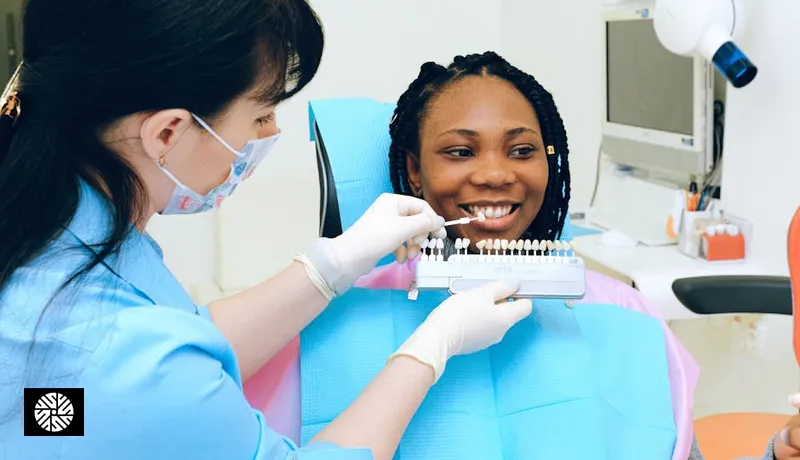
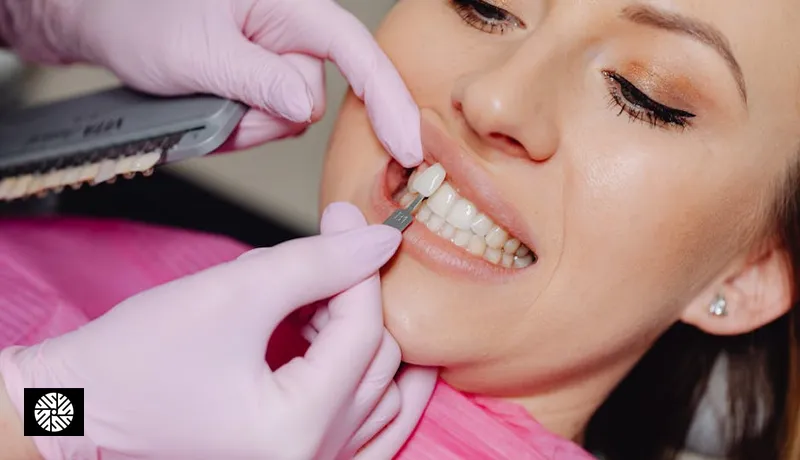
Color matching is where good cosmetic dentistry becomes art. The standard reference is the VITA shade guide, a set of physical tabs covering about 16 standard tooth colors. Your dentist holds the guide next to your existing teeth in natural light to identify a starting shade, then discusses where you want to land — typically one to three shades brighter for cosmetic cases.
Premium clinics go beyond the basic shade guide. They take cross-polarized photographs of your existing teeth, send those photos to the ceramist, and sometimes have you visit the lab in person so the technician can layer porcelain to match the specific translucency, mottling, and edge detail of your real teeth. This is invisible to most patients but it is the difference between veneers that look like dentures and veneers that no one notices you have.
The single most important decision you make on color is "Hollywood ultra-white versus natural." Patients who pick the brightest shade in the guide (often called BL1 or B1) get a dramatic result that photographs well but reads as obviously cosmetic in person. Patients who pick a shade slightly brighter than their natural teeth get a result that looks like they had a really good night's sleep. Most experienced cosmetic dentists in Taiwan will gently steer you toward the second option unless you are explicit about wanting Hollywood white.
For shade-only cases — patients whose teeth are aligned and shaped well but discolored — explore professional whitening first. It is reversible, far cheaper, and may be all you need.
Patient candidacy + risks
Veneers and crowns are not appropriate for every patient or every tooth. The clinical baseline:
- Healthy gums. Active gum disease must be treated before any cosmetic work — a veneer bonded to a tooth with inflamed gums will fail. Expect a periodontal evaluation as part of your consultation.
- No untreated cavities. Decay must be removed and the tooth restored before a veneer can be placed. If a cavity is large, a crown may be more appropriate than a veneer.
- Sufficient enamel. Veneers bond best to enamel, not to dentin. Patients with significant enamel erosion may need crowns instead.
- Realistic expectations. Veneers can dramatically improve color, shape, and minor alignment. They cannot replace orthodontics for severely crowded or rotated teeth.
Known risks to discuss with your dentist:
- Tooth sensitivity post-prep. Common in the first one to four weeks after enamel reduction. Usually resolves with desensitizing toothpaste. Persistent sensitivity warrants a check.
- Marginal failure long-term. The bond at the gum line is the weakest point. Over years, micro-leakage can lead to staining at the margin or, in worse cases, decay under the veneer. Six-month cleanings catch this early.
- Color change of the underlying tooth. If the underlying tooth darkens (due to age, root canal, or trauma), the veneer color stays fixed while the tooth shifts — leading to a visible mismatch over decades.
- Chipping or fracture. Most common in patients who grind, clench, or bite into hard objects. A night guard is mandatory if you grind.
If you also have missing teeth that need replacement before cosmetic work begins, our guide to dental implants in Taiwan covers the prerequisite restorative path.
Maintenance schedule
Veneers and crowns require ongoing care to last their full lifespan. The standard maintenance protocol:
- Six-month cleanings. Non-negotiable. A hygienist removes plaque at the margins where bonding fails first, and the dentist checks for early signs of marginal breakdown.
- Daily flossing. Plaque at the gum line is the primary cause of long-term veneer failure. An electric toothbrush plus floss or a water flosser is the baseline.
- Night guard for grinders. If you grind or clench, wear a custom night guard. Off-the-shelf guards are better than nothing but a custom guard is worth the investment for a full-mouth case.
- Avoid hard biting. No nail-biting, no opening packages with your teeth, no biting ice. These are how chips happen.
- Limit staining drinks if you have composite. Coffee, red wine, and turmeric stain composite. Ceramic veneers and crowns are far more stain-resistant.
For full-mouth cases, your Taiwan clinic will typically offer a six-month and twelve-month follow-up via photo or telehealth. Use it. Many warranty terms require documented follow-up to remain valid.
Ready to plan a consultation? Our services page outlines the dental categories we coordinate, and our providers directory introduces the clinics we work with for veneer and crown cases.
Sources & Further Reading
FAQ
Plan 7 to 10 days for 10 to 12 anterior veneers. The case typically runs: day 1 consultation and smile design, day 2 prep with temporaries, days 3 to 6 lab fabrication, day 7 to 8 try-in and adjustment, day 9 to 10 final cementation and bite check. Compressing past 7 days sacrifices try-in time, which is where aesthetic problems get caught and fixed.
e.max is the default for front teeth because lithium disilicate has natural translucency — light passes through the edge the way it does in real enamel. Zirconia is stronger but historically less translucent, though multilayer zirconia has narrowed the gap. Pick zirconia on front teeth if you grind, clench, or have a history of cracking ceramic. Pick e.max if maximum aesthetics is the priority and your bite is normal.
Lumineers are worth it when your teeth are already light, well-aligned, and you want a subtle improvement without removing enamel. They are not worth it if you have darkly stained, crowded, or rotated teeth — at 0.3mm, they cannot mask the underlying tooth, and the result can look bulky if the tooth is not first reduced. Most experienced cosmetic dentists in Taiwan will recommend hybrid minimal-prep veneers as a middle ground.
Most reputable Taiwan clinics offer a one to five year warranty on bonded ceramic restorations and will repair or replace at no charge if you can return. For minor chips, a local dentist abroad can polish or do a small composite repair. For full debond, you typically need to return to the original clinic for proper re-bonding. This is why we recommend choosing a clinic with documented international patient follow-up policies before you book.
Your dentist starts with the VITA shade guide in natural light to identify your current tooth color, then discusses the target shade. Premium clinics take cross-polarized photographs and send them to the ceramist for layered porcelain matching. For partial cases (e.g., four front veneers), color matching the existing canines and laterals is critical — ask whether the lab does in-person shade verification or relies on photographs alone.
Most experienced cosmetic dentists steer patients toward natural — one to three shades brighter than your existing teeth — unless you are explicit about wanting Hollywood white. Ultra-white shades like BL1 photograph dramatically but read as obviously cosmetic in person. The natural target gives a result that looks like you had a really good night sleep, which most patients describe as the outcome they actually wanted. You can always go brighter on a future case; you cannot easily go more natural without replacing the work.
Six-month professional cleanings are non-negotiable — they catch margin breakdown early. Daily flossing or water flossing is the baseline because plaque at the gum line is the primary cause of long-term failure. Grinders need a custom night guard. Avoid biting nails, opening packages with teeth, or chewing ice. With this protocol, e.max veneers reliably last 10 to 15 years and zirconia crowns 12 to 20 years.