April 23, 2026
Laser skin treatment is one of the most common reasons international patients fly to Taiwan for medical aesthetics. The clinics here run the same flagship platforms used in top dermatology practices in the U.S., Korea, and Japan — Cynosure's Picosure Pro, Lumenis Stellar M22, Lutronic and Mosaic fractional CO2 systems, Cutera Excel V — but at a fraction of the price. The harder question for travelers is not whether to get a laser done in Taiwan, but which laser for which concern, and how to fit recovery into a trip that may only run a week or two.
This guide breaks down the major laser categories used in Taiwan's medical beauty clinics, what each one actually does at the tissue level, when to choose one over another, and how to plan your visit around treatment downtime. We'll also reference clinical perspective from Dr. Andre Zahn, who treats a wide range of pigmentation, scarring, and rejuvenation cases at iHope Clinic — his framing on melasma, Asian skin, and laser selection is woven throughout.
"Laser" is a broad word. The platforms used in skin clinics fall into roughly six families, each defined by wavelength, pulse duration, and how the energy interacts with skin. Understanding the category matters more than memorizing brand names.
| Category | Common Platforms | What It Treats | Recovery |
|---|---|---|---|
| Picosecond | Picosure Pro, PicoWay, Discovery Pico | Pigmentation, melasma, tattoo, brightening | 1-3 days mild redness |
| Q-switched (older) | Q-switch Nd:YAG | Tattoos, deep pigment (use cautiously on melasma) | 3-5 days |
| IPL / pulsed light | Stellar M22, Lumecca, BBL | Sun damage, redness, vascular, photo-aging | 24-48h mild |
| Fractional CO2 (ablative) | Mosaic, Lutronic eCO2, DEKA | Acne scars, deep wrinkles, resurfacing | 7-14 days social downtime |
| Fractional non-ablative | Fraxel Re:store, Erbium | Texture, fine lines, mild scarring | 3-5 days |
| Vascular | Excel V, V-Beam, Pulsed Dye Laser | Rosacea, capillaries, port wine stain | 2-7 days bruising possible |
| Hybrid / combined | Halo by Sciton, Tixel | Tone + texture in one session | 5-7 days |
The simplest mental model: shorter pulses target pigment with less heat (picosecond, Q-switched), broad spectrum addresses redness plus pigment together (IPL), fractional ablative remodels collagen at depth (CO2), and specific wavelengths chase blood vessels (vascular). Choosing the wrong family wastes money and can cause harm — particularly on Asian skin, where the wrong laser triggers post-inflammatory hyperpigmentation (PIH) that takes months to fade.
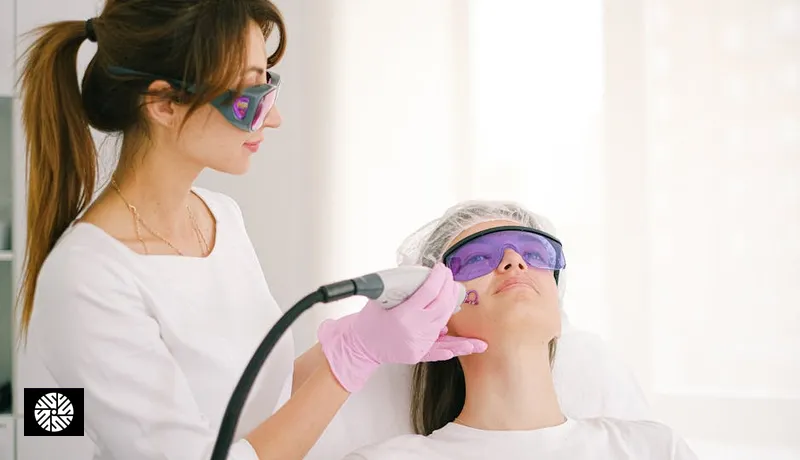
Cynosure's Picosure Pro has become the default first-line laser for pigmentation in Taiwan's top derm clinics, and there's a clinical reason for that. It delivers energy in picosecond pulses (a trillionth of a second) — short enough to shatter pigment particles via photoacoustic effect rather than photothermal heating. In plain terms: the laser breaks the pigment without cooking the surrounding skin.
This matters enormously for melasma. Melasma is hormone- and heat-sensitive — older Q-switched lasers, while powerful, deliver enough thermal energy to worsen melasma in many patients. Dr. Zahn's framing is consistent with what most experienced laser dermatologists will tell you: for melasma and post-inflammatory hyperpigmentation, the Picosure Pro is the safer, more predictable choice. It handles sun spots, freckles, café-au-lait, and the diffuse "muddy" pigmentation that's common after years of sun exposure.
Practical specifics: a full-face Picosure Pro session in Taipei typically runs NT$8,000-12,000 (roughly USD $250-380). Treatment series for melasma usually involves 3-6 sessions at 4-week intervals; for sun spots and uneven tone, 3-4 sessions is common. Recovery is mild — slight redness for 1-3 days, often subtle enough that patients return to work the next day. Our skin rejuvenation guide covers how Picosure stacks alongside chemical peels.
The Lumenis Stellar M22 is not a single laser — it's a modular platform with multiple handpieces, the most commonly used being the IPL (intense pulsed light) head. IPL emits a broad spectrum of light wavelengths rather than one. That breadth is the point: it lets the operator target both melanin (pigment) and hemoglobin (redness, vessels) in the same pass.
This makes Stellar M22 IPL ideal for the patient profile of "I have sun damage, some broken capillaries, my skin tone is uneven, and I want overall photo-rejuvenation." It's also one of the gentlest options for first-time laser patients — there's no needling, no ablation, just light pulses with a cooling tip. Recovery is typically 24-48 hours of mild flushing.
One important caveat: IPL is not ideal for melasma. The thermal component can aggravate it. Trained operators screen for this in consultation. For diffuse photo-aging without melasma, IPL series of 3-5 monthly sessions produces visible brightening. Taiwan pricing runs NT$6,000-10,000 per session for full face.
Fractional CO2 is the heaviest hitter in the laser arsenal. It's an ablative laser — meaning it actually vaporizes microscopic columns of skin tissue in a fractional pattern, leaving healthy tissue in between to drive healing. This triggers a deep wound-healing cascade with collagen remodeling that lasts months.
Use cases: acne scarring (boxcar, ice pick, rolling — particularly the deeper varieties), deep static wrinkles, severe sun damage, and scar revision. For patients with significant acne scarring, fractional CO2 — often combined with subcision or microneedling RF — is the most effective single modality available short of surgical excision.
The trade-off is recovery. Expect 7-14 days of social downtime: visible redness, peeling, micro-crusting, and skin sensitivity for the first week, with residual pinkness sometimes lasting weeks. This is not a "lunchtime" laser. Series typically runs 2-4 sessions at 6-12 week intervals for acne scarring. Taiwan pricing per session: NT$15,000-25,000, depending on coverage area and depth setting.
For Asian skin specifically, fractional CO2 must be done by an experienced operator with conservative settings — aggressive parameters dramatically raise PIH risk in Fitzpatrick IV-VI skin. Many Taiwan clinics now favor a multi-session, lower-density approach over a single high-density treatment for safer results.
Vascular lasers target hemoglobin in blood vessels using specific wavelengths (typically 532nm KTP, 595nm pulsed dye, or 1064nm Nd:YAG for deeper vessels). Cutera's Excel V combines two wavelengths in one platform; Candela's V-Beam is the classic pulsed dye laser used for decades on port wine stains and rosacea.
What they treat: persistent facial redness, rosacea flushing, broken capillaries (telangiectasias) on the cheeks and nose, cherry angiomas, spider veins, and selected scars with vascular components. Vascular laser is the only modality that actually addresses redness at the source — chasing it with topical anti-redness products is symptom management; the laser closes the offending vessels.
Recovery varies by intensity. Lower-purpura settings produce mild redness for 24-48 hours. Higher-purpura settings (sometimes used for stubborn vessels) cause temporary bruising lasting 5-7 days — important to plan around. Taiwan pricing: NT$8,000-12,000 per session, with most rosacea patients needing 3-5 sessions.
Skin tone changes everything in laser selection. The Fitzpatrick scale (I-VI) classifies skin from very fair to very dark based on how it responds to UV. Most Taiwanese, Korean, and Southeast Asian patients fall in the III-IV range, with some V; this is the population Taiwan's laser clinics see daily, and their protocols are calibrated accordingly.
The Asian-specific consideration is PIH — post-inflammatory hyperpigmentation. Asian skin has more reactive melanocytes that respond to thermal injury by producing extra pigment, often leaving a darker mark that takes 3-6 months to fade. The clinical workaround in Taiwan is a "low and slow" approach: gentler fluences, more sessions, longer treatment series. A typical melasma course in Taiwan might be 6-8 light Picosure Pro sessions rather than 3 aggressive ones — the cumulative result is comparable, the PIH risk far lower.
Translating the science into "what should I get": here are the most common requests and the modern preferred answer in Taiwan's clinics.
Pricing varies by clinic tier and operator experience, but Taiwan's mid-to-premium clinics cluster in predictable ranges. The table below benchmarks against U.S. pricing for the same platforms.
| Treatment | Taiwan per Session | Typical Series | U.S. per Session (benchmark) |
|---|---|---|---|
| Picosure Pro (full face) | NT$8,000-12,000 | 3-6 sessions | USD $500-900 |
| Stellar M22 IPL | NT$6,000-10,000 | 3-5 sessions | USD $400-700 |
| Fractional CO2 (full face) | NT$15,000-25,000 | 2-4 sessions | USD $1,200-3,000 |
| Vascular (Excel V) | NT$8,000-12,000 | 3-5 sessions | USD $500-1,000 |
| Fractional non-ablative | NT$10,000-18,000 | 3-5 sessions | USD $800-1,500 |
| Tixel / Hybrid | NT$12,000-20,000 | 2-4 sessions | USD $900-1,800 |
Total series cost in Taiwan typically runs NT$30,000-100,000 depending on modality and number of sessions — meaningfully less than the U.S. equivalent of $2,000-12,000+ for a full course. For a deeper breakdown, see our cost comparison guide.
Laser results live or die by the protocol around them. The treatment is maybe 30 minutes; the prep and aftercare are weeks long.
Pre-treatment (2-4 weeks before):
Post-treatment (varies by laser):
Skipping post-laser sun protection is the single most common cause of disappointing or worsened results. For a more detailed walkthrough, see our pre-treatment and aftercare guides referenced in the Dr. Zahn Q&A.
Practical reality for travelers: your laser choice often comes down to how much downtime fits the trip. A 5-day weekend is fundamentally different from a 14-day visit, and pretending otherwise leads to bad outcomes.
Short trip (3-5 days): Picosure Pro, Stellar M22 IPL, or vascular at low-purpura settings. All allow same-day or next-day return to normal activities. Schedule the session early in the trip so any redness has time to settle before flying home. These also pair well with sightseeing if you wear a hat and SPF religiously.
Medium trip (7-10 days): opens up fractional non-ablative (Fraxel) and Tixel / hybrid options. Schedule treatment in the first 2-3 days, plan indoor or covered activities for the next 3-5 days, and the final stretch of the trip is recovery-friendly enough for return travel.
Longer trip (14+ days): the only realistic window for fractional CO2. Schedule on day 2-3, expect to spend the next 7-10 days mostly indoors or in low-exposure activities, and the final few days for residual redness to fade enough that flying home isn't a problem. This is also the trip length that makes sense for stacking multiple sessions of a different laser (e.g., two Picosure Pro sessions 2 weeks apart).
Combining lasers in a single trip: possible but requires careful planning. Picosure Pro Toning + IPL on different days is a common combination and both have minimal recovery. Combining ablative with anything else in one trip is generally not recommended — the skin needs full healing time between modalities. For multi-modality protocols, most clinics will have you return on a separate trip 4-8 weeks later.
Not every clinic that markets "laser" has the equipment or the expertise to deliver the right treatment. Look for clinics that name the specific platform they use (Picosure Pro vs. generic "pico"), where the lead doctor has dermatology or laser-specific training, and that conduct a real consultation rather than a sales pitch. A consultation that doesn't mention your Fitzpatrick type, screen for melasma, or ask about retinoid use is a red flag.
For broader context on safety standards, regulation, and clinic vetting in Taiwan, see our safety standards guide and our overview of why Taiwan dominates this space. Browse our laser services and vetted clinic partners to start planning.
Laser is not one thing. The Picosure Pro that brightens melasma is not the fractional CO2 that smooths acne scars, and either applied to the wrong concern wastes your time and money — or, on Asian skin, can leave you worse than when you started. Taiwan offers world-class equipment and clinical expertise at a discount, but only if you walk in knowing roughly what category fits your concern and asking the right questions in consultation. Match the laser to the goal, match the recovery to your trip, and the results follow.
Picosure Pro is the modern standard for melasma. Q-switched lasers, while powerful for tattoos and deep pigment, deliver enough thermal energy to potentially worsen melasma in many patients. Picosure Pro's picosecond pulses break pigment via photoacoustic effect with less heat, making it both more effective and safer for hormone-sensitive pigmentation. Most experienced laser dermatologists in Taiwan now use Picosure Pro as first-line for melasma, often with topical tranexamic acid or Tri-Luma support.
For Asian skin (typically Fitzpatrick III-V), picosecond lasers like Picosure Pro and 1064nm Nd:YAG are the safest first-line options. The key concern with Asian skin is post-inflammatory hyperpigmentation (PIH) — reactive melanocytes can produce extra pigment after thermal injury. The clinical approach in Taiwan favors gentler fluences, more sessions, and longer treatment series ("low and slow") rather than aggressive single sessions. Fractional CO2 can be done on Asian skin but requires conservative settings and an experienced operator.
Most acne scarring protocols run 4-8 sessions over 6-12 months, depending on scar depth and combination of modalities. A typical Taiwan protocol uses fractional CO2 every 6-12 weeks (2-4 sessions), often combined with microneedling RF (Sylfirm X, Genius RF) and TCA cross for ice pick scars. Improvement is gradual — collagen remodeling continues for 3-6 months after each session. Patients with deeper boxcar or rolling scars often need the full 6-8 session course.
Picosure Pro recovery is mild — typically 1-3 days of light redness, sometimes with subtle pinpoint marks that fade within 24-48 hours. Most patients return to work and normal activities the next day. Strict sun avoidance and daily SPF 50 are essential for 2-4 weeks post-treatment to prevent post-inflammatory hyperpigmentation. Avoid retinoids, AHA/BHA, and aggressive exfoliation for about a week, and stick with gentle hydrating and barrier-repair products during recovery.
Some combinations work well, others don't. Picosure Pro Toning plus Stellar M22 IPL on different days is a common combination — both have minimal recovery and complementary effects. Combining fractional CO2 with anything else in one trip is generally not recommended; the skin needs full healing time between aggressive modalities. For multi-modality protocols, most clinics schedule a return visit 4-8 weeks later. If you have a 14+ day trip, two Picosure Pro sessions 2 weeks apart is feasible.
For first-time laser patients, Picosure Pro at conservative settings (often called "Pico Toning") or Stellar M22 IPL are the gentlest entry points. Both have minimal downtime, low risk profiles, and produce visible brightening and tone improvement after the first session. They give you a sense of how your skin responds before committing to anything more aggressive. Avoid jumping straight to fractional CO2 as a first treatment unless you have a specific scarring concern that demands it and you've allocated 7-14 days of recovery time.
Yes, when you choose properly. Taiwan's top medical beauty clinics use the same FDA/CE-cleared platforms found in U.S. and European dermatology offices, and the lead doctors at reputable clinics are board-certified dermatologists or aesthetic physicians. The key is selecting a clinic that names specific platforms (not generic "laser"), conducts a real consultation including Fitzpatrick assessment, and has experience with international patients. Our safety standards guide covers regulatory and vetting details for English-speaking visitors.