Hard mineral deposits that can cause sudden, severe pain. Ultrasound can show some before they hurt, but scanning for them is not routine screening.
Last updated October 2026 · New Dawn Health editorial team
How common
Common, and often recurrent once you have had one
Usually silent?
Until a stone moves — some are found by chance
First imaging test
Ultrasound; CT sees small stones better
Key modifiable factor
Fluid intake — dilute urine resists stones
What are kidney stones?
Kidney stones are hard, crystal-like deposits that form in the kidney when minerals in the urine
become concentrated enough to clump together. The most common type is calcium oxalate.
A small stone can sit quietly for years. When one breaks loose into the ureter, the narrow tube that
drains the kidney, it can cause severe pain. Stones often come back: in one five-year trial, 27 of
100 people who had passed a first stone formed another.
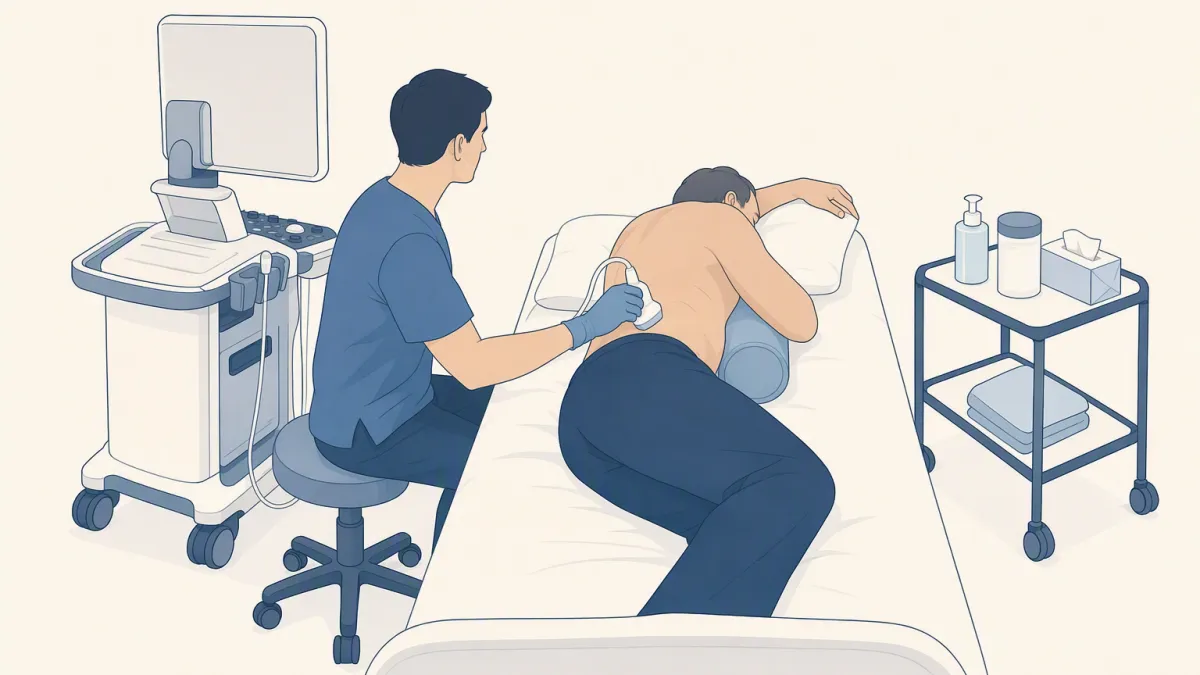
The probe goes to the flank, where the kidney sits close to the back.
What do kidney stones feel like?
A moving stone usually causes sudden, severe pain in the side or back that spreads toward the groin,
often in waves. Blood in the urine, nausea and an urgent need to urinate are common. A stone that has
not moved may cause nothing at all.
What raises your risk of kidney stones?
A major driver is not drinking enough. Concentrated urine lets minerals crystallize. Other
established factors include:
A diet high in salt or animal protein
A family history of stones
Obesity and related metabolic conditions
Heat or heavy sweating without replacing the fluid
Certain medical conditions and medicines
How kidney stones are found
An abdominal ultrasound can show a
stone and any swelling of the kidney (hydronephrosis) from a blockage. It uses no
radiation, but it does not see every stone.
✓
What ultrasound can show
Many stones resting in the kidney
Hydronephrosis — kidney swelling from a blockage
!
What it can miss
Small stones, or ones low in the ureter. A CT scan without contrast sees these better, with some radiation.
Why stones form. A blood panel, urine tests and analysis of a passed stone answer that.
Lowering the risk, and what to do now
Fluid is the most effective single step. In a five-year randomized trial, 12 of 99 people told to
drink more water formed another stone, against 27 of 100 without that advice. The AUA guideline
advises enough fluid to make at least 2.5 liters of urine a day after a calcium-based stone.
Pain with fever, being unable to pass urine, or vomiting that will not stop: call 119 in Taiwan, as in the box above.
Sudden flank pain or blood in the urine without those signs: see a doctor the same day.
A stone found by chance: drink enough to keep your urine pale, cut back on salt, and ask whether tests to find the cause are worthwhile.
These steps lower the chance of a repeat stone; they cannot guarantee one never forms.
A moving stone usually causes sudden, severe pain in the side or back that spreads toward the groin, often with nausea or blood in the urine. Pain with fever or chills, being unable to pass urine, or vomiting that will not stop is an emergency. In Taiwan call 119 (the local equivalent of 911).
Can a kidney stone show up on a scan before it hurts?
+
Sometimes. An abdominal ultrasound can show a stone resting in the kidney, and swelling if one is blocking urine flow. It can miss small stones. Finding one early does not usually mean treatment; it is a reason to talk about fluids and diet.
Do all kidney stones need to be treated?
+
No. Small stones that cause no symptoms and are not blocking the kidney are often monitored. Pain, blockage, infection, reduced kidney function or repeated stones can each call for treatment, and a urologist decides.
How can I lower the chance of kidney stones coming back?
+
Drink enough to keep your urine pale. In a five-year trial, 12 of 99 people who drank more water formed another stone, against 27 of 100 who did not. Less salt and very high animal protein helps. If stones keep forming, tests of the stone and your urine tailor the advice.
Compare screening packages, see exactly what each one includes, or talk to a coordinator
about fitting Kidney Stones screening into your visit to Taiwan.