What is a CT scan?
A CT (computed tomography) scan takes X-rays from many angles and rebuilds them into a stack of thin slices. A plain X-ray is one flattened shadow; a CT is a loaf you can look through slice by slice. That is why CT can find a lung nodule a few millimeters across that a chest film often misses.
| Scan | How it makes the picture | Ionizing radiation | Reads well |
|---|---|---|---|
| X-ray | One flat shadow | Yes, small | Bone, and a broad look at the chest |
| CT | Hundreds of shadows rebuilt into slices | Yes, more than an X-ray | Lungs, bone, calcium, and most organs |
| MRI | Magnet and radio waves | None | Soft tissue: brain, spine, organs |
How a CT scanner works
-
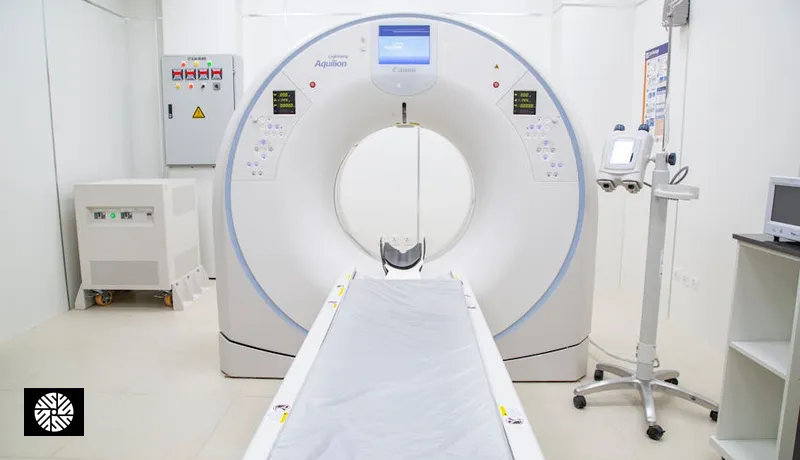
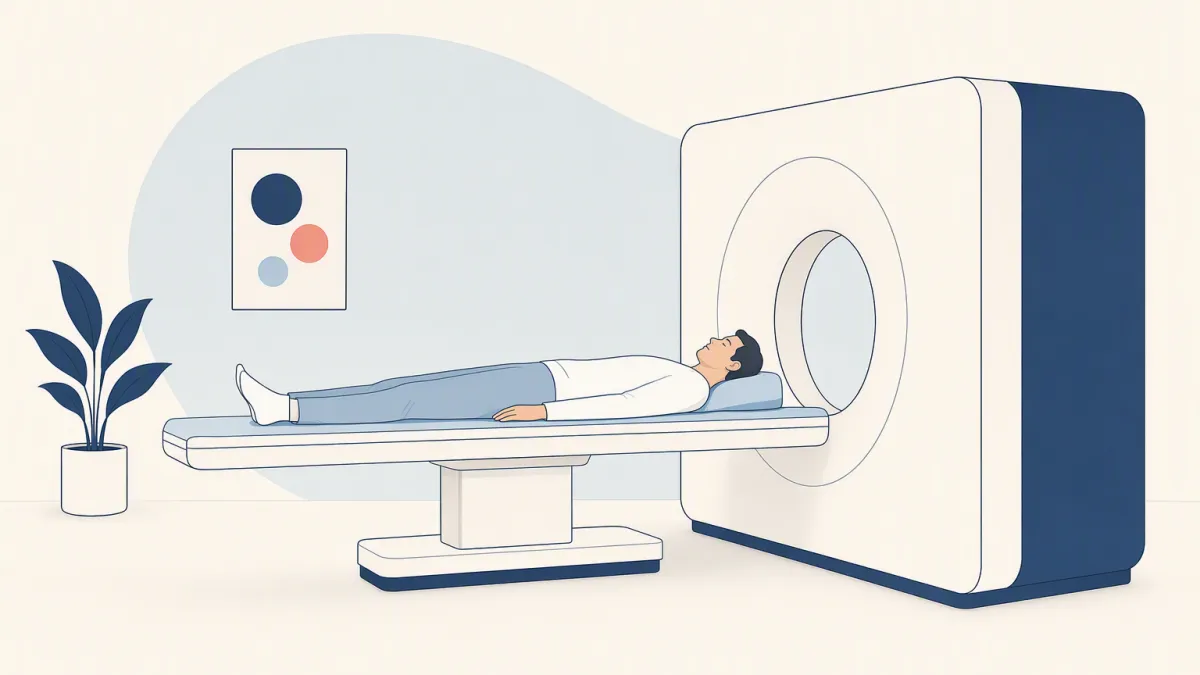
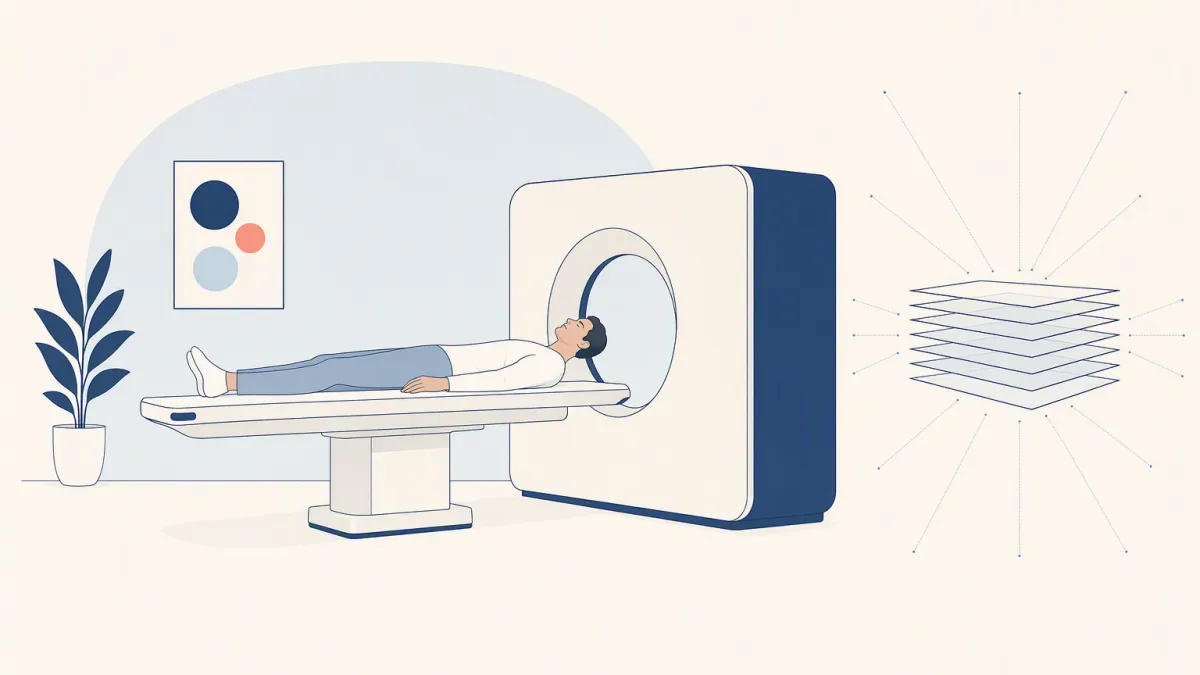
1You lie down, the table movesYou lie on your back and the table glides through a short, open ring. Nothing encloses your head, and you can see out of both ends.
-
2The ring spins, taking shadowsAn X-ray tube and a bank of detectors face each other and spin around you. Every moment of that spin captures one flat shadow from one angle.
-
3One shadow is ambiguous — hundreds are notIn a single image, things at different depths overlap. Given shadows from all the way around, a computer works out which arrangement of tissue would cast every one of them. That calculation is the computed in computed tomography.
-
4Breathe in and holdA recorded voice asks for a breath-hold. With the lungs still, nothing moves mid-scan, so the slices stay sharp.
-
5Back on your feetMost of the visit is positioning rather than scanning, and the X-rays themselves are silent and painless. Your coordinator confirms the total visit time when you book.
Before your scan: what to tell the team
A screening low-dose lung CT or a calcium score involves no injection; a diagnostic chest CT may use contrast. A coronary CT angiogram, and some other CT exams, use contrast dye:
What CT screens for
Of the three CT exams on this page, only one is a recommended screen, and only for defined groups. (CT colonography, not covered here, is another recognized screening option.) The others answer a question a clinician has already asked:
| The exam | What CT does that other scans cannot | When it is used |
|---|---|---|
| Low-dose lung CT | Reads air-filled lungs, which MRI cannot, and finds small nodules | A screen for people who meet Taiwan's HPA criteria or, in the US, the USPSTF criteria |
| Heart calcium score | Turns calcified coronary plaque into a single number, with no contrast | Selectively, when heart risk is uncertain and the result would change a decision |
| Coronary CT angiogram | Images the artery channels directly, including soft plaque a calcium score misses | A contrast exam for a defined clinical question, not a routine screen |
Who qualifies for lung CT screening
- In Taiwan, the Health Promotion Administration funds a scan every 2 years for people with a parent, sibling or child with lung cancer (men 45–74, women 40–74).
- Also in Taiwan, smokers aged 50–74 with at least 20 pack-years (packs per day × years smoked) who currently smoke and are willing to quit, or who quit less than 15 years ago. Funded screening is for people with National Health Insurance who meet the criteria.
- In the US, the US Preventive Services Task Force (2021) recommends yearly screening at 50–80 with at least 20 pack-years, still smoking or quit within 15 years.
Radiation, and when another scan does the job
CT uses ionizing radiation — enough energy to break chemical bonds inside a cell. Dose is counted in millisieverts (mSv), a unit that means little on its own, so read it next to the exposure you already live with:
About 10 days of average US background radiation.
About 6 months of background.
About 6 months of background.
The average yearly US dose from natural sources — the yardstick.
About 3 years of background.
Background is the US average; your dose varies (RadiologyInfo figures, checked October 2026).
Those doses are small. They are not zero. That is the reason CT is aimed at a question rather than sprayed across the body: a whole-body CT survey would stack dose on organs nobody had asked about.
- The lungs, which no radiation-free scan reads well
- Coronary calcium, and the coronary arteries when a clinician needs them imaged
- A question about the brain, spine or soft organs — an MRI or an ultrasound often answers it with no radiation.
- A general whole-body survey — CT is not paired with MRI into a universal whole-body screen. The full-body MRI page explains why the American College of Radiology says evidence is insufficient to recommend total-body screening for people without symptoms.