What is a single-region CT?
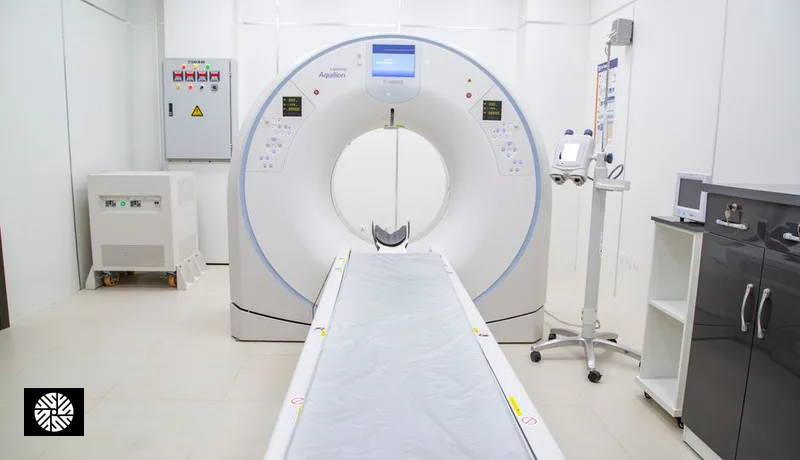
A single-region CT scans one part of the body: the head, the sinuses, the chest, the abdomen and pelvis, or the spine. It uses X-rays taken from many angles, which a computer turns into thin cross-sectional slices. How a CT scanner works explains the machine.
It is a diagnostic test, usually ordered to answer one question about one area. Three things set it apart:
- One area. The scan answers a question about one region, most often a symptom or an earlier finding.
- X-rays. It uses ionizing radiation; the dose by region is in the table below.
- No contrast. New Dawn Health books it without contrast, as one region per booking.
Head, sinuses, chest, abdomen and spine: what each scan is for
RadiologyInfo, the patient site of the American College of Radiology (ACR) and the Radiological Society of North America, lists the common reasons for each:
| Region | What it is commonly used to look for |
|---|---|
| Head | Bleeding, brain injury and skull fractures after a head injury; bleeding from a burst aneurysm; brain tumors; enlarged fluid spaces in the brain |
| Sinuses | Sinusitis, fluid-filled sinuses or thickened linings, tumors of the nose and sinuses, and the anatomy before sinus surgery |
| Chest | A closer look at something seen on a chest X-ray; tumors in the chest and how far they reach |
| Abdomen and pelvis | Kidney and bladder stones, appendicitis, diverticulitis, pancreatitis, cancers of the abdominal organs, aortic aneurysms, injuries |
| Spine | Fractures and damage after an injury, the spine before and after surgery, scoliosis, tumors |
A sinus CT does not commonly need contrast, according to RadiologyInfo. For kidney stones, the US National Institute of Diabetes and Digestive and Kidney Diseases (NIDDK) says CT is most often done without contrast. It shows the size and location of a stone, and whether it blocks the urinary tract.
CT or MRI: which one answers your question?
CT and MRI see different things well. The right one depends on the question, not on which scan sounds more thorough:
| Question | Usually the better tool |
|---|---|
| Bleeding in the head after an injury, or a sudden severe headache | CT. RadiologyInfo says it can reveal bleeding quickly enough to help save lives. This is an emergency, not a booking. |
| Complex fractures, eroded joints or bone tumors | CT. The US National Institute of Biomedical Imaging and Bioengineering (NIBIB) calls it particularly useful here. |
| The lungs: tumors, pneumonia, emphysema, fluid | CT |
| Kidney and bladder stones | CT, usually without contrast |
| Fine detail of brain tissue | MRI. RadiologyInfo says brain soft-tissue detail is less visible on CT. |
| Discs, ligaments and the spinal cord | MRI. Spinal CT does not consistently show enough detail of the cord. |
| Some liver, kidney, pancreas, uterus or ovary questions | MRI may be preferable; for gallstones, ultrasound |
| You want no radiation, or you are pregnant and the question is in the abdomen | MRI or ultrasound |
| You have a pacemaker or other implant, or find it hard to lie still | CT. RadiologyInfo says no implanted device prevents a CT, and CT is less sensitive to movement. |
The single-region MRI page covers the MRI side, and how an MRI works explains why it needs no radiation.
With or without contrast
Many CT questions need no contrast; the sinus and kidney-stone scans above are two. Contrast is an iodine-based dye injected into a vein. NIBIB explains why it exists: soft tissues can be faint on CT, and contrast makes them easier to see.
New Dawn Health's single-region CT is booked without contrast. If a doctor's request says "with contrast", tell your coordinator before you book, because that is a different exam.
Our explainer on when contrast dye is used in MRI and CT covers both agents and their safety data.
How much radiation does each region use?
CT uses ionizing radiation, and the dose depends on the region. The figures below are RadiologyInfo's typical adult doses. They are compared with natural background radiation, which RadiologyInfo puts at about 3 mSv a year for the average person in the US:
| Scan | Typical effective dose | About the same as average US background radiation for |
|---|---|---|
| Chest X-ray (for reference) | 0.1 mSv | 10 days |
| CT head and neck | 1.2 mSv | 5 months |
| CT brain | 1.6 mSv | 7 months |
| CT chest | 6.1 mSv | 2 years |
| CT abdomen and pelvis | 7.7 mSv | 2.6 years |
| CT spine | 8.8 mSv | 3 years |
- Sinuses are not listed separately. RadiologyInfo gives no figure for a sinus CT on its own.
- Scanning twice doubles it. A brain CT repeated with and without contrast is listed at 3.2 mSv, and the abdomen and pelvis at 15.4 mSv.
- Your dose is not the table. These are typical values; the scanner, the protocol and your body size change the real figure.
- The risk is small, not zero. The US Food and Drug Administration (FDA) says CT radiation may be associated with a very small increase in cancer risk later in life.
RadiologyInfo says hospitals keep doses "as low as reasonably achievable" and that an accurate diagnosis outweighs the small risk. That trade holds when there is a question to answer. What CT radiation dose actually means puts these numbers in context.
Who should get one, and who should not
The ACR publishes Appropriateness Criteria: evidence-based guidelines that help doctors choose the right imaging test for a clinical condition. A CT is picked for a question, so the fit depends on yours:
| Situation | Fit |
|---|---|
| A symptom a doctor wants imaged, in an area CT sees well | Good fit: for example a suspected stone, sinus trouble or a bone problem |
| A known finding to follow, such as a lung nodule | Good fit; bring the earlier images so the two can be compared |
| Something seen on a chest X-ray that needs a closer look | Good fit; this is a listed use of chest CT |
| Planning sinus surgery | Good fit; CT defines the anatomy for the surgeon |
| No symptoms and no finding, "just to check" | Weak fit: radiation and incidental findings with no question to answer |
| Smoking or family history of lung cancer, no symptoms | The test built for this is a low-dose lung CT, not a standard chest CT |
| Pregnant, or could be | Usually not, unless medically necessary; tell the team first |
| Symptoms happening right now | Not a booking; see the box below |
On whole-body CT for people without symptoms, both US bodies are direct. The ACR does not believe there is sufficient evidence to justify recommending it. The FDA knows of no scientific evidence that it provides more benefit than harm.
What it can show, and what it cannot
- Bone: fractures, eroded joints and bone tumors
- The lungs: tumors, pneumonia, emphysema and fluid
- Bleeding inside the head
- Kidney and bladder stones, with their size and position
- Sinus disease and the sinus anatomy
- Fine soft-tissue detail in the brain, discs, ligaments and spinal cord: a single-region MRI shows it better.
- Gallstones, which CT may not see well: an abdominal ultrasound is preferred.
- The coronary arteries: a heart calcium score or a coronary CT angiogram is built for them.
- Lung cancer screening for people who qualify: a low-dose lung CT uses a lower-dose protocol.
- Anything outside the scanned region. A full-body MRI surveys several regions without radiation.
Getting a single-region CT in Taiwan
Taiwan's government-funded screening uses CT for one test only: a low-dose lung CT. It is offered every 2 years to two groups with National Health Insurance:
- Family history: a first-degree relative with lung cancer, for men 45–74 and women 40–74.
- Smoking: smokers 50–74 with 20+ pack-years who currently smoke and are willing to quit, or who quit less than 15 years ago.
New Dawn Health books a single-region CT at Central Clinic & Hospital Healthcare Center in Taipei. The listing says this about it:
- No contrast. It is a non-contrast scan of one area.
- You name the region. After booking, you email the region and the symptom or concern. The listing gives the head, chest, abdomen, pelvis and spine as examples.
- One region per booking. Whether your area, such as the abdomen and pelvis together, counts as one is confirmed when you book.
- An English report. When it arrives is confirmed when you book.
What to expect on scan day
-
1Before you goBring any doctor's request and earlier scans or reports of the same area. Tell the team if you are or could be pregnant.
-
2ChangeWear loose clothing. You may be asked to remove jewelry, belts, glasses and other metal near the area being scanned.
-
3The scanYou lie on a table that moves through a ring-shaped scanner. You may be asked to hold your breath for a few seconds. Your coordinator confirms the visit time when you book.
-
4AfterwardsA scan without contrast needs no recovery, so you can carry on with your day.
What are the risks?
A CT is painless. Its risks come from the radiation, from contrast when it is used, and from what the scan finds:
- Radiation. A very small possible increase in cancer risk later in life, per the FDA. The table above gives the dose by region.
- Pregnancy. RadiologyInfo says doctors do not generally recommend CT in pregnancy unless medically necessary. NIBIB says there is no known risk to the baby when the abdomen and pelvis are not scanned.
- Children. Children are more sensitive to radiation. RadiologyInfo says they should have CT only if it is essential for a diagnosis, always with a low-dose technique.
- Contrast, when used. Reactions are possible but severe ones are very uncommon. Reduced kidney function needs special consideration first.
- Incidental findings. The scan may show something unrelated to your question, explained below.
When the scan finds something you were not looking for
A CT shows everything in the scanned area, not only the part you asked about. The ACR's concern about scanning people without symptoms is exactly this. Many such findings never affect health, but they can lead to unnecessary follow-up tests and treatment.
Radiologists use published rules to decide which findings need follow-up:
- Lung nodules: the Fleischner Society's 2017 guideline raised the minimum size that needs routine follow-up. It gives follow-up intervals as a range, to fit your risk and preferences.
- Adrenal and other abdominal findings: the ACR Incidental Findings Committee publishes algorithms. For an adrenal mass, each branch ends either with a finding benign enough to stop follow-up or with a next step.
Results & follow-up after you fly home
A radiologist, a doctor trained to read scans, writes the report. Who receives it, and who explains it to you, is confirmed when you book. Then:
-
1Keep the written reportIt describes what the radiologist saw in the scanned area. Your doctor at home needs it.
-
2Ask for the imagesAsk whether the clinic can release the scan in DICOM, the standard format for medical images. A report alone cannot be compared with a future scan.
-
3Book a doctor if anything is flaggedA finding is not a diagnosis. Take the report and images to a doctor who can examine you and read them with your symptoms.
-
4Compare before you repeatIf a finding needs watching, your doctor sets the interval. A new scan is read against this one, so keep both.
-
5Act on new symptoms, whatever the report saidA normal scan covers one area on one day. Signs of a stroke or a serious head injury still means an emergency call. In Taiwan call 119 (the local equivalent of 911).
Cost and coverage
The live price further down this page is New Dawn Health's booking price for one region without contrast. What happens after that depends on your coverage:
- Short-term visitors are not covered by Taiwan's National Health Insurance, so screening is self-funded.
- Reimbursement at home is a question for your insurer. A plan may ask for a referral or a symptom for CT. Ask them before you book.
- A second region is a second booking. Your coordinator confirms what one booking covers.