What is a carotid ultrasound?
A carotid ultrasound is a painless scan that uses sound waves to picture the two carotid arteries in your neck — the main vessels carrying blood up to your brain. These arteries sit close to the skin, so plaque inside their walls (atherosclerosis) is easy to see. There is no radiation and nothing enters your body.
How does it work?
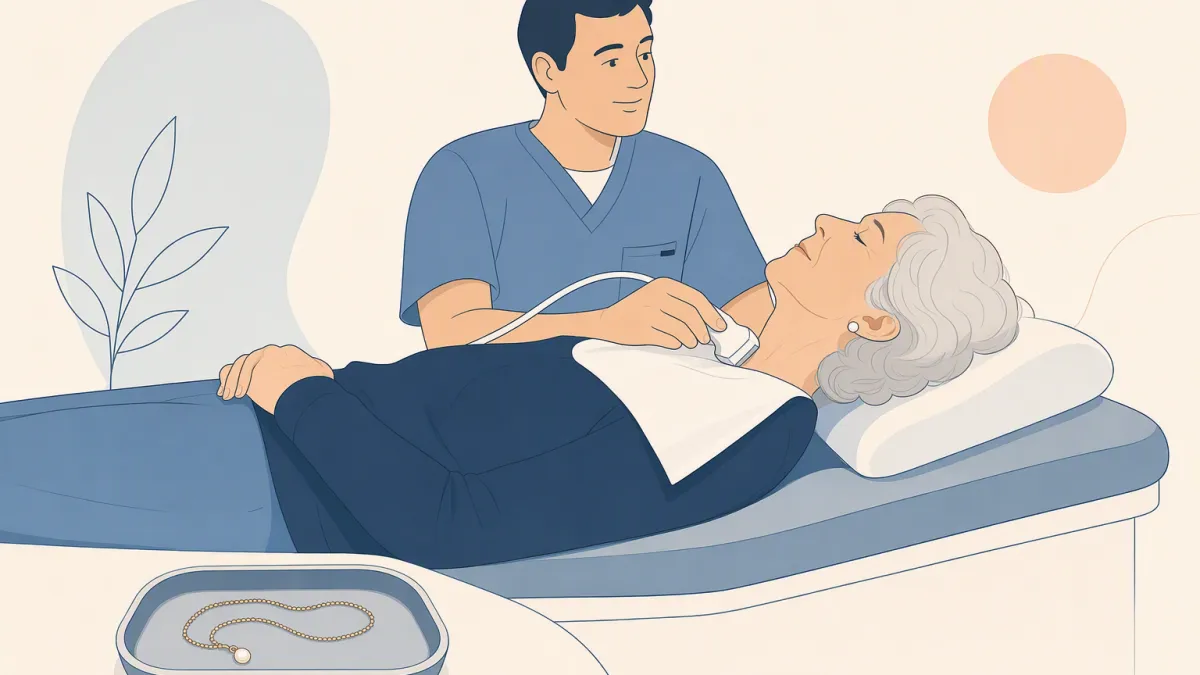
The scan works in two layers. A sonographer glides a small probe over your neck with a little gel. The live picture shows each artery wall, so any plaque can be seen and measured. Then Doppler mode adds color and sound. Blood speeds up where a channel narrows, the way water speeds up through a pinched hose, so the speed tells the reader how tight a narrowing is.
What it can find — and what it can't
- Plaque deposits along the artery wall
- Narrowing (stenosis) and how severe it is
- Abnormal or turbulent blood flow
- Wall thickness (intima-media thickness, or IMT) — of limited use, as explained below
- Arteries inside the skull — the vessels your carotids feed are mapped by a brain MR angiogram when a clinician needs that answer
- The heart's arteries — a heart calcium score measures calcified plaque there
- Whether you will have a stroke — many strokes have other causes, such as an irregular heartbeat, which an ECG looks for
Who it helps — and who it does not
Whether this scan makes sense depends mostly on symptoms. Here is how the guideline bodies divide it up:
| Situation | What the guidance says |
|---|---|
| Stroke or TIA symptoms happening now | An emergency — call 119, do not book a scan |
| A past TIA, stroke or other neurological symptoms | A diagnostic test your doctor orders as part of the work-up |
| A doctor hears a whooshing sound (a bruit) over the neck | A reason your doctor may order the scan |
| No symptoms, but at increased risk of carotid narrowing | SVS suggests screening only if you would be fit for, and willing to consider, a carotid procedure if severe narrowing were found |
| No symptoms, general adult population | Not recommended by either body |
The argument against doing this scan at all
It would be easy to leave this out, so here it is. The US Preventive Services Task Force recommends against routine carotid screening in the general adult population. That is not merely advice against acting hastily on a result. It is advice against running the scan in people without symptoms in the first place, graded "D" in the 2021 statement.
Its reasoning is simple. Severe narrowing is uncommon in people without symptoms, so screening them produces false alarms. Those lead to more imaging and sometimes surgery, which carries its own risk of stroke. In the Task Force's judgment, those harms outweigh the benefit.
- The real difference is who gets screened. The USPSTF says no to screening adults without symptoms. The Society for Vascular Surgery agrees for the general population, but suggests screening selected higher-risk people who would consider a procedure.
- The 70% figure is something else. SVS supports intervention for asymptomatic narrowing above roughly 70% in suitable patients. That is a treatment question, not a screening one. It applies once narrowing is found, in people whose surgical risk is low.
- Prevention starts elsewhere. Blood pressure, smoking, diabetes and cholesterol are the established ways to lower stroke risk, scan or no scan.
We include the carotid scan because it is inexpensive and radiation free — and because it illustrates the disagreement above; cost is not a clinical indication. Some people and their doctors want the answer after weighing all of this. That disagreement is between serious institutions, and a screening company's website will not resolve it. That is our reasoning, and you are entitled to weigh it against theirs.
What to expect on scan day
-
1Before you arriveLittle or no preparation is needed: no fasting and nothing to swallow. Wear an open-collared top and leave necklaces at home.
-
2On the tableYou lie on your back and tilt your head slightly to one side. Gel and a probe are moved along each side of your neck.
-
3Doppler soundsYou may hear a whooshing noise as the machine measures blood flow. That is normal.
-
4AfterwardsYou wipe off the gel and carry on with your day. Your coordinator confirms the total time when you book.
Reading your result
A carotid report can answer two separate questions, and they are easy to confuse. The first is wall thickness (IMT), a millimeter-scale measurement of the artery's inner lining. The second is stenosis: how much of the channel a plaque narrows, as a percentage estimated mostly from the Doppler speed.
It is the stenosis figure that drives the response. The categories below follow a 2003 consensus of the Society of Radiologists in Ultrasound. Exact boundaries vary between laboratories, so read yours as the category your report assigns:
A ladder like this is the general pattern, not a rule your case must obey. Reporting conventions differ between hospitals, and two experienced clinicians can read the same finding and reasonably advise differently. Where your report or your doctor differs from this table, go with them — they are looking at your actual result.
As with every grading scale in medicine, the band is a classification, not a diagnosis. It sets the next step: reassurance, surveillance, or referral. That step is decided with your symptoms, your age and the rest of your risk profile, not by the percentage on its own.
What plaque here says about the rest of you
Atherosclerosis is not limited to one artery. People with plaque in the neck are, on average, at higher risk of heart disease as well as stroke. That is an association, not proof that any other artery is narrowed.
- It can sharpen a prevention conversation. Visible plaque may tip a borderline cholesterol decision.
- It does not automatically mean more scans. A calcium score or other test is worth it only if the result would change your treatment.
Cost and coverage
The live price further down this page is the booking price at New Dawn Health; anything billed separately — such as biopsy or pathology where it applies — is confirmed when you book. What happens after that depends on where your coverage comes from:
- In Taiwan, screening is paid for by the visitor. Short-term visitors are not covered by Taiwan's National Health Insurance, so screening is self-funded.
- Reimbursement at home is a question for your insurer. Plans differ on whether they pay for a carotid scan done without symptoms. Ask them before you book, and ask which documents they need.
- Which packages include it is listed below and confirmed when you book.
Results & follow-up
- A written report describing any plaque, the flow velocities and the stenosis category. Turnaround, language and how findings are explained are confirmed when you book.
- Mild findings usually mean attention to blood pressure, cholesterol, glucose and smoking — not a procedure.
- A significant narrowing is a reason to see a doctor, usually with a referral to a vascular specialist. Take the report home to your own doctor.
- New symptoms after the scan — even with a normal result — still mean calling 119.