A gentle, radiation-free look at your upper airway — ears, nose, sinuses, throat and larynx, often with a thin scope.
Last updated October 2026 · New Dawn Health editorial team
What it checks
Ears, nose, sinuses, throat, larynx
Hearing
Hearing test only if the package includes one
Radiation
None — a scope and a light
Prep
None — no fasting or contrast
What is an ENT exam?
An ENT exam is a focused check of your ears, nose, sinuses, throat and voice box
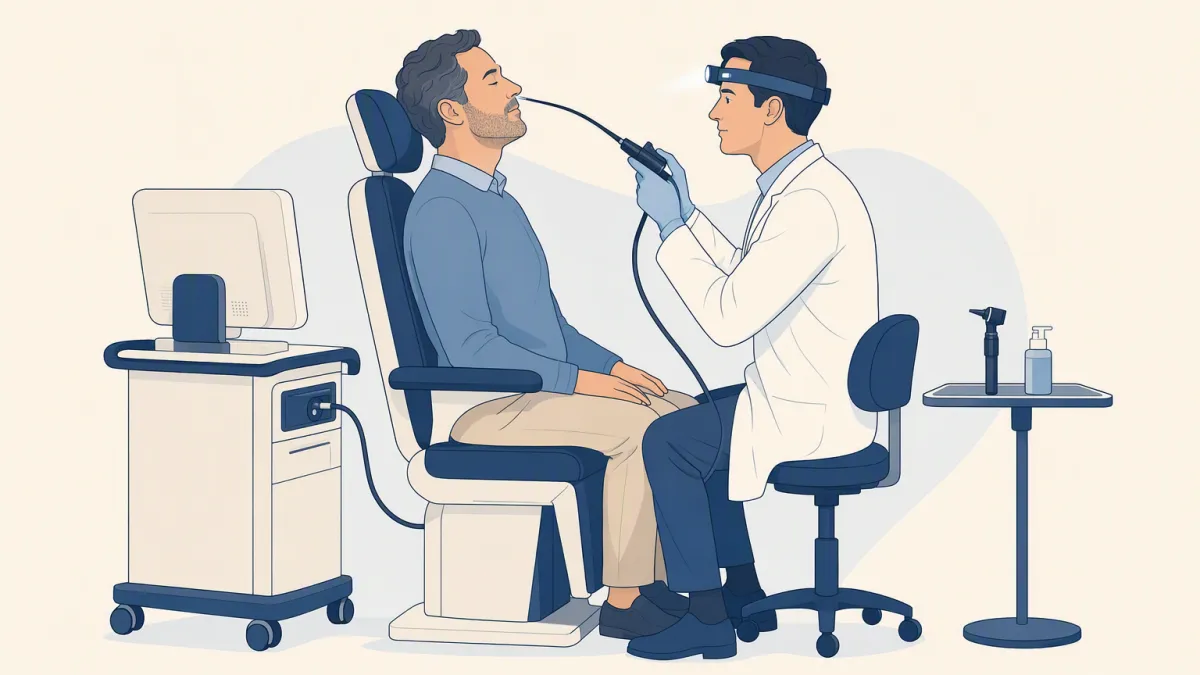
(larynx). The examiner looks into the ear canals and, often, passes a thin lighted scope
through the nose to see the airway lining directly. Some packages add a hearing test. There are no
needles, no radiation and little preparation.
A thin scope gives a direct look at the nose, throat and voice box.
How the exam is done
1
Questions and a look in the ears
The examiner asks about hearing, blocked nose, nosebleeds and voice changes, then checks the ear canals and eardrums with an otoscope.
2
A hearing test, if your package includes one
Audiometry asks you to signal when you hear tones at different pitches and volumes. Your coordinator confirms whether it is included when you book.
3
The scope
After a numbing spray, a slim endoscope passes through the nose to show the nasal passages, the openings of the sinuses, the back of the nose, the throat and the larynx.
4
Findings explained
Anything that needs a closer look is referred on — to imaging, a biopsy, or an ENT specialist at home.
What it can find
Because the examiner sees the lining directly, an ENT exam can pick up:
Nasal blockage — a deviated septum or swollen lining
Chronic sinus disease and nasal polyps, as far as the scope can see
Growths, inflammation or bleeding points on the visible lining of the nose, throat and voice box
Ear-canal and eardrum problems, and hearing loss if a hearing test is done
For hearing, the US Preventive Services Task Force (2021) found the evidence insufficient to judge
screening adults 50 or older who have not noticed a problem. A test is most useful when you have.
Nasopharyngeal cancer: what a scope can and cannot do
Nasopharyngeal cancer grows at the back of the nose. The US National Cancer Institute lists
Epstein-Barr virus (EBV) infection and living in or having ancestry in parts of Asia among its risk
factors. It is more common in parts of Asia, including Taiwan, where the national cancer registry
recorded 39,412 new cases from 1995 to 2021.
Whether EBV testing suits you depends on family history and where your family comes from; ask a
doctor. Do not wait for a screening visit if you have symptoms the NCI lists:
A lump in the neck
Pain, pulsing or ringing in one ear, or trouble hearing
Nosebleeds, or a stuffy nose that does not clear
A sore throat that persists
What it can't see
✓
What the scope reaches
The surfaces of the nose, the back of the nose, throat and voice box
The ear canal and eardrum
!
What sits beyond it
The sinuses in full. A sinus CT scan shows them when symptoms or findings call for it.
The inner ear and skull base. A dedicated MRI ordered for that question — a survey full-body MRI is not built for it.
The thyroid. A thyroid ultrasound images it when there is a lump or another indication; in the US it is not recommended as routine screening (USPSTF).
An ENT exam tells you how the visible airway looks today, and how you hear if that is tested. It
does not see deep structures, and a normal look does not rule out disease beneath the surface.
Usually not. The scope is passed gently after a numbing spray, which tastes bitter and numbs the throat for a while. Most people find it briefly odd rather than painful, and a hearing test only asks you to respond to tones.
Can an ENT exam detect nasopharyngeal cancer?
+
A scope can see a visible tumor at the back of the nose, but it is not the screening test. A Hong Kong screening study used an Epstein-Barr virus blood test, then a scope and MRI for persistently positive results (Chan 2017). Symptoms such as a neck lump need a doctor promptly.
Do I need an ENT exam if I feel fine?
+
Not as a routine screen. It is most useful when you have symptoms such as hearing trouble, a blocked nose or nosebleeds. If nasopharyngeal cancer is your concern because of family history, ask a doctor about EBV blood testing.