What is a thyroid ultrasound?
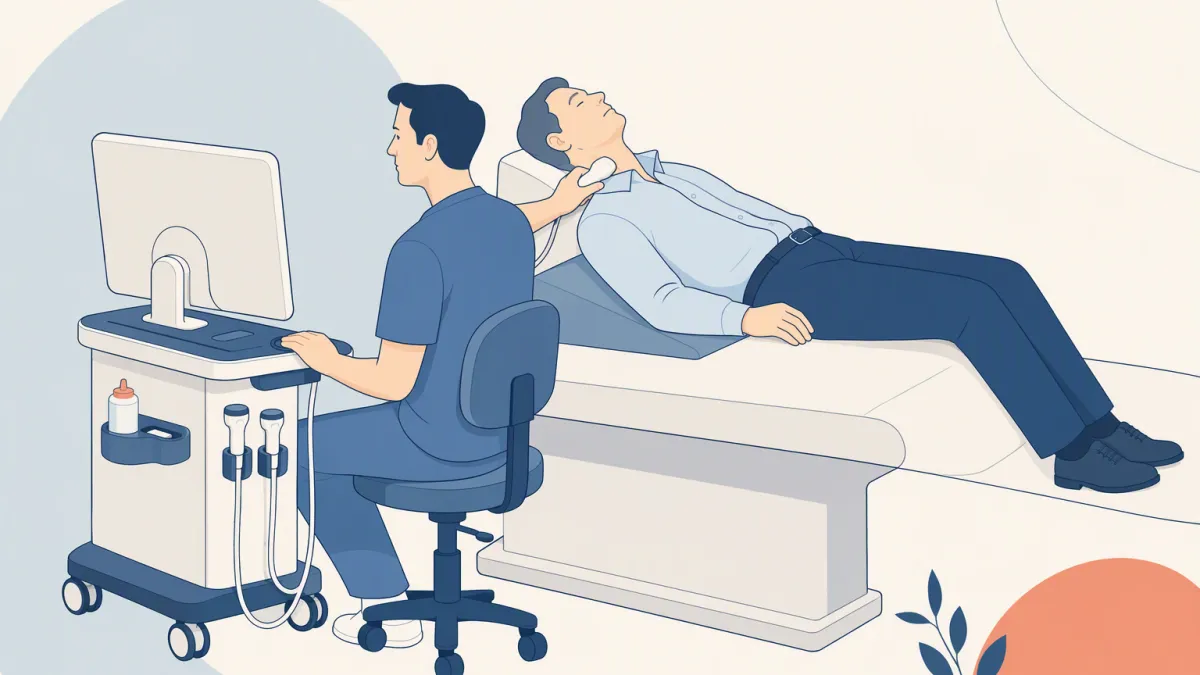
A thyroid ultrasound is a painless, radiation-free scan that uses high-frequency sound waves to picture the thyroid — the small, butterfly-shaped gland at the base of your neck that regulates your metabolism. A probe glides over the skin with a little gel, and the returning echoes build a live image of the gland.
It shows thyroid structure: whether the gland is enlarged, and whether it contains nodules — small lumps that many healthy people carry without knowing. The neck and thyroid page shows what else sits in the same part of the neck.
What it looks for
- Nodules, with the features that set their level of suspicion
- An enlarged gland (goiter)
- Changes in the gland's texture
- How well the gland works. Hormone levels come from a blood test; a gland can look normal and still be over- or under-active.
- Whether a nodule is cancer. Only a sample of cells can answer that — a fine-needle biopsy, which can itself be inconclusive.
Who should consider it
The US Preventive Services Task Force (2017) recommends against screening for thyroid cancer in adults without symptoms. Looking more often finds more small, harmless cancers. So the scan fits a reason:
- A lump you or a doctor can feel in the neck
- Symptoms or an abnormal examination that point to the thyroid
- Past radiation to the head or neck
- A relevant family history, or another reason your clinician identifies
An abnormal thyroid blood test is mainly about function. Whether it also needs an ultrasound is your doctor's call.
What to expect on scan day
-
1Loosen your collar and lie backYou lie on your back with your chin tilted up to expose the neck. No fasting and no injection.
-
2Gel and a gliding probeThe probe moves over your thyroid with a little water-based gel. You feel light pressure and the coolness of the gel.
-
3DoneThe images are captured in real time; your coordinator confirms the time on the day. You can carry on with your day straight away.
What a nodule finding means
Start with the fact that changes how the rest of this reads: thyroid nodules are one of the most common findings in medicine. The 2015 American Thyroid Association guideline puts it plainly — high-resolution ultrasound finds nodules in roughly 19% to 68% of randomly selected people, more often in women and with age. The same guideline puts the cancer rate among nodules at about 7–15%, depending on age, sex, radiation history and family history. The scan's job is triage, not alarm.
ACR TI-RADS is one widely used system for grading nodules; others exist, and your coordinator can confirm which one your clinic uses. In ACR TI-RADS there are five levels:
A ladder like this is the general pattern, not a rule your case must obey. Reporting conventions differ between hospitals, and two experienced clinicians can read the same finding and reasonably advise differently. Where your report or your doctor differs from this table, go with them — they are looking at your actual result.
The level is arithmetic, not a guess:
- Five feature groups are scored: composition, echogenicity (how bright the nodule looks against normal thyroid tissue), shape, margin, and echogenic foci (bright specks, some of them tiny calcium deposits).
- The points add up to a TR level.
- The TR level together with the nodule's size decides between a biopsy, a repeat scan or nothing. Higher levels trigger action at smaller sizes.
Why “size alone” is the wrong question
Almost everyone who finds a nodule on a report goes looking for one chart: how many millimeters is too many? That chart does not exist, because size is only half of the decision. A large nodule with plainly benign features can be left alone. A much smaller one with suspicious features can go straight to a needle.
So ask about the pair. “It's 1.4 cm” is not an answer. “It's a 1.4 cm TR3” is.
What a biopsy can and cannot settle
A fine-needle biopsy takes a few cells with a thin needle. Pathologists sort the result into the Bethesda categories, and not every result is a clear yes or no:
- Benign or malignant: the clear answers most people expect.
- Indeterminate: the cells cannot be classified reliably. The ATA says this happens in up to 20% of biopsies, and it may mean a repeat biopsy, molecular testing or surgery.
- Nondiagnostic: too few cells; with ultrasound guidance, the ATA puts this under 5%. The biopsy is usually repeated.
The honest cost: overdiagnosis is real
There is a genuine argument against looking at thyroids too eagerly, and it belongs on this page. Thyroid ultrasound is very good at finding small cancers — and some of those cancers would never have caused harm in the person's lifetime. Finding them still leads to biopsies, surgery and sometimes lifelong hormone replacement.
This is not a theoretical worry. In South Korea, thyroid-cancer diagnoses climbed steeply as ultrasound screening spread, while the thyroid-cancer death rate stayed essentially flat. That is the signature pattern of overdiagnosis.
Cost and coverage
The live price further down this page is the booking price at New Dawn Health; anything billed separately — such as biopsy or pathology where it applies — is confirmed when you book. What happens after that depends on where your coverage comes from:
- Screening in Taiwan is self-funded for visitors. Short-term visitors are not covered by Taiwan's National Health Insurance, so screening is self-funded.
- Reimbursement at home is a question for your insurer. A plan may pay only when the scan is ordered for a symptom or a lump, not as screening. Ask them before you book.
Results and follow-up
- A written report describing the gland and each nodule, with its level of suspicion and size. Turnaround and how the findings are explained vary by hospital — your coordinator confirms both when you book.
- A next step for each nodule — most often nothing or a recheck interval, occasionally a referral for a fine-needle biopsy.
- A baseline to compare against if a later scan is ever needed.