Kidneys & Urinary Tract

Blood and urine tests measure how well the kidneys work; an ultrasound shows what they look like, when there is a reason to scan.

Last updated October 2026 · New Dawn Health editorial team

Two organs, one radiation-free scan, and a blood and urine test the scan cannot replace. This is the clearest case on the site of a picture and a number answering different questions.
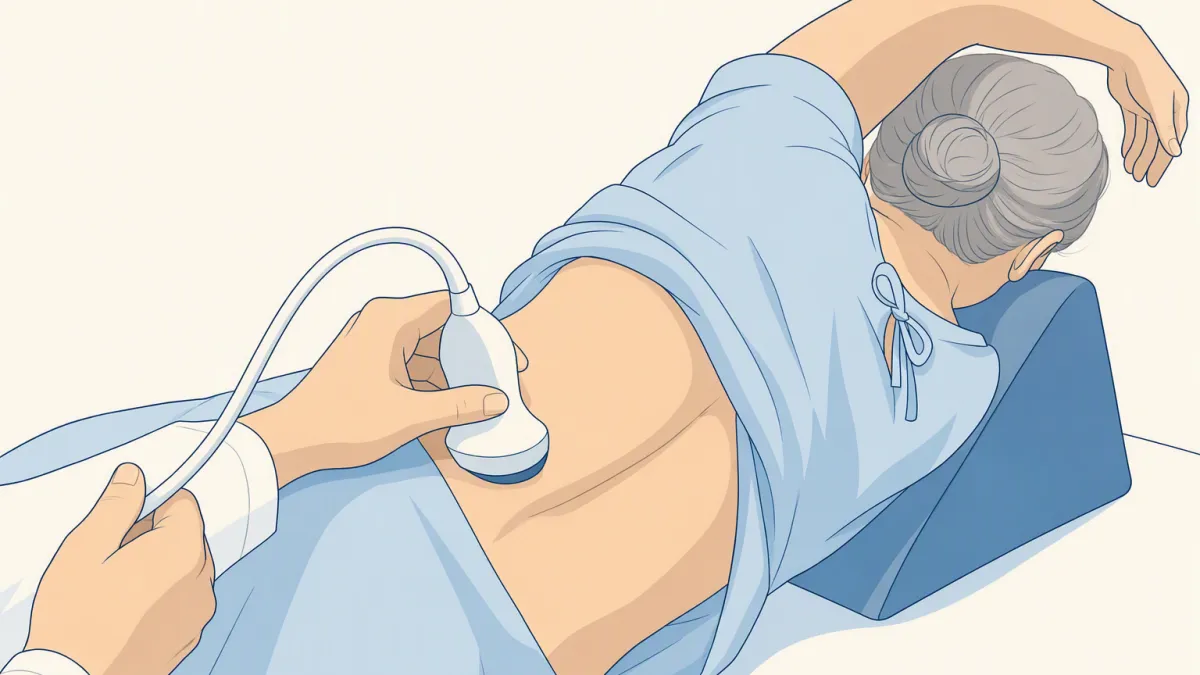
A sonographer pressing a curved-face probe into a patient's flank, seen close from behind the patient's back.
The scan shows structure; blood and urine tests show function.

What gets checked, and with what

Structure comes from ultrasound; function comes from blood and urine tests.
Organ What the test looks for The test that does it
Kidneys Stones, cysts and masses — plus the swelling a stone causes when it blocks the outflow of urine Abdominal ultrasound; creatinine with eGFR on a blood panel that includes them, and a urine test
Bladder Wall changes, stones, and how completely it empties Abdominal ultrasound; whether it is scanned full and again after you empty it is confirmed when you book

Kidneys

  • Why it matters: a kidney can look normal while its filtering quietly declines — or the reverse. That is why the picture and the blood numbers are read together.
  • Most common finding: a simple cyst. NIDDK cites a large study in which about 1 in 10 people had one, and nearly 1 in 5 of those aged 50 and over. They are usually harmless.
  • Imaging can't: measure kidney function. Creatinine with eGFR estimates filtering, and protein in the urine can be an early sign of damage. Ultrasound does not see every stone, either.

Bladder

  • What the rescan measures: when a protocol rescans after you empty your bladder, it measures what is left behind — a practical check of how well it empties. Whether that is done is confirmed when you book.
  • No routine cancer screen: the USPSTF found the evidence insufficient to screen adults without symptoms for bladder cancer (2011, US). Blood in the urine needs a doctor, whatever a scan shows.
  • Imaging can't: inspect the inner lining. Ultrasound reads the bladder from the outside; only a urologist's cystoscopy looks directly at the surface.

What this region's screening does not cover

What this pairing gives you
  • The structure and the function of the same organ, from a scan and a blood and urine test
  • Ultrasound uses no X-rays and no injection
  • A baseline for a decline that otherwise announces itself late
What it does not
  • Incidental simple cysts are common, more so with age. Most need nothing more than a line in your report, and at most a recheck on a future scan.
  • Every stone. Small stones can be missed; a CT finds more, but it uses X-rays, so tell the team if you are or could be pregnant.
  • What a mass actually is. That takes dedicated imaging a clinician selects, often a CT or MRI with a specific contrast protocol. Kidney function is checked first when contrast is planned.
  • The prostate, which sits below the bladder and is covered with the pelvic organs.
Sources & further reading

  1. [1] Taiwan HPA: adult preventive health service (成人預防保健) — blood pressure, urine protein, creatinine and eGFR for eligible ages — Health Promotion Administration, Ministry of Health and Welfare (Taiwan)
  2. [2] Taiwan adult preventive check-up from 2025: ages 30–39 every 5 years, 40–64 every 3 years, 65+ yearly; blood pressure, BMI and waist, urine protein, eGFR, glucose, lipids, liver enzymes — Public Television Service (PTS) News
  3. [3] Tests to diagnose kidney disease — eGFR blood test and urine albumin — NIH / NIDDK
  4. [4] Simple kidney cysts — about 1 in 10 people; nearly 1 in 5 at age 50 and older — NIH / NIDDK
  5. [5] Kidney stones — symptoms and causes: see a professional right away for fever, chills or inability to urinate — NIH / NIDDK
  6. [6] Kidney Stones — NIH / NIDDK
  7. [7] Bladder Cancer in Adults: Screening (2011, "I" statement — evidence insufficient in adults without symptoms) — US Preventive Services Task Force
  8. [8] Abdominal Ultrasound — patient guide — RadiologyInfo.org (RSNA/ACR)
  9. [9] CT of the abdomen and pelvis — patient guide (pregnancy, contrast) — RadiologyInfo.org (RSNA/ACR)

Kidneys & Urinary Tract — Frequently Asked Questions

Do kidney cysts found on a scan need treatment?

Usually not. Simple kidney cysts are common: NIDDK cites a large study in which about 1 in 10 people had one, rising to nearly 1 in 5 from age 50. They are usually noted in the report and, at most, rechecked later. Only cysts with unusual features lead to further tests.

Can ultrasound check how well my kidneys work?

No — ultrasound shows the kidneys' structure, not their function. Filtering is estimated from a blood test, creatinine with eGFR, and damage can show first as protein in the urine. A normal-looking kidney can still be filtering poorly.

How are kidney stones found?

Ultrasound shows many stones, and any swelling they cause by blocking urine flow, without radiation. It does not see every stone, so a doctor may order a CT. CT uses X-rays, so tell the team if you are or could be pregnant.

Screen smart. Travel once. Know where you stand.

Compare screening packages, see exactly what each one includes, or talk to a coordinator about fitting Kidneys & Urinary Tract screening into your visit to Taiwan.