What is a DEXA scan?
A DEXA scan (dual-energy X-ray absorptiometry) is a quick, very-low-dose X-ray exam. Its main job is measuring bone mineral density at the hip and spine — the standard test for osteoporosis.
Some bookings add a whole-body body composition scan, which estimates fat and lean tissue. That is a separate measurement, included only when your booking includes it. The spine, bones and skin page explains how a bone density test fits with the other checks for that part of the body.
Understanding your T-score
Your bone density result is reported as a T-score: your bone compared with the peak bone mass of a healthy young adult. It lands in one of three bands:
A ladder like this is the general pattern, not a rule your case must obey. Reporting conventions differ between hospitals, and two experienced clinicians can read the same finding and reasonably advise differently. Where your report or your doctor differs from this table, go with them — they are looking at your actual result.
Those cut-offs are the World Health Organization's definition. They are a classification, not a verdict: the band shapes what happens next, together with your other risks. Bone loss is silent, and the first symptom is often the fracture itself.
Two caveats the bands do not carry on their face. The WHO thresholds were derived in postmenopausal women, and applying them to other groups takes more care than a lookup table suggests — which is part of why the Z-score below exists. And a fragility fracture — a break from a fall that should not have broken anything — can point to osteoporosis even with a T-score above −2.5.
T-score vs Z-score — and why the comparison group matters
| Score | Compares you with | Preferred for |
|---|---|---|
| T-score | A healthy young adult at peak bone mass | Postmenopausal women and men aged 50 and over |
| Z-score | People of your own age and sex | Women before menopause, men under 50, and children; −2.0 or lower is “below the expected range for age” |
Judging a 70-year-old against a 30-year-old looks odd until you see the alternative. Bone density declines with age in almost everyone, so an age-matched standard would call the bones of an average 75-year-old “normal” even while fracture risk is rising. The young-adult yardstick stays fixed to the structure that actually breaks.
The Z-score earns its place elsewhere. Bone well below your own age group suggests something is actively driving the loss — a medication, a hormonal or digestive condition — rather than time alone. A markedly low Z-score is usually a prompt to look for that cause.
Body composition, if your booking includes it
Body composition is a separate whole-body scan, not part of every DEXA. Your coordinator confirms whether your booking includes it. The ISCD lists only a few medical uses for it; outside those, it is a measurement, not a diagnosis.
- Lean tissue, not pure muscle: DEXA measures lean mass, which is mostly muscle but also includes organs and water.
- Visceral fat is an estimate: the machine models abdominal fat from the density data, and manufacturers do this differently.
- Machines are not interchangeable: numbers from different scanners should not be compared directly.
- A single scan cannot show a trend: change only shows against an earlier scan on a comparable machine.
Why visceral fat gets attention
Visceral fat is the fat packed around and between the abdominal organs, not the fat you can pinch under the skin. It is metabolically active and is linked with insulin resistance, unfavorable cholesterol and cardiovascular risk.
That is why two people with the same height and weight — the same BMI — can carry different risk. BMI cannot tell muscle from fat, or fat under the skin from fat around the organs. DEXA can estimate both, but a single value compared with a threshold found online means little.
Who should get one?
Two respected bodies set out who should have a bone density test, and they disagree on men:
| Group | USPSTF (US, 2025) | ISCD (2023) |
|---|---|---|
| Women 65 and older | Recommended | Indicated |
| Postmenopausal women under 65 with risk factors | Recommended | Indicated |
| Men 70 and older | Evidence insufficient to weigh benefits and harms (“I” statement) | Indicated |
| Younger men with risk factors | Evidence insufficient to weigh benefits and harms (“I” statement) | Indicated (e.g. low body weight, prior fracture, high-risk medication) |
Anyone who has had a fragility fracture needs an evaluation, not a screening decision. Body composition is not a screening recommendation of either body.
What DEXA can't tell you
- Bone mineral density at the hip and spine
- An input to your fracture-risk estimate
- Fat and lean tissue estimates, if body composition is included
- Why bone is low. Looking for a cause usually starts with a blood panel and a physician's review.
- Cholesterol, blood sugar or hormones. A comprehensive blood panel covers that.
- The organs themselves. An abdominal ultrasound looks at the upper abdomen.
What to expect on scan day
-
1Before you arriveSkip calcium supplements for at least 24 hours. Tell the team if you could be pregnant, or if you recently had a barium exam or contrast for a CT or nuclear scan — you may need to wait 10–14 days. Your coordinator confirms prep when you book.
-
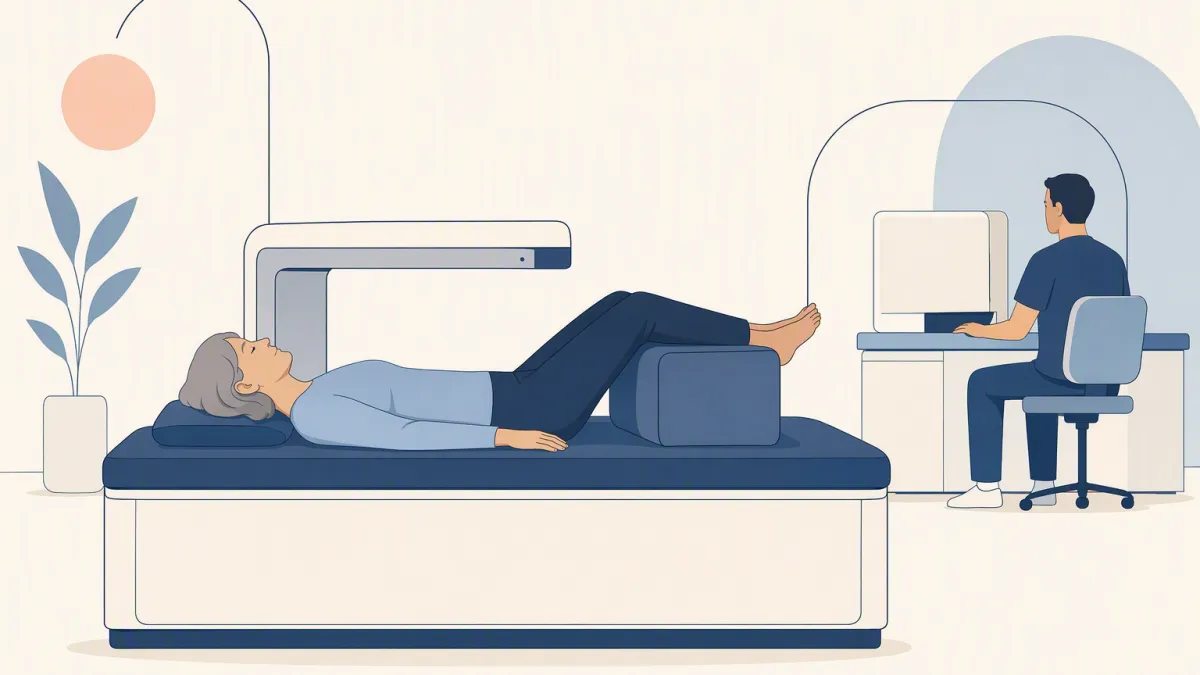
2Lie still on an open tableWear clothing without metal (zippers, underwire). A scanner arm passes slowly above you; nothing touches you and nothing encloses you.
-
3DoneYour coordinator confirms the time on the day. RadiologyInfo estimates the dose at about 0.001 mSv — around three hours of the average US background radiation, and about one-hundredth of a chest X-ray.
Cost and coverage
The live price further down this page is the booking price at New Dawn Health; anything billed separately — such as biopsy or pathology where it applies — is confirmed when you book. What happens after that depends on where your coverage comes from:
- Screening in Taiwan is self-funded for visitors. Short-term visitors are not covered by Taiwan's National Health Insurance, so screening is self-funded.
- Reimbursement at home is a question for your insurer. A plan may pay for bone density only for defined age and risk groups, and may not cover body composition. Ask them before you book.
Results and follow-up
- A written report with your T-score or Z-score and its classification, plus body composition only if it was included. Turnaround and who explains it vary by hospital — your coordinator confirms both when you book.
- A low result starts a conversation. It tells you bone density is reduced, not why.
- Repeat scans need a reason. A clinician repeats DEXA when the result could change your care, ideally on the same machine.