Neither ultrasound needs radiation or an injection. One probe can reach two organs that have nothing to do with each other — but each scan still needs its own reason.
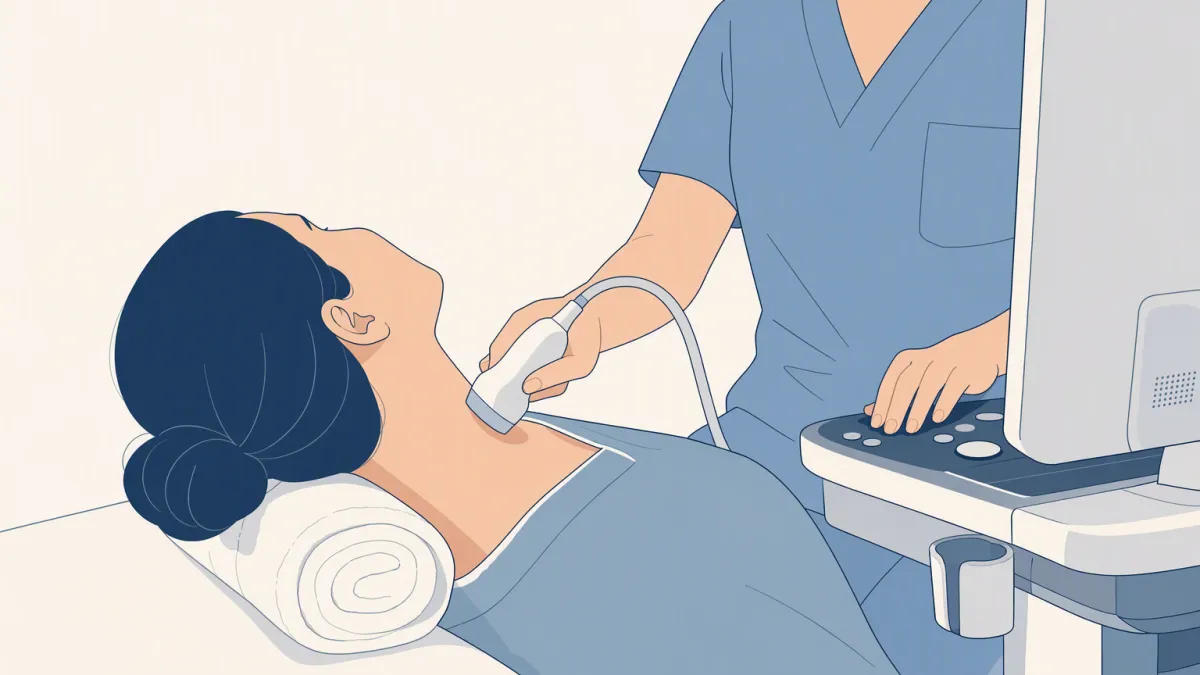
What gets checked, and with what
| Organ | What the test looks for | The test that does it |
|---|---|---|
| Thyroid | Nodules — lumps inside the gland — and whether the gland is under- or over-active | Thyroid ultrasound, plus a TSH blood test on a comprehensive blood panel |
| Carotid arteries | Plaque narrowing the two vessels that carry blood to the brain | Carotid ultrasound |
| Lymph nodes | The size, shape and internal structure of the chain running through the neck | Seen on the same ultrasound, and on a full-body MRI when the neck is imaged |
Thyroid
- Most common finding: a nodule. The American Thyroid Association says about half of people have one by age 60, and most are benign. Whether it is rechecked, and when, depends on its features and size.
- Why scanning everyone is not advised: looking harder finds more small thyroid cancers, and many of those cancers would never have caused harm. When South Korea screened widely, diagnoses rose sharply while deaths did not change (Ahn 2014).
- Thyroid hormone: a TSH blood test checks function, which no scan shows. The USPSTF found the evidence insufficient to screen adults without symptoms for thyroid dysfunction (2015, US).
- Imaging can't: call a nodule cancer. Ultrasound sorts it into "watch" or "look closer"; a needle biopsy of a suspicious one is the next step. It can itself be inconclusive, and some nodules need molecular testing or surgery to settle.
Carotid Arteries
- What the scan is used for: checking plaque and narrowing after a mini-stroke (TIA), a stroke or other neurological symptoms. It is also used when a doctor hears a bruit (a whooshing sound) over the artery.
- Worth knowing: the USPSTF recommends against routine carotid screening in the general adult population. Stroke prevention starts with blood pressure, smoking, diabetes and cholesterol. The carotid ultrasound page sets out that position and the selected cases where the scan is used.
- Imaging can't: see the rest of your circulation. The scan reads the neck segment only, so a clean result is one clear window, not the whole map.
Lymph Nodes
- Why it matters: the neck chain is visible on a neck scan done for another reason, so an enlarged node can be noticed without a separate test.
- Most common finding: small, ordinary-looking nodes. One that is persistently enlarged or abnormal in shape can point to infection or, less often, cancer.
- Imaging can't: see inside a node. Ultrasound describes it from the outside; only tissue sampling settles a suspicious one.
What this region's screening does not cover
What a neck scan gives you
- The structure of the thyroid and the neck arteries, when there is a reason to look
- No radiation, no needle, no contrast dye
- A baseline, so a later scan has something to be compared against
What it does not
- Whether anything found is cancer. That is a biopsy question, not a picture question.
- Thyroid function. A TSH test on a comprehensive blood panel measures that.
- Incidental findings are common here: a small thyroid nodule, a slightly prominent node. Most are harmless and are watched rather than treated.
- Your heart. A clear carotid says nothing about the coronary arteries — a heart calcium score measures calcified plaque there, when the result would change a decision.