
Here's the thing nobody warns you about before a trip to Taiwan: the eye care is excellent and cheap, but the process of getting it is completely unlike what you're used to. There's no front-desk receptionist who takes your insurance, no "we'll call you when the doctor is ready," no separate trip to a pharmacy across town. You walk in, you take a number, you see an eye specialist — often within the hour — and you pay on your way out. Once you've done it once, it's genuinely faster and simpler than a Western clinic. The trick is knowing which door to walk through in the first place, because in Taiwan "eye care" splits into two completely different places: the optical shop where you buy glasses, and the ophthalmology clinic where you fix an actual medical problem. Mix those up and you'll either waste an afternoon or, worse, sit in a glasses shop while your red eye gets angrier.
This guide walks you through the whole thing — when it's a clinic versus a hospital versus the ER, how the 掛號 (registration) ritual works, what a self-pay visit roughly costs, and how to get glasses or contacts fast. It's the eye-care companion to our complete guide to seeing a doctor in Taiwan, which covers the generic patient-journey mechanics every specialty shares.
Optical shop (配眼鏡) vs ophthalmologist (眼科) — pick the right door
This is the single most useful thing to understand, so let's get it out of the way first. Taiwan has two separate worlds for your eyes, and they don't overlap the way they sometimes do back home.
The optical shop (眼鏡行 / 配眼鏡) is a retail store. It sells frames, lenses, and contact lenses, and it'll give you a quick refraction test — the "which is clearer, one or two?" check — usually free, because they want to sell you glasses. These shops are everywhere: near MRT stations, in malls, on busy shopping streets. What they are not is medical. They don't diagnose disease, they don't prescribe medication, and they can't treat an infection or an injury. If your only problem is "I sat on my glasses" or "I'm running low on contacts," this is your door.
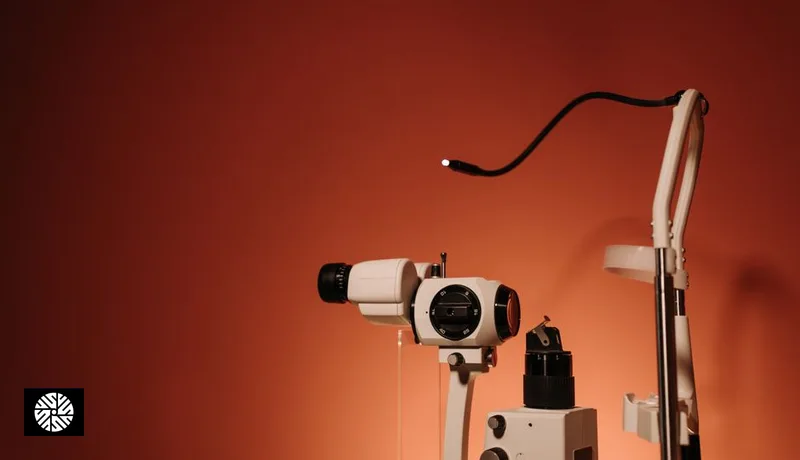
The ophthalmologist (眼科 / yǎn kē) is a medical eye doctor. This is where you go for anything that hurts, looks wrong, or affects your vision unexpectedly — red eye, pink eye, a foreign object, a stye, a contact-lens problem that's gone past annoying, or a sudden change in how you see. 眼科 clinics are standalone neighborhood clinics (診所) as well as departments inside every hospital. They have the proper equipment — the slit-lamp microscope, eye-pressure testing, dilation drops — and they can write you a prescription that an actual pharmacy will fill.
The simplest rule: if it's about buying eyewear, go to an optical shop; if it's about a problem with the eye itself, go to 眼科. When in doubt, go to the 眼科 — an eye doctor can always also write you a glasses prescription, but a glasses shop can't treat your eye.
Eye care in Taiwan in 60 seconds
Taiwan runs on a walk-in culture. You generally don't need a referral to see a specialist — no GP gatekeeper, no waiting weeks for a slot. You can walk straight into an 眼科 clinic or even an eye department at a large hospital and be seen the same day. For locals, the National Health Insurance (NHI) card makes this almost absurdly cheap. As a short-term visitor, you won't have an NHI card, so you'll pay self-pay (自費) — still very reasonable by Western standards, and clinics are used to treating foreigners this way.
The flow, every time, is the same six beats: find the right place, register at the 掛號 counter, take a number, see the doctor, do any tests in the same visit, then pay at the cashier and pick up meds on your way out. The reversal that trips people up is that you pay at the end, not the start. Let's walk it.
Step 1 — Clinic vs hospital vs ER
For the overwhelming majority of eye problems on a trip — pink eye, a stye, mild irritation, a contact stuck or scratchy, dry or gritty eyes — a neighborhood 眼科 clinic (診所) is the right call. It's faster, cheaper, and the doctors handle these dozens of times a day. You can find one by searching "眼科" plus your district on a map app; look for the green-cross or hospital-style signage and the characters 眼科.
Go to a hospital eye department instead when the problem is more serious or you want imaging and sub-specialists on hand — a deep or embedded foreign body, an injury that's more than superficial, or anything where you'd rather have a full hospital around you. Taiwan's hospitals are tiered, and a regional hospital or medical center has the heaviest equipment and the international patient desks; our guide to Taiwan's hospital tiers explains how clinics, regional hospitals, and medical centers differ and when to choose each.
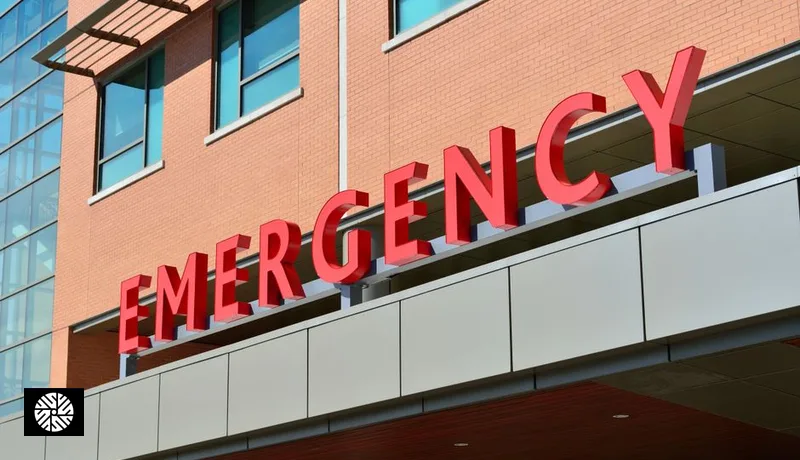
Go straight to the emergency room — do not wait for a clinic to open — if you have any of the red-flag emergencies covered below: a chemical splash, sudden vision loss, or significant trauma to the eye. We'll flag those clearly in their own section. For how ER triage and self-pay billing work, see our emergency room guide for foreigners.
Step 2 — Register at the 掛號 counter
Walk in and look for the 掛號 (guà hào) counter or kiosk — this is registration, and it's the first stop, before you see anyone medical. Larger hospitals often have self-service touchscreen kiosks; smaller clinics have a human at a desk. Either way, on a first visit you'll fill out a short registration form with your basic details and show your passport as ID. (Taiwanese patients tap their NHI card here; as a self-pay visitor you'll register as 自費.) Tell them, or write, "眼科" so you're queued for the eye doctor.
You don't need an appointment for most clinics — same-day walk-in is the norm. Some hospitals let you book a specific doctor's session online or through their app in advance, which can shave your wait, but it's optional. Bring your passport, a payment method (card and some cash — small clinics may be cash-only), and your insurance details if you have travel insurance and plan to claim later. Once you're registered, you're handed a number.
Step 3 — Take a number and watch the board
Registration gives you a number ticket, and then you wait in the seating area and watch a digital call-up board. The board shows which number each doctor's room is currently seeing; when yours comes up, you go in. The display and any audio announcements are in Mandarin, but the system is visual — you're matching your printed number to the number on the screen, so you don't need to read Chinese to follow it. If you're unsure which room corresponds to your number, the 掛號 staff will point you the right way.
Waits vary a lot by clinic and time of day — a quiet neighborhood 眼科 might see you in fifteen minutes; a popular doctor at a big hospital could run longer. There's no universal number, so don't anchor on one; just keep an eye on the board.
Step 4 — See the doctor
Taiwanese consultations are efficient — often surprisingly short by Western standards. The doctor will ask what's wrong, look at your eye (usually at the slit-lamp microscope, with your chin on a rest), and form a plan. This isn't a sign of being rushed; it's how the system runs high volumes while staying thorough. Come in with your symptoms ready in a sentence or two: when it started, which eye, whether it hurts, whether your vision changed, and — critically — whether you wear contact lenses, because that changes how an eye doctor thinks about a red or painful eye.
English varies. At major hospitals and medical centers, especially through their international patient centers, you'll usually find English-speaking eye doctors. At a small neighborhood clinic, it's hit-or-miss — some doctors trained abroad and are fluent, others less so. A translation app on your phone bridges the gap nicely; typing or showing the key facts (symptoms, contact-lens use, any allergies, current medications) works well. If English support matters to you, lean toward the hospital international centers described further down.
Step 5 — Tests in the same visit
One of the genuinely nice things about Taiwan's system is that the tests usually happen right then, in the same visit — no separate appointment, no second trip. For eye problems that typically means a vision check (reading a chart), a slit-lamp examination (the microscope that lets the doctor see the surface of your eye in detail, often with a harmless orange dye called fluorescein to reveal scratches or foreign material), and sometimes an eye-pressure test. If your vision changed and the doctor needs to see the back of your eye, they may use dilating drops — be aware these blur your near vision and make you light-sensitive for a few hours, so don't plan to drive or read fine print right after, and bring sunglasses.
Step 6 — Pay at 批價, collect meds at 領藥
Here's the reversal that surprises first-timers. After the doctor, you don't pay at the room — you take your paperwork to the 批價 (pī jià) cashier window and settle up there. As a self-pay foreigner, this is where your total is calculated: the consultation plus any tests and procedures. Pay, and keep the itemized receipt — you'll need it if you're claiming on travel insurance later.
If the doctor prescribed eye drops or medication, you then go to the 領藥 (lǐng yào) pharmacy window — usually right there in the clinic or hospital — hand over your prescription slip, and collect your meds. For most eye complaints you'll walk out with everything in hand. That's the whole loop: register, number, doctor, tests, pay, collect. No referral needed at any point to see the specialist or to go to a bigger hospital.
One important caveat: Taiwanese pharmacies will not fill a prescription written by a doctor back home. If you rely on a specific eye medication, you can't just hand a foreign script over the counter — you'll need to see a local eye doctor to get an equivalent prescribed. Bring the name of the drug (the generic name helps) and a photo of the packaging to make that conversation easy.
What it costs as a self-pay foreigner
Without an NHI card you pay self-pay (自費), and the honest answer is that it's still very affordable compared with the US or Western Europe. As a rough guide, a self-pay specialist eye visit tends to run somewhere in the region of NT$1,500–5,000 (roughly US$45–155), depending on the tier of facility and whether you need imaging or extra procedures. A simple consultation for something like mild pink eye sits toward the lower end; a hospital visit with more involved testing climbs higher.
Treat every number here as approximate — prices vary by clinic, by city, and over time, and the only reliable figure is the one the 批價 window gives you. Confirm on site. If cost matters to you, it's completely normal to ask the 掛號 staff for an estimate of the self-pay fee before you register. Glasses and contact lenses, bought at an optical shop, are a separate retail cost entirely and aren't part of a medical visit.
Eye emergencies — when to skip the clinic and go to the ER
Most eye problems are not emergencies. A few absolutely are, and for these you should not wait for a clinic — go to a hospital emergency room immediately, and if you can't get there safely, call 119 for an ambulance (Taiwan's emergency number is 119, not 911). If you have poor phone reception or can't communicate, 112 also connects to emergency services. Treat the following as red flags:
- Chemical splash in the eye. Any chemical — cleaning products, solvents, pool chemicals — is a true emergency. Alkali splashes in particular can damage sight fast. The first-aid step taught by eye authorities is to flush the eye immediately with clean water for a sustained period (think many minutes of continuous rinsing) and get to emergency care right away, ideally while still flushing en route.
- Sudden loss of vision, or a sudden curtain, shadow, or burst of new floaters and flashing lights. Sudden vision loss is treated as an ophthalmic emergency — get assessed urgently, because some causes are time-critical for saving sight.
- Trauma to the eye — a hard blow, a penetrating injury, or anything that has cut or pierced the eye. Do not press on it or try to remove an embedded object yourself; cover it lightly and get to the ER.
- Severe eye pain with vision change, especially with intense redness, halos around lights, nausea, or a fixed cloudy eye — get seen the same day.
For a foreign object that's loose on the surface — an eyelash, grit, a fleck of dust — you can usually blink, let tears wash it out, or gently rinse with clean water or saline, and see an 眼科 clinic if irritation persists. But anything stuck, embedded, or hammered/drilled into the eye is an ER trip, not a DIY one. When you're unsure whether something counts as an emergency, err toward the ER; our emergency room guide walks through how triage and self-pay billing work there.
Getting glasses and contacts fast
This is the easy, pleasant side of eye care in Taiwan — and the country is genuinely good at it. Optical shops (眼鏡行) are plentiful, the service is quick, and you can often walk out the same day with new glasses. The typical flow: pick frames, get a quick refraction test in-store, choose your lenses, and either wait while they're cut (many shops do single-vision lenses on the spot or within a couple of hours) or come back later for more complex prescriptions.
A few practical notes for travelers:
- Bring your current prescription if you have it — it speeds things up — but most shops will measure you for free anyway.
- Replacing lost or broken glasses is one of the smoothest errands you can run here; the price range is wide depending on frames and lens coatings, so shop around a little.
- Contact lenses are widely available. If you know your exact parameters (power, base curve, brand), restocking is simple. If you're switching brands or aren't sure of your fit, it's worth getting checked properly — an ill-fitting lens is a fast route to the red, painful eye that lands you back in 眼科.
- If you have any medical concern alongside the vision issue — irritation, infection, an old eye condition — start at the 眼科 doctor, get the all-clear and a prescription, then take that to the optical shop.
Finding English-speaking eye doctors
If language is a worry, you have good options. The most reliable route is a large hospital's international patient center — most major medical centers in Taipei and other big cities run dedicated international desks with English-speaking staff who can route you to an English-speaking ophthalmologist and help with self-pay logistics. Many Taiwanese eye specialists trained abroad, so English fluency at the hospital tier is common.
For a vetted starting point, the American Institute in Taiwan (AIT) publishes regional lists of physicians and medical providers — covering Taipei, Taichung, Kaohsiung, Tainan, and beyond — and notes that the providers on those lists speak English. It's not exhaustive, but it's a trustworthy place to begin, and it's useful for any specialty, not just eyes. Combine that with a hospital international center and you've got English-language eye care covered.
Common scenarios on your trip
"My eye is red, gunky, and crusting over in the morning." That pattern is classic conjunctivitis (pink eye), which is often very contagious — wash your hands, don't share towels or pillows, and stop wearing contacts until it clears. Go to an 眼科 clinic; the doctor will examine you and, depending on the cause, may prescribe drops. It's a routine clinic visit, not an ER trip — unless your vision is affected or the pain is severe.
"Something flew into my eye on the scooter." If it's loose grit and rinsing clears it, you're probably fine — see a clinic if it stays scratchy, since something can leave a small abrasion. If it's embedded, or it hit your eye at speed (think metal, glass, or anything sharp), that's an ER visit, not a rinse-it-yourself situation.
"My contact lens problem went from annoying to painful." Take the lens out and leave it out. A contact-lens-related red, painful, light-sensitive eye can be a corneal infection, which eye doctors take seriously. Get to an 眼科 clinic promptly — same day — and bring your lens case and solution so the doctor knows what you've been using.
"I've got a painful red lump on my eyelid." That's most likely a stye — common, usually not dangerous, and often settles with warm compresses. An 眼科 clinic can confirm and treat it if it's stubborn or very painful. No emergency unless the whole lid or area around the eye becomes swollen, hot, and rapidly worse.
"My vision suddenly changed and I don't know why." Don't wait this one out. Sudden vision changes — loss, a shadow, a shower of new floaters with flashes — warrant urgent assessment. Head to a hospital eye department or the ER rather than a small clinic, because some causes are time-sensitive.
The reassuring reality is that Taiwan makes eye care remarkably easy to access once you know the map — optical shop for eyewear, 眼科 for problems, ER for the rare true emergency. Do it once and the whole 掛號-number-doctor-批價-領藥 rhythm becomes second nature. If you want the bigger picture of navigating Taiwanese healthcare as a foreigner, our complete doctor guide ties all of it together, and the sibling guides for ear, nose & throat and skin problems follow the exact same process spine for their specialties.
Sources & Further Reading
- National Health Insurance Administration (Taiwan) — official English site
- American Institute in Taiwan — English-speaking physicians & medical providers list
- American Academy of Ophthalmology — Conjunctivitis (Pink Eye)
- American Academy of Ophthalmology — Recognizing and treating eye injuries
- New Dawn Health — How to See a Doctor in Taiwan: Complete Guide for Foreigners
- New Dawn Health — Emergency Room in Taiwan: A Guide for Foreigners
- New Dawn Health — Taiwan Hospital Tiers: From Clinics to Medical Centers
This article is general information for travelers, not medical advice. Prices are approximate and change; confirm with the clinic and your insurer. For sudden vision loss, eye trauma, or chemical exposure, seek emergency care immediately — call 119.
US / UK terms and the closest Taiwan context
Read this first: These are comparison aids, not claims that coverage, credentials, or care pathways are equivalent. Europe is not one health system; UK examples below refer specifically to NHS England.
PCP / primary care provider; GP / general practitioner
- What it means there
- In the US, a primary care provider may provide prevention, common-illness care, and care coordination. In NHS England, a registered GP commonly coordinates access to non-emergency specialist care.
- Closest Taiwan context
- The closest starting point is a community clinic or family medicine department (基層診所/家庭醫學科).
- Do not treat as equivalent
- Taiwan does not use one universal PCP or GP gatekeeping model. NHI promotes community-first, tiered care, but its referral policy does not make a referral a universal prerequisite to every hospital visit.
- What to ask
- Ask whether this visit is the right first contact, whether direct specialist registration is accepted, and whether a referral changes the appointment or NHI copayment.
Referral
- What it means there
- A US plan, especially an HMO, may require a PCP referral for coverage. In NHS England, specialist hospital care is generally accessed through a GP referral.
- Closest Taiwan context
- Taiwan uses a referral form and two-way referral process (轉診/雙向轉診) when clinical needs call for another facility or level of care.
- Do not treat as equivalent
- A US insurance referral, an NHS clinical access route, and a Taiwan NHI referral do not create the same rights or payment result. Taiwan NHI says referral need not proceed one hospital level at a time and does not universally prohibit direct hospital visits.
- What to ask
- Ask who issues the referral, its validity period, the named facility and department, whether registration is arranged, and what happens to the copayment.