What is a pelvic ultrasound?
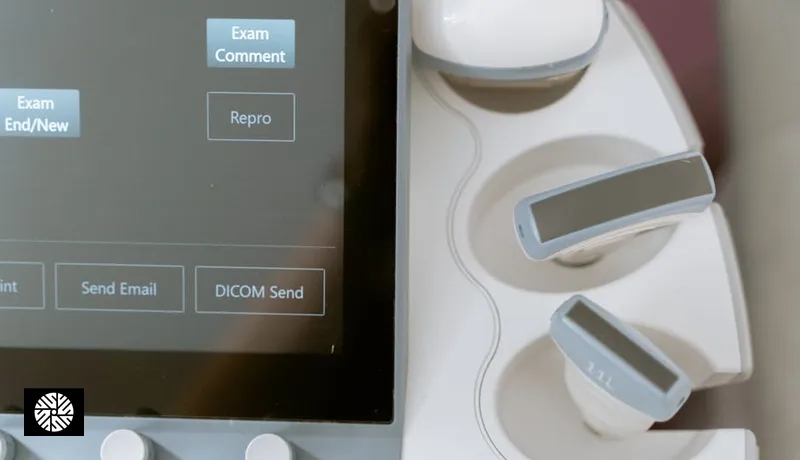
A pelvic ultrasound uses sound waves to make pictures of the organs low in the belly. In women it looks mainly at the uterus, its lining and the ovaries. It is also called a gynecological ultrasound.
It can be done in two ways. Some visits use both, one after the other:
| Approach | How it is done | Bladder | What it is best at |
|---|---|---|---|
| Transabdominal | A probe with gel moves over the lower belly | Full; you may be asked to drink water beforehand | A wide view of the pelvis, including a large uterus |
| Transvaginal | A slim, covered probe is placed a short way into the vagina | Empty, or partly filled | A closer view of the lining of the uterus and the ovaries |
Which approach your clinic uses is confirmed by your coordinator when you book.
What it can find, and what it cannot
A pelvic ultrasound answers questions about the shape and size of the pelvic organs. It does not test cells, so it cannot screen for every cancer in the pelvis.
- Fibroids: noncancerous growths in the uterus, with their size and position
- The lining of the uterus (endometrium), measured as a thickness in millimeters
- Ovarian cysts, and whether a cyst looks simple (thin-walled and filled only with fluid)
- Small follicles in the ovaries, counted as part of a fertility work-up
- Other causes of pain or bleeding, such as an abscess, a twisted ovary or a pregnancy outside the uterus
- Cervical cancer screening: that is a Pap or HPV test at a gynecology exam. New Dawn Health's catalog does not list one.
- Ovarian cancer screening in women without symptoms: no test does this reliably. With a strong family history, ask about genetic counseling instead.
- The breasts: breast imaging is a separate scan.
- Whether the fallopian tubes are open: an HSG X-ray in a fertility assessment checks that.
- The liver, gallbladder and kidneys: an abdominal ultrasound looks at them.
- A mass that is not clearly a simple cyst: a repeat scan or a pelvic MRI can characterize it; a gynecologist decides.
Who should have one, and who should skip it
A pelvic ultrasound works best when it answers a question. The table follows the reasons RadiologyInfo and MedlinePlus give, and the guidance named in each row:
| Your situation | Does it fit? |
|---|---|
| Pelvic pain, or painful periods | Yes. See a doctor too; sudden severe pain means an emergency call. In Taiwan call 119 (the local equivalent of 911). |
| Heavy, irregular or between-period bleeding | Yes. It looks for fibroids or a thick lining. |
| Known fibroids or an ovarian cyst to re-measure | Yes. Bring the earlier report so sizes can be compared. |
| A fertility work-up | Yes. It checks the uterus and counts follicles, beside an AMH blood test. |
| Any bleeding after menopause | Yes. A transvaginal scan of the lining is a first step (ACOG). |
| No symptoms; you want "ovarian cancer screening" | No. The US Preventive Services Task Force recommends against it (grade D). |
| After menopause, no bleeding; you want the lining checked for cancer | No. ACOG says the scan is not an appropriate screening tool for this. |
| You want cervical cancer screening | Wrong test. A Pap or HPV test does that. |
| A BRCA variant or a strong family history of ovarian cancer | Not as a screen. The USPSTF advises genetic counseling for women whose family history suggests BRCA risk. |
Getting a pelvic ultrasound in Taiwan
Taiwan's Health Promotion Administration (HPA) has two cancer screening programs specific to women. Neither one is an ultrasound, and there is no national pelvic-ultrasound program:
- Cervical: a Pap test at ages 25–29 every 3 years; from 30, subsidized yearly (HPA recommends at least every 3 years). An HPV test once at each of 35, 45 and 65.
- Breast: mammography for women 40–74, every 2 years.
New Dawn Health books a pelvic ultrasound in three ways. Routes that can be booked alone are listed with their live price further down this page:
- With a gynecologist. iHope Clinic's Gynecological Consultation & Ultrasound, and the Taiwan Adventist Hospital OB Gyn Appointment, which states that it includes an ovaries and uterus ultrasound.
- Inside a check-up package. At Central Clinic & Hospital Healthcare Center, Vital and Convenient Pro - Package C include a gynecological ultrasound for women. In the Convenient Pro - Holistic Exam, it is one of the ultrasounds you can choose. At Beitou Health Management Hospital, the Advanced Package with Brain MRA lists one.
- As an add-on. A gynecological ultrasound is among the add-on ultrasounds at Central Clinic, depending on the package.
The fertility packages also include a pelvic ultrasound with a fertility doctor; the fertility assessment page covers them.
What happens on the day?
-
1Before you goTell your coordinator the date of your last period and whether you could be pregnant. For a fertility scan, the timing in your cycle matters. Your coordinator confirms the instructions when you book.
-
2The transabdominal scanYou may be asked to drink water and not empty your bladder. A full bladder helps the uterus show clearly. Gel goes on your lower belly and the probe moves over it.
-
3The transvaginal scanYou empty your bladder and undress from the waist down. You lie on your back with your knees bent. A covered, lubricated probe goes a short way into the vagina. Most women feel mild pressure, not pain.
-
4If you would like a chaperoneYou can ask for a chaperone or a female clinician. Your coordinator confirms what the clinic can offer.
-
5AfterwardsYou wipe off the gel and carry on with your day. RadiologyInfo says these scans are usually completed within 30 minutes; your coordinator confirms the visit time.
Reading your report
A report lists the size of the uterus, any fibroids, the thickness of the lining and both ovaries. Three findings cause the most questions.
A simple ovarian cyst found by chance
Before menopause, most simple cysts are follicles or the cyst left after ovulation. MedlinePlus says such cysts often go away on their own within 8 to 12 weeks. The US Society of Radiologists in Ultrasound (SRU) found that a well-seen simple cyst carries an exceptionally low risk of cancer. Its 2019 consensus sets when one needs another scan:
| Largest size of the cyst | Before menopause | After menopause |
|---|---|---|
| 1 cm or less | Normal; no follow-up | Normal; no follow-up |
| Over 1 cm, up to 3 cm | Normal; often called a follicle | Benign; no follow-up needed |
| Over 3 cm, up to 5 cm | Benign; no follow-up needed | Usually a follow-up scan; none if exceptionally well seen |
| Over 5 cm, up to 7 cm | Usually a follow-up scan; none if exceptionally well seen | Follow-up scan |
| Over 7 cm | Follow-up scan, sometimes MRI; a gynecologist decides | Follow-up scan, sometimes MRI; a gynecologist decides |
- A cyst that shrinks needs no more scans. The SRU says follow-up ends once a cyst is at least 10–15% smaller.
- The table is not for everyone. It does not apply when the cyst itself causes symptoms, or with a high genetic risk or a strong family history.
- A cyst with solid parts, thick walls or blood flow is not simple. It is described with different terms, and a gynecologist decides the next step.
The lining after menopause
A ladder like this is the general pattern, not a rule your case must obey. Reporting conventions differ between hospitals, and two experienced clinicians can read the same finding and reasonably advise differently. Where your report or your doctor differs from this table, go with them — they are looking at your actual result.
Bleeding is the reason this matters. ACOG notes that bleeding is the presenting sign in more than 90% of postmenopausal women with endometrial cancer. Bleeding that continues or comes back needs more tests, even after a reassuring scan.
Follicles counted for fertility
The antral follicle count is the number of small follicles in both ovaries, usually 2–10 mm across. It is counted by transvaginal scan early in the cycle. The American Society for Reproductive Medicine (ASRM) notes that studies show it is equivalent to the AMH blood test:
- Both predict how many eggs IVF stimulation is likely to yield. Neither is a good guide to your chance of conceiving naturally.
- They can disagree. ASRM cites one study in which AMH and the count were discordant up to 30% of the time.
- A fertility doctor reads them together, with your age. The fertility assessment page explains AMH.
What are the risks?
Ultrasound uses no radiation. RadiologyInfo says standard diagnostic ultrasound has no known harmful effects on humans. A transvaginal scan may cause mild pressure. The real risks come from the result:
- Surgery for a false alarm. In screening trials, some women without cancer had ovaries or tubes removed after an abnormal result (USPSTF).
- Repeat scans for harmless cysts. The SRU wrote its thresholds to spare women follow-up, anxiety and surgery for benign cysts.
- Tests that chase a chance finding. A thicker lining after menopause, with no bleeding, does not routinely need more tests (ACOG).
- False reassurance. A normal scan says nothing about the cervix or the breasts. It does not rule out ovarian cancer later.
Results & follow-up after you fly home
When the report arrives, in which language, and who explains it are confirmed when you book. What follows depends on what it says:
-
1Keep the written reportIt gives the size of the uterus and any fibroids, the thickness of the lining, and any cyst with its size. A doctor at home needs those numbers.
-
2Ask for the imagesAsk whether the clinic can release the images in DICOM, the standard format for medical images. A later scan is more useful when compared with this one.
-
3See a gynecologist if anything is flaggedA cyst above the SRU size limits, a cyst that is not simple, or a thick lining after menopause goes to a gynecologist. Take the report and images with you.
-
4Let the gynecologist set any repeat scanA functional cyst is often rechecked weeks later to see if it is gone. Fibroids without symptoms may need no treatment at all.
-
5Act on symptoms, whatever the report saidBleeding after menopause, new pelvic pain or bleeding between periods needs a doctor. Sudden severe pain means an emergency call. In Taiwan call 119 (the local equivalent of 911).
Cost and coverage
The live prices further down this page are New Dawn Health's booking prices for the routes above. What each one covers differs:
- Packages include the scan among many tests. Each package card lists what it covers.
- The gynecologist routes add a doctor's visit. Your coordinator confirms what the visit includes when you book.
- Short-term visitors are not covered by Taiwan's National Health Insurance, so screening is self-funded.
- Reimbursement at home is a question for your insurer. Ask before you book whether your plan pays for a scan done abroad.