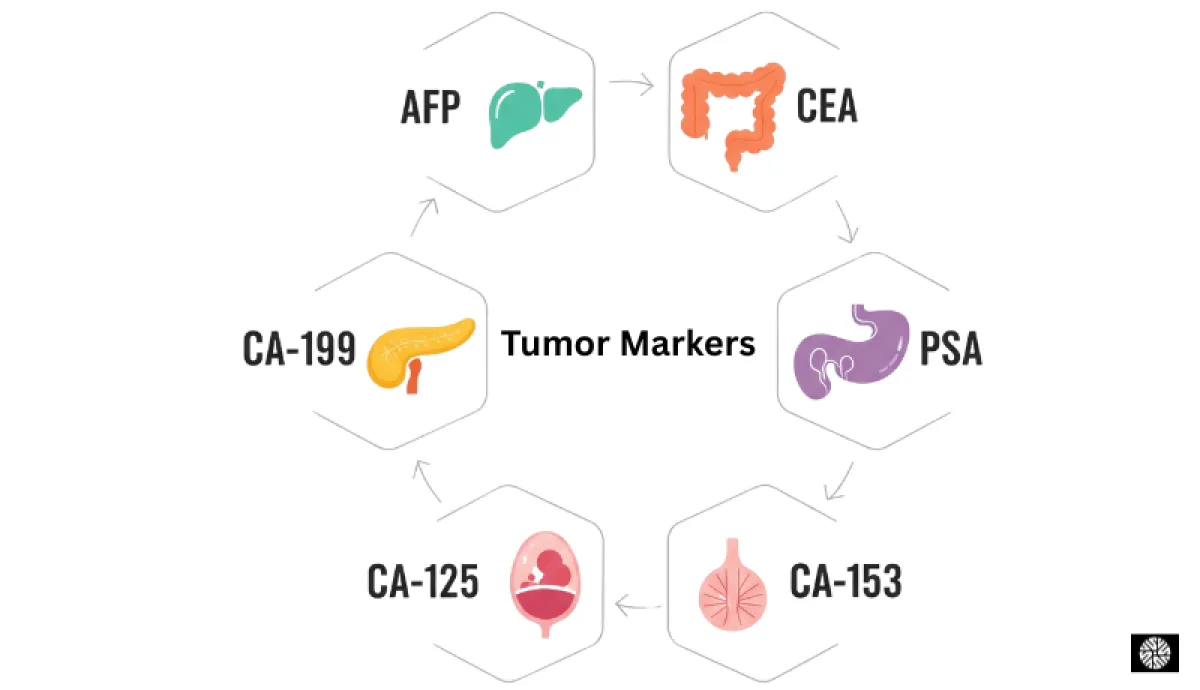
What are tumor markers?
A tumor marker is a substance made by cancer cells, or by the body in response to cancer. Most of the ones in a health-check panel are proteins measured in a blood sample.
The catch is in the word "marker". Healthy and inflamed tissue makes the same substances, and not every cancer makes them. So a marker level is a clue that needs context, never an answer on its own. The comprehensive blood panel page explains how the rest of a blood test is read.
The six markers most panels include
Panels differ by package, and the package card lists the markers it includes. These six are the most common:
| Marker | Linked with | Can also rise with | Established use (NCI) |
|---|---|---|---|
| CEA | Colorectal and some other cancers | Smoking, gastritis, ulcers, COPD, liver disease, inflammatory bowel disease | Checking treatment and watching for recurrence |
| AFP | Liver cancer, some ovarian and germ cell tumors | Cirrhosis, chronic hepatitis B or C, other liver disease | Helping diagnosis and following treatment |
| CA-125 | Ovarian cancer | Menstrual periods, pregnancy, endometriosis, fibroids, pelvic infection, liver disease | Helping diagnosis, response to treatment, recurrence |
| CA 19-9 | Pancreatic, gallbladder, bile duct and stomach cancers | Gallstones, pancreatitis, liver disease; healthy people can be high | Checking whether treatment is working |
| PSA | Prostate cancer | An enlarged prostate, prostatitis, urinary infection, some medicines | Helping diagnosis, response to treatment, recurrence |
| Cyfra 21-1 | Lung cancer | Not specific to cancer; ask a physician to interpret any rise | Monitoring for recurrence |
Read the last column closely. For every marker, the established job is tracking a cancer that has already been found. None of them is listed for finding cancer in people without symptoms.
Why they are not a cancer screen
A screening test has to work in healthy people, where cancer is rare. In that setting, a test that misses some cancers and flags harmless conditions produces mostly false alarms. Each alarm then leads to more tests, and sometimes to surgery, in people who never had cancer.
That is not a theory. Named guideline bodies have looked at the evidence marker by marker:
| Body | Position |
|---|---|
| US National Cancer Institute | Tumor markers have generally not worked well for screening; they are not sensitive enough |
| ASCO (American Society of Clinical Oncology, 2006) | CEA is not recommended as a screening test for colorectal cancer; CA 19-9 is not recommended as a screening test for pancreatic cancer |
| USPSTF (US, 2018) | Recommends against ovarian cancer screening, CA-125 included, in women without symptoms or a known hereditary syndrome |
| USPSTF (US, 2019) | Recommends against pancreatic cancer screening in adults without symptoms; no validated early-detection biomarker exists |
What a false alarm costs
The ovarian evidence shows the harm in numbers. In the US PLCO trial, 9.6% of women had a false-positive result over six rounds of CA-125 plus ultrasound. Some had surgery to check, and the USPSTF reports that up to 15% of those operated on had major complications.
- False reassurance: some people do not make CA 19-9 at all, even with a cancer that usually produces it.
- False alarm: smoking alone raises CEA, and liver disease raises several markers at once.
- Lost time: a normal panel can delay a proven screen, such as a stool test for colorectal cancer.
Taiwan's own programmes reflect this. Government-funded cancer screening uses stool tests, mammography, Pap and HPV tests, low-dose lung CT, oral exams and an H. pylori stool test. None uses a blood tumor marker.
PSA: the separate case
PSA is the one marker with a screening recommendation of its own. The US Preventive Services Task Force (USPSTF) treats it as a choice, not a routine test:
| Men aged | USPSTF position |
|---|---|
| 55–69 | An individual decision, made after discussing benefits and harms with a clinician (grade C) |
| 70 and over | Recommends against PSA-based screening (grade D) |
The harms are the reason for the caution. A raised PSA can lead to a prostate biopsy, and some raised results are false positives. The USPSTF also estimates that 20% to 50% of men diagnosed through screening may be overdiagnosed — found with a cancer that would never have harmed them.
When tumor markers are useful
Markers earn their place when the question is narrow and a specialist is asking it:
- Monitoring a known cancer: ASCO recommends CEA every three months after surgery for stage II and III colorectal cancer, for at least three years, when further treatment is possible.
- Liver cancer surveillance in high-risk people: in cirrhosis or chronic hepatitis, AFP may be paired with a liver ultrasound every six months. AASLD guidance sets out who qualifies.
- Very high ovarian risk: for people with a BRCA1, BRCA2 or Lynch syndrome change, a specialist may suggest CA-125 checks.
- Lung cancer: Cyfra 21-1 helps monitor recurrence; screening itself is a low-dose lung CT for people who meet the criteria.
Nasopharyngeal cancer is a different kind of exception. A 2017 Hong Kong study screened 20,174 people without symptoms using plasma EBV DNA, a viral test rather than a protein marker. A positive result led to a repeat test, then endoscopy and MRI.
What a marker panel can't tell you
- The level of each marker against the laboratory's reference range
- Change over time, when the same test is repeated at the same lab
- A baseline, if a physician has a reason to follow one marker
- Rule out colorectal cancer. A stool test or colonoscopy is the proven screen.
- Rule out breast cancer. Mammography is the proven screen.
- Rule out lung cancer. A low-dose lung CT screens people who meet the criteria.
- Show the liver. An abdominal ultrasound images it; AFP alone cannot.
- Diagnose cancer. Only a biopsy, read by a pathologist, does that.
Before your blood draw
-
1Check what is in your panelThe package card lists the markers. Your coordinator confirms fasting and other preparation when you book.
-
2Tell the team what you takeMention supplements, including biotin, which can interfere with some lab tests, and any urinary infection, which can raise PSA.
-
3Note anything that raises markersSmoking raises CEA, and a menstrual period or pregnancy can raise CA-125. Knowing this helps whoever reads the result.
Cost and coverage
The live price further down this page is the booking price at New Dawn Health. Whether a marker panel is the right purchase is a separate question from its price:
- Screening in Taiwan is self-funded for visitors. Short-term visitors are not covered by Taiwan's National Health Insurance, so screening is self-funded.
- Reimbursement at home is a question for your insurer. A plan may treat tumor markers as monitoring tests rather than screening. Ask them before you book.
Results and follow-up
-
1A normal resultIt does not rule out cancer. Keep up the screening that is proven for your age and risk.
-
2A raised resultDo not act on one value. A physician usually repeats the test and looks for a harmless cause first.
-
3If it stays raisedThe next step depends on the marker: imaging of the organ it points to, or a specialist referral. Only a biopsy diagnoses cancer.
Report language and turnaround vary by clinic; your coordinator confirms when you book.