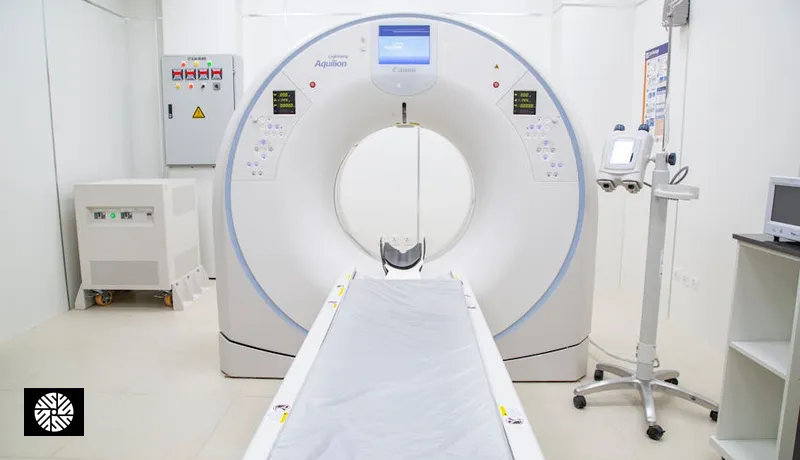
What is a low-dose lung CT?
A low-dose lung CT — often shortened to LDCT — is a quick, needle-free chest scan that looks for early lung cancer. RadiologyInfo estimates its dose at about 1.5 millisieverts, against about 6.1 for a standard chest CT.
It is screening with trial evidence behind it. In the US National Lung Screening Trial, low-dose CT cut lung-cancer deaths by about 20% compared with chest X-ray in high-risk smokers. Lungs share the chest with the heart — the chest, heart and lungs page explains why no single scan reads everything there.
What it can and cannot see
- Lung nodules — small spots in the lung, often before any symptom
- Other visible chest changes, such as emphysema
- Whether a nodule is cancer. A single scan cannot say; follow-up imaging or a biopsy decides.
- Coronary calcium. A calcium-score CT measures it in selected people; it does not measure overall heart risk.
- Organs below the chest. LDCT does not assess them. The right test depends on the organ and the question; an abdominal ultrasound is one option.
Who is eligible
The trial evidence comes from defined risk groups, so both Taiwan and the US screen by risk.
| Group | Taiwan (funded, every 2 years) | US (annual) |
|---|---|---|
| Family history | A parent, sibling or child with lung cancer: men 45–74, women 40–74 | Not an eligibility criterion |
| Smoking history | Ages 50–74, at least 20 pack-years, who currently smoke and are willing to quit, or who quit less than 15 years ago | Ages 50–80, at least 20 pack-years, still smoking or quit within the past 15 years |
A pack-year is one pack a day for a year. Neither system offers screening simply because of East Asian ancestry, or because someone would like a baseline.
Why the US rulebook travels badly
The US trials enrolled smokers, and the USPSTF recommendation drew on them and on modeling studies of smokers. But in Taiwan, lung cancers occur predominantly in never-smokers, many of them women. A rule built only on smoking misses them. Taiwan's own study:
- What Taiwan studied: the TALENT study scanned 12,011 never- or light smokers aged 55–75 who had a risk factor.
- What it found: invasive lung cancer turned up in 2.7% of those with a family history, against 1.6% without one.
- What it did not show: TALENT reported how many cancers were found, not whether screening saved lives.
- The authors' own caveat: some of the cancers found may have been overdiagnosed, especially the earliest, non-invasive ones.
That is why Taiwan added the family-history group. For never-smokers, a family history is the group Taiwan funds, not every never-smoker. TALENT shows higher detection in that group, not a mortality benefit.
What to expect on scan day
-
1Before the scanTell the team if you could be pregnant: CT is generally not recommended in pregnancy unless medically necessary. No injection or contrast is used for a screening LDCT.
-
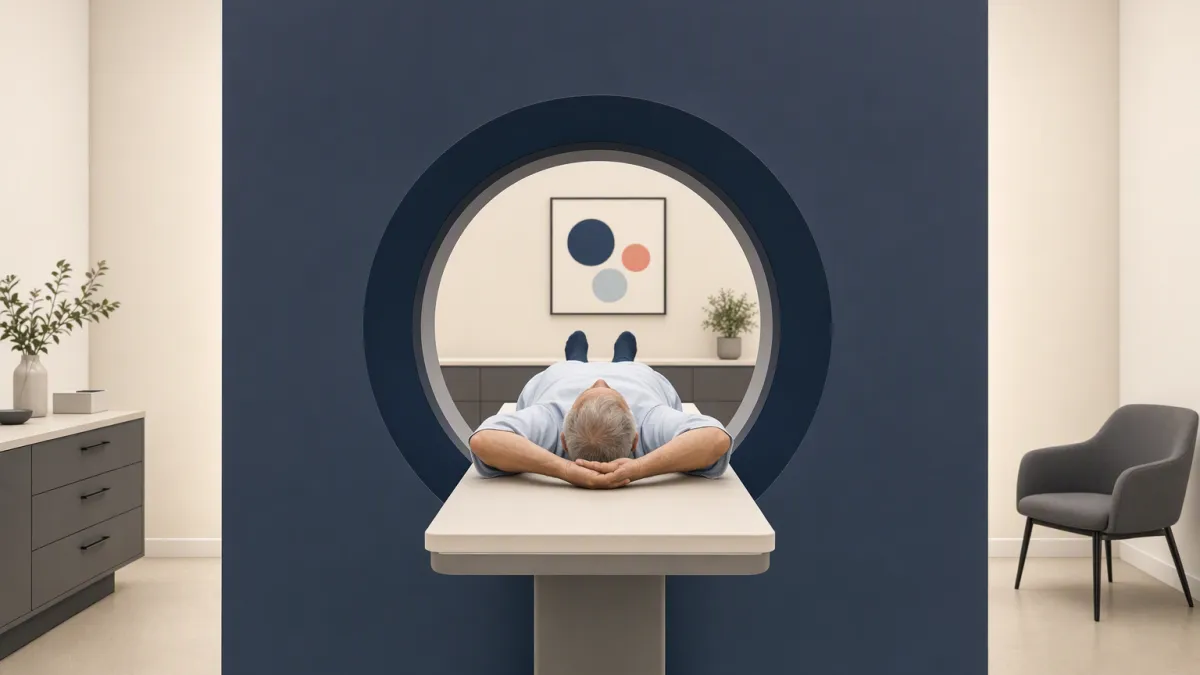
2Lie down and hold your breathYou lie on the CT table with your arms above your head. The scanner sweeps the chest during one short breath-hold.
-
3DoneThe scan takes seconds; your coordinator confirms the total time on the day. The dose is about 1.5 mSv — roughly six months of the average US background radiation, per RadiologyInfo — and varies with the scanner and your body size.
What a nodule finding actually means
If the scan found a nodule, here is the part worth reading twice: most lung nodules found on screening are benign. They are often the scar of a past infection or a small lymph node. A scanner sensitive enough to catch a cancer at a few millimeters also catches all of this.
Finding nodules is not the scan failing. Sorting the few that need watching from the many that do not is the scan's actual job.
Size is the first thing the radiologist looks at
Size is not a verdict, but it is the strongest single clue on a first scan:
A ladder like this is the general pattern, not a rule your case must obey. Reporting conventions differ between hospitals, and two experienced clinicians can read the same finding and reasonably advise differently. Where your report or your doctor differs from this table, go with them — they are looking at your actual result.
Treat that ladder as a pattern, not as law. The millimeter cutoffs come from the radiologist's reporting system. They shift with the type of nodule: a solid nodule and a hazy, ground-glass one are read on different scales. Whether this is your first scan or a repeat also changes the reading. Your report's recommendation beats any chart, including this one.
Lung-RADS: what the category actually outputs
Lung-RADS, published by the American College of Radiology, is one established reporting system for screening CT. Your coordinator can confirm which system your clinic uses. In Lung-RADS (version 2022, built around US annual screening), the categories broadly mean:
A Lung-RADS category is not a diagnosis and not a probability you can quote — it guides management: routine screening, short-interval imaging, or diagnostic work-up. It answers one question: when do we look again, and how hard? A category 3 does not mean “probably cancer.” It means “look again in about six months.”
Why “watch it” is the right answer so often
Because growth is a key signal, and a single scan cannot show growth. One scan is a photograph; two scans show a trend. Benign nodules mostly stay the same for years, while cancers tend to change. Two scans do not settle every nodule, though. Some need several rounds or a biopsy. Besides growth, the radiologist weighs:
- The nodule's type — solid, hazy ground-glass, or a mix
- Its shape and edges
- Any earlier images to compare against
- The rules of the reporting system in use
The trial that made this a screening test
LDCT is offered as screening because of the National Lung Screening Trial (NLST). It enrolled more than 53,000 high-risk smokers in the US and compared three yearly low-dose CTs against chest X-ray. The CT group had about 20% fewer lung-cancer deaths.
The same trial is also the honest case for restraint: in NLST, about 96% of positive low-dose CT screens turned out not to be cancer. Read that twice — not “some.” Almost all of them.
- What sat behind the 96%: most false positives were benign findings such as small lymph nodes or granulomas (small clusters of immune cells, often left by an old infection).
- How they were settled: mostly by a follow-up scan, not a biopsy.
- Why the rate is lower today: NLST called anything from 4 mm a positive, and Lung-RADS was designed to bring that rate down.
That gap between the finding rate and the cancer rate is why the ladder above exists. Anyone offering you this scan without telling you that is selling rather than screening.
Cost and coverage
The live price further down this page is the booking price at New Dawn Health; anything billed separately — such as biopsy or pathology where it applies — is confirmed when you book. What happens after that depends on where your coverage comes from:
- Taiwan's funded screening is for eligible people in the national system. It requires National Health Insurance status and has further exclusion criteria; the two groups in the table above qualify every two years. Short-term visitors' screening in Taiwan is self-funded.
- Reimbursement at home is a question for your insurer. Whether a foreign insurance plan or health savings account pays any of it back depends on that plan, and may depend on whether you meet its risk criteria.
- In the US, the US Preventive Services Task Force recommendation covers only the smoking group in the table.
Results and follow-up
- A written report. Who interprets the scan, the turnaround and who explains the findings vary by hospital; your coordinator confirms all three when you book.
- A clean scan becomes the comparison image for future scans.
- A nodule finding may come with a recommendation — often a repeat scan at an interval the report sets. Follow the actual report, and take it home to your own doctor. In screening, change over time tells you more than any single image.