
Here's something most travel guides skip entirely: Taiwan has one of the most accessible traditional medicine cultures on earth, sitting right alongside its world-class Western hospitals — and as a curious visitor, you can walk into a 中醫 (TCM) clinic and try acupuncture, cupping, or a tui-na massage the same afternoon you decide you're curious. No referral, no special arrangement, no membership. You just show up. The catch is that the process looks nothing like booking a "wellness experience" back home, and if you don't know how it works, you'll hover in the doorway feeling lost. Once you've done it once, though, it's genuinely simpler than you'd expect — and far cheaper.
This guide walks you through what traditional Chinese medicine is reasonable to try as a traveler, what an acupuncture or tui-na session actually feels like, what it costs, and — just as importantly — when you should skip the herbs entirely and go straight to Western medicine. We'll treat TCM with the respect it earns from being a regulated, integrated part of Taiwan's health system, while staying honest about where the evidence is strong and where it isn't.
First: a TCM clinic is for curiosity and minor complaints, not emergencies
Let's draw the boundary before anything else, because it matters. Traditional Chinese medicine in Taiwan is a reasonable thing to explore for the kinds of complaints that are nagging rather than dangerous — a stiff neck from a long flight, lower-back tightness, general stress and poor sleep, tension headaches, sore muscles after hiking. Many people find these therapies genuinely helpful, and we'll get into what the research actually supports below.
What TCM is not for: chest pain, difficulty breathing, a high fever that won't break, a head injury, signs of stroke, severe abdominal pain, an allergic reaction, or anything sudden and frightening. Those are Western-emergency-medicine situations, full stop. In Taiwan you call 119 for an ambulance — not 911 — and you head to a hospital emergency room. We've written a separate guide to the ER in Taiwan for foreigners precisely because knowing the difference between "this can wait for a clinic" and "this needs an ambulance now" is the single most useful piece of health knowledge a traveler can carry. A TCM clinic is a place for curiosity and comfort, not crisis.
A clinic vs. a hospital TCM department — and why licensing is a real credibility point
You'll find traditional Chinese medicine in two settings. The first is a standalone 中醫診所 (TCM clinic) — small, neighborhood-scale, often a single licensed practitioner with a treatment room or two. These are everywhere, and for a casual visit they're perfect: quick, personal, low-key. The second is a TCM department inside a larger hospital, where Chinese and Western medicine operate under one roof. If you want to understand how Taiwan's facilities are layered from small clinics up to giant medical centers, our breakdown of Taiwan's hospital tiers explains the whole structure — but for a first TCM visit, a neighborhood 中醫診所 is the natural starting point.
Here's the part that should reassure you: this isn't a fringe, unregulated corner of Taiwanese healthcare. Traditional Chinese medicine is fully integrated into Taiwan's official health system and regulated by the Ministry of Health and Welfare. Practitioners must pass national licensing examinations, and the country passed a dedicated Traditional Chinese Medicine Development Act in 2019 to formalize specialist training and accreditation while pushing toward more evidence-based standards. Crucially, Taiwan's National Health Insurance actually covers licensed TCM — outpatient acupuncture, herbal prescriptions, and traumatology manipulation — for enrolled residents, who pay only a small copay. A national health system doesn't fold a therapy into its insurance scheme casually. That regulatory backbone is exactly why trying TCM in Taiwan feels different from booking something off a tourist flyer abroad: there's a licensing system standing behind the person treating you.
One honest footnote for visitors: NHI coverage is for enrolled residents. As a short-term traveler you won't be in the system, so you'll pay out of pocket — 自費 (self-pay). The good news is that even at self-pay rates, a TCM consultation plus a treatment session is generally inexpensive by Western standards. Treat every price in this article as approximate and always confirm on site before you commit.
The process, step by step
If you've read our guide to seeing a doctor in Taiwan, the rhythm here will feel familiar — TCM clinics run on the same register-number-consult-pay-collect flow as everywhere else. Here's how it goes:
- 1. Register at the 掛號 (guà hào) counter. This is the front desk, and it's your first stop. On a first visit you'll fill out a short form — bring your passport for ID. You hand it over, and they create a simple record for you. This is also the moment to confirm you're self-paying and to ask, gently, whether anyone speaks English (more on that below).
- 2. Take your number ticket. After registering, you'll get a number — sometimes a paper ticket, sometimes just told verbally. Taiwan runs on a numbered queue system rather than fixed appointment slots, which feels chaotic until you realize it's actually efficient.
- 3. Watch the call-up board. There's usually a digital display (or a staff member calling out numbers) showing whose turn is next. Find a seat, watch for your number, and relax. Wait times at a neighborhood clinic are often short.
- 4. The consultation. When your number comes up, you'll see the practitioner. TCM diagnosis runs on the classic four examinations — looking (including a close look at your tongue), listening and smelling, asking about your symptoms and lifestyle, and pulse-taking at the wrist. They'll likely check your tongue and feel your pulse on both wrists; it's quick and painless. This is the diagnostic heart of TCM, and it's worth experiencing even just for the curiosity of it.
- 5. The treatment — often the same visit. This is the part that surprises Westerners: there's frequently no second appointment. Depending on what you came in for, the practitioner may do acupuncture, cupping, or tui-na (推拿) massage right then, or write you an herbal prescription — or some combination.
- 6. Pay AFTER at the 批價 (pī jià) cashier, then collect herbs at 領藥 (lǐng yào). You don't pay up front. After your consultation and treatment, you settle the bill at the 批價 cashier window. If you were prescribed herbal medicine, you pick it up at the 領藥 (dispensing) window — usually right there in the clinic.
And to repeat the headline for visitors used to gatekept systems: no referral is required. You don't need a Western doctor's note or a primary-care sign-off to walk into a 中醫 clinic. You simply go.
What acupuncture, cupping, and tui-na actually feel like
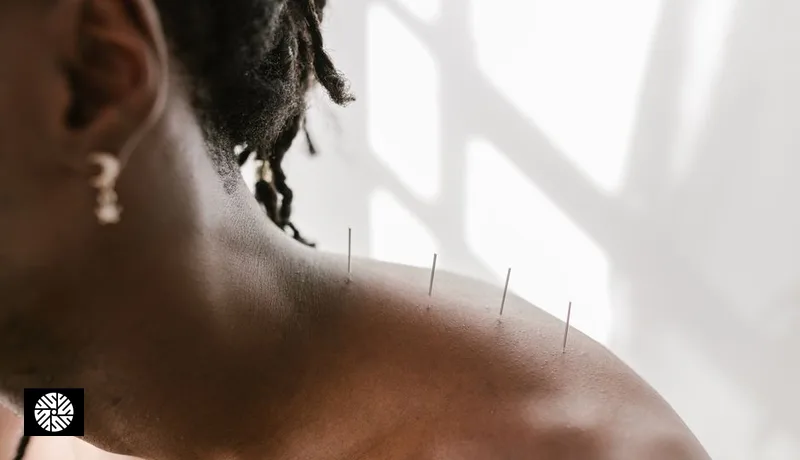
Acupuncture. Hair-thin needles are inserted at specific points on the body — the sensation is usually a tiny pinch or a dull, heavy ache rather than the sharp jab you might brace for. Some points you barely feel. Once the needles are in, you typically rest for fifteen to twenty-five minutes while they do their work; many people find this part oddly relaxing and a few even doze off. On hygiene: in Taiwan, reputable clinics use single-use, sterile, disposable needles, which is the standard you should expect and are entitled to ask about. Acupuncture is generally considered safe when performed by a trained practitioner with sterile needles.
Cupping (拔罐). Glass or silicone cups create suction on the skin, usually across the back or shoulders. It feels like a firm, tugging pull. The famous side effect is the circular bruise-like marks it leaves — they're harmless and fade over several days, but don't schedule a beach day right after if you'd rather not explain the polka dots. Many people find cupping satisfying for muscle tightness; just know the visual.
Tui-na (推拿). This is therapeutic Chinese bodywork — firmer and more clinical than a spa massage, working along muscles and joints with pressing, kneading, and stretching. If you've come in with a stiff neck or a sore back, this is often the most immediately satisfying part. If you enjoy structural bodywork, it pairs conceptually with the kind of soft-tissue work we cover in our piece on fascia bodywork in Taiwan — different traditions, overlapping territory of releasing tension and improving mobility.
Herbal medicine. Rather than a single pill, you'll often get a customized formula — frequently dispensed as concentrated granules you dissolve in hot water, sometimes raw herbs to brew. The taste is, to be diplomatic, an acquired one. Follow the dosing instructions you're given.
What it costs (approximate — confirm on site)
Because you're self-paying as a visitor, you're not getting the subsidized NHI copay, but TCM in Taiwan is still affordable. As a rough mental model, a self-pay consultation plus a treatment session at a neighborhood clinic is generally modest — often in the range of a casual restaurant meal rather than a luxury spa day. Herbal prescriptions add to that depending on the formula and how many days' supply you're given. The honest answer is that prices vary by clinic, by city, and by exactly what you have done, so ask at the 掛號 counter before you commit — staff are used to the question and it's completely normal to ask. Whatever you do, keep your itemized receipts; if you have travel insurance that reimburses outpatient care, you'll want them.
Safety, hygiene, and the herb–drug interaction you must not ignore
Three things to keep front of mind:
- Single-use needles. Sterile, disposable needles are the standard at reputable Taiwanese clinics. You're entitled to see them opened or to ask — a good practitioner won't be offended.
- Herb–drug interactions are real, not hypothetical. This is the most important safety point in the entire article. Herbal products are pharmacologically active — the popular notion that "natural means safe" is simply wrong. Some herbs can amplify a medication's effect, others can blunt it, occasionally to a dangerous degree. The classic cautionary example is St. John's wort, which speeds up how the body clears many drugs and can render them less effective. So: tell the practitioner about every medication and supplement you take — prescription drugs, the contraceptive pill, blood thinners, everything. Don't assume an herbal formula is automatically compatible with what's already in your system. If you're on regular medication for a real condition, this conversation isn't optional.
- Pharmacies won't fill foreign prescriptions. A prescription from your home country can't be dispensed at a Taiwanese pharmacy. If you need an ongoing medication, you'll have to see a doctor in Taiwan to get a local prescription — a TCM herbal formula is not a substitute for a drug you depend on.
How TCM fits alongside conventional care — and where the evidence actually stands
The healthiest way to think about traditional Chinese medicine, especially as a curious visitor, is as something that can sit alongside conventional medicine rather than replace it. That's exactly how Taiwan's own system treats it — integrated, regulated, insured for residents, and frequently used as an adjunct to Western care rather than a rival to it.
On the evidence, let's be straight, because respecting a tradition doesn't mean overselling it. Acupuncture has the most supportive research, particularly for pain. Reviews summarized by the U.S. National Center for Complementary and Integrative Health (NCCIH) found acupuncture can help with several pain conditions — including back and neck pain and osteoarthritis of the knee — and clinical guidelines list it among recommended non-drug options for chronic low-back pain. For many other uses the evidence is weaker, more mixed, or still emerging. In short: musculoskeletal aches and certain chronic pain are the areas where trying acupuncture is most reasonable on the evidence, and where many people report real relief.
For herbal medicine and many other TCM uses, the evidence is more limited or mixed, and quality varies — which is all the more reason to keep using Western medicine for anything serious, acute, or diagnostic. A traditional formula is not the place to manage a suspected infection, a worsening condition, or anything that needs a real workup. If you want the full picture of navigating Taiwan's healthcare system as a foreigner — TCM and Western care together — start with our complete guide to seeing a doctor in Taiwan.
A note on English, and what to bring
English fluency at TCM clinics varies widely. Big-hospital TCM departments and clinics in central Taipei are more likely to have someone who can help in English; a small neighborhood clinic may rely on a translation app and goodwill — which, honestly, often works fine. A few tips: have your symptoms and any medications written down (a translation app helps), point and gesture without embarrassment, and don't let a language gap stop you, because the staff deal with curious foreigners more than you'd think.
Pack the essentials before you go: your passport (needed to register on a first visit), both a payment card and cash (smaller clinics may be cash-preferred), your travel insurance details, and a written list of your current medications and allergies for that all-important interaction conversation. Keep your itemized receipts for any insurance claim.
Common scenarios
- "My neck and shoulders are wrecked after the flight and a few days of hauling a backpack." A classic, low-risk reason to try a 中醫 clinic. Tui-na, possibly acupuncture or cupping, often gives noticeable relief. Walk in, register, and explain where it hurts.
- "I'm curious about acupuncture and want to experience it properly while I'm here." Perfectly valid. Pick a neighborhood 中醫診所 or a hospital TCM department, register at 掛號, and tell the practitioner you'd like to try acupuncture for general tension or a specific ache. Confirm single-use needles and the self-pay price up front.
- "I've been stressed and sleeping badly on this trip." Many people find acupuncture and herbal approaches helpful for stress and sleep, though the evidence here is softer than for pain. Reasonable to try — but if poor sleep is part of a bigger health problem, see a regular doctor too.
- "I take daily prescription medication — is an herbal formula safe for me?" Only after you've told the practitioner exactly what you take. Herb–drug interactions are genuine. When in doubt, lean toward acupuncture or tui-na (no ingested compounds) over herbs, and loop in a Western doctor if you're unsure.
- "I suddenly have chest pain / a high fever / severe pain / something scary." This is not a TCM visit. Call 119 and go to a Western emergency room — see our ER guide.
- "I love good bodywork and want to make wellness part of the trip." Beyond clinical tui-na, Taiwan has a rich soft-tissue and bodywork culture worth exploring — our piece on Taiwan as a destination for fascia and bodywork wellness is a good companion read.
Trying traditional Chinese medicine in Taiwan is one of those small adventures that rewards a little courage. Walk in, register at the counter, take your number, let someone read your pulse and your tongue, and see what acupuncture or a firm tui-na session actually feels like. Keep your expectations honest, keep Western medicine in reserve for anything serious, be upfront about your medications — and enjoy experiencing a living medical tradition the way locals actually use it.
Sources & Further Reading
- National Health Insurance Administration (NHI), Taiwan — TCM is covered for enrolled residents (outpatient acupuncture, herbal prescriptions, traumatology manipulation) at a low copay; visitors self-pay.
- Taiwan Ministry of Health and Welfare — Traditional Chinese Medicine regulation and licensing
- NCCIH (NIH) — Acupuncture: Effectiveness and Safety — what the evidence shows for pain, plus safety and sterile-needle guidance.
- NCCIH (NIH) — How Herbs Can Interact With Medicines — why "natural" doesn't mean safe, and why you must tell your provider about every herb and drug.
- New Dawn Health — How to See a Doctor in Taiwan: A Complete Guide for Foreigners
- New Dawn Health — The Emergency Room in Taiwan: A Guide for Foreigners
This article is general information for travelers, not medical advice. Traditional therapies are not a substitute for emergency or evidence-based care; prices are approximate and change. Tell any practitioner about your medications to avoid herb–drug interactions, and in an emergency call 119.