What is a full-body MRI?
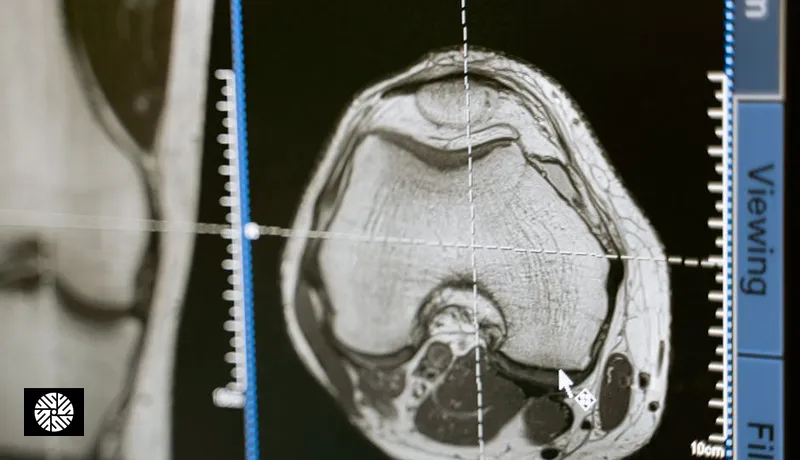
Magnetic resonance imaging uses a strong magnetic field and radio waves to build detailed, cross-sectional pictures of the inside of your body. It uses no ionizing radiation — not a low dose, none — because there is no X-ray beam anywhere in the machine. That is what makes it the screening tool of choice for imaging large areas of someone who feels perfectly healthy: you can scan broadly, and again next year, with nothing accumulating. How an MRI works covers the physics — and why the machine is so loud.
A full-body MRI applies that technology as a survey scan. Instead of examining one joint or one organ in response to a symptom, it sweeps the major organ systems in a single session, looking for things that are not supposed to be there — masses, cysts, aneurysms, enlarged lymph nodes, and structural changes — at a stage when they are usually silent. What that sweep actually reaches in the pelvis and reproductive organs — and the one cervical test it does not replace — is set out there.
What regions does it cover?
A full-body screening MRI typically covers the regions below in one visit — the current package listing shows exactly what is included today:
What it can find — and what it can't
MRI has outstanding soft-tissue contrast, which makes it well suited to catching solid-organ problems early — often while they are still small and asymptomatic. But honesty matters more than marketing here, and each gap has a proven test that covers it:
- Solid-organ tumors and masses
- Brain abnormalities and (with MRA) aneurysms
- Liver conditions such as fatty liver
- Kidney and liver cysts
- Spinal disc degeneration and alignment issues
- Lung nodules — air images poorly on MRI; a low-dose lung CT is the proven test
- Coronary arteries — measured by a heart calcium score or CT angiogram
- Colon polyps — only a colonoscopy can find and remove them in one procedure
Who should consider it?
- Adults who want a baseline — a documented "map" of their organs to compare against in future years
- People with a family history of cancer who want surveillance without yearly radiation
- Anyone who wants aneurysm and solid-organ screening that a standard annual physical simply does not include
- Travelers combining a comprehensive check-up with a trip — the scan fits in a single morning
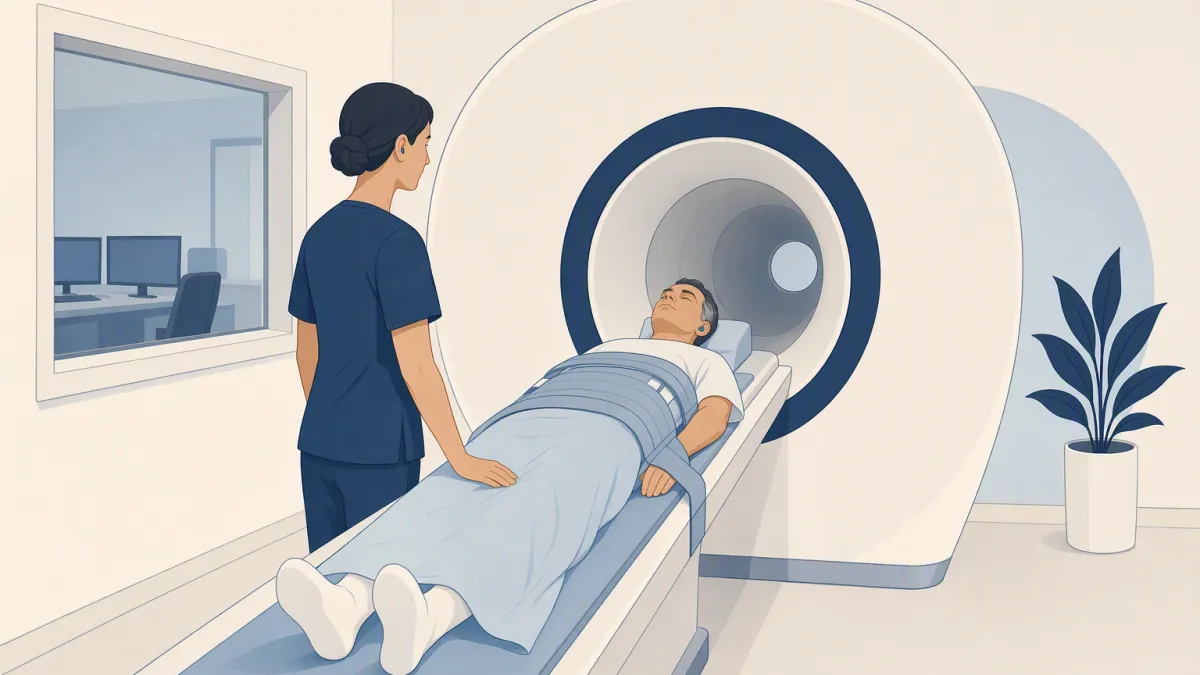
Worth saying plainly before you book: this scan means 60 to 90 minutes lying still inside a tunnel while it hammers. Most people find it dull rather than difficult, but a real minority find it hard, and that is a normal reaction rather than a failing — the honest section on claustrophobia covers what the bore is actually like, what helps, and why raising it in advance is far better than discovering it on the table.
What to expect on scan day
Below is the standard sequence for a screening MRI, as of July 2026 — the flow on the day follows the hospital's current protocol, and your coordinator confirms the specifics when you book:
-
1Check in & metal-safety formYou confirm implants, devices, and metal history one item at a time — this is the main safety step for MRI.
-
2Change & prepareGown on, valuables in a locker, earplugs or headphones — the scanner knocks loudly enough that hearing protection is a requirement, not a courtesy. No injections and no contrast for a standard screening protocol.
-
3The scan — about 60–90 minutesYou lie still on the table while the scanner works region by region. It is painless but loud; some sequences ask you to hold your breath for a few seconds.
-
4Done — no recovery timeYou can go straight to lunch or your next exam. Plan roughly two hours door to door.
Why do it in Taiwan?
In the United States, direct-to-consumer whole-body MRI services typically charge on the order of a few thousand US dollars for the MRI alone. In Taiwan, the same category of scan costs a fraction of that — and it arrives inside a package that also covers ultrasounds, CT scans, bloodwork, and a physician consultation. Reports are provided in English, and scheduling is built around international visitors.
The live package prices below come straight from our booking system, so what you see is what you would pay today.
Results and follow-up
A radiologist reads every sequence and issues a written report. Turnaround and how the findings reach you vary by hospital — your coordinator confirms when and how your report arrives. If something needs attention, it is explained together with a concrete recommendation — usually either a follow-up interval ("re-image in 12 months") or a referral pathway you can take home to your own doctor.