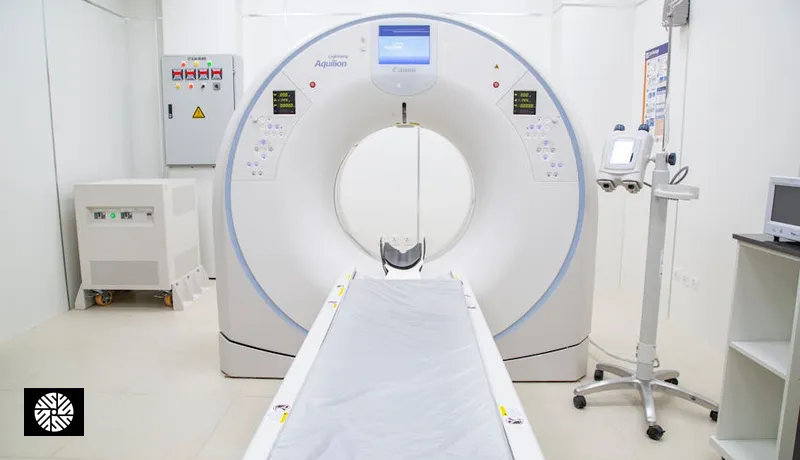
Three organs share one cavity, and no single scan reads all three. That is physics rather than packaging: lungs are full of air, and air gives MRI almost nothing to work with.
What gets checked, and with what
| Organ | What the test looks for | The test that does it |
|---|---|---|
| Heart | Calcified plaque in the coronary arteries, the build-up behind most heart attacks | Heart calcium score; a coronary CT angiogram for a diagnostic question |
| Lungs | Lung cancer and lung nodules, in people who meet the risk criteria | Low-dose lung CT |
| Breast | Breast cancer, including cancers hidden by dense tissue | Breast imaging — mammography first; ultrasound or MRI for a specific reason |
Heart
- Why it matters: coronary plaque builds without symptoms. A calcium score can sharpen a risk estimate when a prevention decision is uncertain; it cannot say whether you will have one.
- Who it helps: people whose risk is borderline or intermediate. If the result would not change your treatment, the scan adds little.
- Imaging can't: count soft plaque. The score reads calcified, hardened plaque only, so a score of zero is reassuring but not a guarantee.
- The diagnostic alternative: a coronary CT angiogram images the arteries directly, soft plaque included. It uses contrast dye and a higher radiation dose, so it is ordered for a defined question.
Lungs
- Why it matters: in the US National Lung Screening Trial, low-dose CT cut lung-cancer deaths by about 20% compared with chest X-ray, in heavy smokers.
- Never-smokers: in Taiwan, a parent, sibling or child with lung cancer is the eligible group. TALENT reported how many cancers were found, not whether screening saved lives.
- Most common finding: a small nodule, usually benign. In the NLST, about 96% of positive screens were not cancer, and settling them meant more scans.
- Imaging can't: substitute MRI for CT. Air returns almost no MRI signal, so a full-body MRI reads the lungs poorly.
Breast
- Why it matters: about half of women over 40 have dense breasts, and dense tissue can hide a cancer on a mammogram.
- Mammography comes first: it remains the main screening test for most women. Ultrasound is added for a specific reason, such as dense breasts or a finding to clarify. Screening MRI is generally for people at high risk.
- In Taiwan: the government funds mammography every two years for women 40–74.
- Radiation differs: ultrasound and MRI use no ionizing radiation; mammography does, at a low dose.
- The trade-off: more sensitive imaging also flags more findings that turn out to be harmless, so a positive result often leads to a recheck rather than treatment.
What this region's screening does not cover
What chest screening gives you
- Three organs, each read by the test matched to it
- A calcium score without needles or dye, when the result would change a decision
- Lung screening for people who meet Taiwan's family-history or smoking criteria
What it does not
- Incidental findings are routine here — a lung nodule, a breast cyst, a fleck of coronary calcium. Most are harmless, and the value is the follow-up plan rather than the scan alone.
- Function. None of these scans measures how well your heart pumps or how much air your lungs move; an echocardiogram or a lung-function test does.
- The esophagus, which runs through the chest but is read from the inside — see the digestive tract.