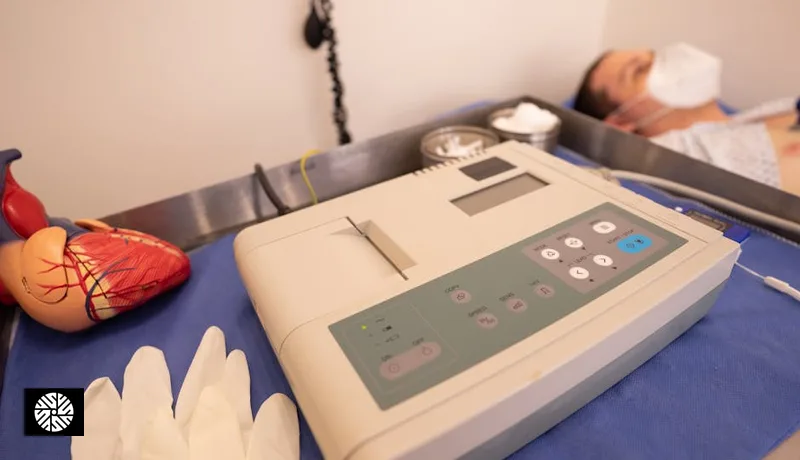
Five solid organs, one scan to start with, and one honest reason it is not always enough: gas. Bowel gas sits between the probe and the deeper organs, and it is the limit that shapes this region.
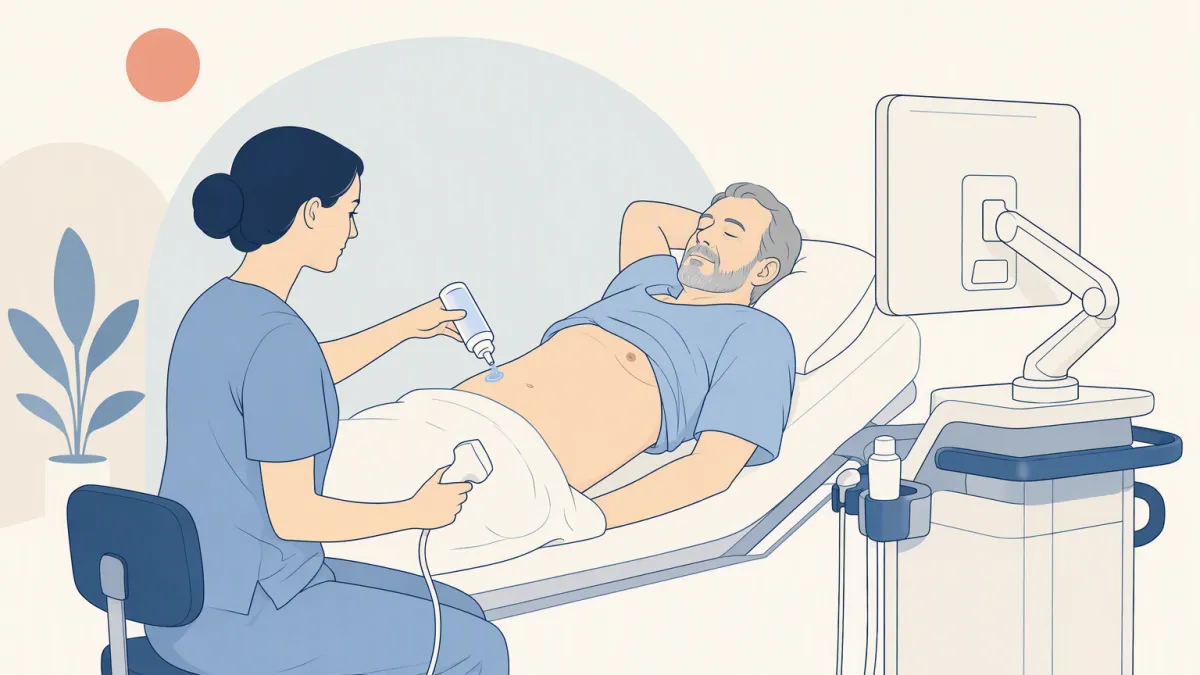
What gets checked, and with what
| Organ | What imaging looks for | The test that does it |
|---|---|---|
| Liver | Fatty change, cysts and masses | Abdominal ultrasound; a dedicated MRI or CT if a finding needs a closer look |
| Gallbladder | Gallstones, wall thickening and polyps | Abdominal ultrasound — the usual first test for gallstones |
| Pancreas | Cysts, masses and structural change | MRI or CT shows it more fully; ultrasound views are often limited by bowel gas |
| Spleen | Size and internal structure | Abdominal ultrasound or a full-body MRI |
| Adrenal glands | Nodules and enlargement | Usually seen on MRI or CT, often by chance — they are small and sit deep |
Liver
- Why it matters: fatty change is common and is often the first visible sign of metabolic trouble. Ultrasound shows it reliably when moderate or severe; milder fat is harder to see.
- In Taiwan: the government-funded adult preventive check-up includes a one-time hepatitis B and C blood test at ages 45–79 (40–79 for Indigenous people). Regular liver ultrasound is for people with cirrhosis and some people with chronic hepatitis B, as part of their care.
- Imaging can't: measure how well the liver is working, or show scarring from fat alone. Function comes from a comprehensive blood panel.
Gallbladder
- Most common finding: gallstones, and most of them stay silent. NIDDK advises that stones causing no symptoms probably need no treatment.
- Imaging can't: tell you whether a silent stone will ever cause trouble. That is why such a finding is documented and watched, not automatically acted on.
Pancreas
- Why it matters: it sits deep, and bowel gas often hides part of it on ultrasound. This is the organ here that the first-line scan reads least completely.
- Imaging can't: rule out a small lesion — not from a normal ultrasound, and not from a survey MRI. The USPSTF recommendation against pancreatic screening does not apply to people with inherited syndromes or familial pancreatic cancer, who need specialist advice.
Spleen
- Why it matters: when the spleen is enlarged it is usually a downstream sign of something else, rather than a problem of the spleen itself.
- Most common finding: a normal spleen. Imaging here is mostly about noticing a change and pointing toward its cause.
Adrenal Glands
- Why it matters: two small glands sitting on top of the kidneys, too small and too deep for ultrasound to read reliably.
- Most common finding: an incidental nodule on an MRI or CT done for another reason, and most are benign. A doctor decides whether its features need further tests or a later recheck.
What this region's screening does not cover
What an abdominal scan gives you
- Several organs in a single radiation-free pass, when there is a reason to look
- Fatty liver and gallstones — the two most common findings in the region — on the first test
- A baseline for organs where the question is nearly always "has this changed?"
What it does not
- Incidental cysts and small nodules turn up across all five organs. Most are harmless, and many are rechecked after an interval rather than treated.
- A cancer all-clear. A normal scan does not exclude abdominal cancer; a dedicated CT or MRI, and sometimes a biopsy, answers a specific question.
- How well the liver and kidneys are working — that is a blood panel question, not an imaging one.
- The hollow organs running past them. The stomach and colon are read from the inside — see the digestive tract.