What is a pulmonary function test?
A pulmonary function test (PFT) measures how well your lungs move air. The most common part is spirometry. You take the deepest breath you can, then blow out as hard and as fast as you can into a tube. A machine called a spirometer measures how much air comes out, and how fast.
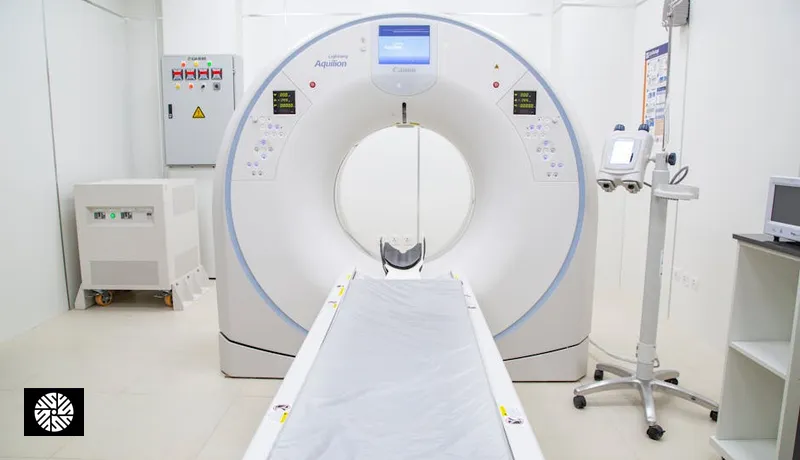
It is a breathing test, not a scan. Nothing is injected and there is no radiation. The numbers on the report come from that one forced breath out:
| Measurement | What it tells you |
|---|---|
| FVC (forced vital capacity) | The total amount of air you can blow out after the deepest breath in |
| FEV1 (forced expiratory volume in 1 second) | How much of that air comes out in the first second |
| FEV1/FVC ratio | The share of your air that leaves in the first second; narrowed airways make it low |
| Flow-volume loop | A graph of airflow against volume; its shape helps show narrowed airways or a poor blow |
A full lung function workup can add two other tests. They need different equipment, so they are not part of spirometry itself:
- Lung volume test: measures how much air your lungs can hold, sometimes while you sit in a small airtight booth.
- Diffusion capacity test: checks how well oxygen passes from the air you breathe into your blood.
The chest, heart and lungs page shows where each chest test fits. The respiratory disease page covers COPD and lung cancer themselves.
What it can find, and what it cannot
Spirometry shows how air flows. It does not show what the lungs look like, and it does not look for cancer.
- Narrowed airways, the obstructive pattern seen in asthma, COPD and chronic bronchitis
- A pattern that suggests smaller lungs, which a lung volume test then confirms or rules out
- Whether your airways open up after an inhaled medicine, when the test is repeated
- Change over time, when compared with your own earlier results
- Lung cancer: a low-dose lung CT looks for it in people who meet the screening criteria
- What the lungs look like: a chest X-ray or a CT scan shows the structure
- How well oxygen reaches your blood: a diffusion capacity test measures it, only if it is added to the spirometry
- Sleep apnea: a home sleep study records your breathing during sleep
- A heart cause of breathlessness: an echocardiogram checks the heart's pumping and valves, and an ECG records its rhythm
How the results are read
Your numbers are compared with healthy people of the same age, sex and height. The 2022 technical standard of the European Respiratory Society and the American Thoracic Society (ERS/ATS) sets the cut-off as the lower limit of normal (LLN).
The LLN is the 5th percentile: the level that only 5% of healthy people fall below. The standard accepts that 5% of healthy people will therefore be flagged by mistake. Each result becomes a z-score: how far it sits from the healthy average. The standard grades it like this:
A ladder like this is the general pattern, not a rule your case must obey. Reporting conventions differ between hospitals, and two experienced clinicians can read the same finding and reasonably advise differently. Where your report or your doctor differs from this table, go with them — they are looking at your actual result.
Two rules for the same ratio
A low FEV1/FVC ratio points to narrowed airways. Two expert bodies draw the line in different places, and your report may use either:
| Body | Rule | Notes |
|---|---|---|
| ERS/ATS (2022 interpretation standard) | Obstruction means a ratio below your own lower limit of normal | It advises against the fixed 0.70 cut-off, which misclassifies some older and younger adults |
| GOLD (Global Initiative for Chronic Obstructive Lung Disease, 2025) | Three acceptable blows after an inhaled bronchodilator, all with a ratio below 0.7, confirm airflow obstruction | One fixed number, used to confirm COPD in people with symptoms |
The patterns a doctor looks for
| Pattern | What the numbers show | Examples of causes |
|---|---|---|
| Obstructive | FEV1/FVC below the lower limit; air leaves the lungs slowly | Asthma, COPD, emphysema, chronic bronchitis |
| Possible restriction | Low FVC with a normal or high ratio; only a lung volume test showing low total lung capacity confirms it | Pulmonary fibrosis, sarcoidosis, scleroderma |
| Non-specific | Low FVC, normal ratio and normal total lung capacity | Can come from obstruction or restriction; when restrictive, often a chest wall or nerve and muscle disorder |
| Low effort or weak muscles | Low FEV1 and FVC with a normal ratio, even when the lungs are healthy | A blow that was not maximal, or muscle weakness |
If you inhale a bronchodilator and blow again, the standard defines a positive response as a rise in FEV1 or FVC above a set share of your predicted value.
Who should have one, and who should skip it
Spirometry is a diagnostic test for breathing symptoms. As a check-up for people who feel well, US guidance advises against it:
| Your situation | Does it fit? |
|---|---|
| Breathlessness, a cough that will not go away, coughing up phlegm, or wheezing | Yes. See a doctor; spirometry helps find the cause. |
| You smoke or used to, and you have any of those symptoms | Yes. The US National Heart, Lung, and Blood Institute calls spirometry the main test for COPD. |
| You already have asthma or COPD | Yes, to monitor the disease and your response to treatment. |
| You work with dust, fumes or chemicals | Yes, to check whether the exposure is affecting your lungs. |
| You are having surgery | When your surgeon or anesthetist asks for it. |
| No symptoms; you want your lungs checked or a baseline | No. The US Preventive Services Task Force recommends against screening for COPD in adults without symptoms. |
That US recommendation, from 2022, is a grade D. It does not apply to people with symptoms such as chronic cough, sputum, difficulty breathing or wheezing. If you smoke and feel fine, the screening test with evidence is a low-dose lung CT, for those who meet its criteria.
Getting a PFT in Taiwan
Taiwan has no national lung function screening program. The government-funded adult check-up covers a physical exam, blood and urine tests and health counseling; it does not list a lung function test. Taiwan's national lung program is low-dose CT, every 2 years, for two groups:
- Family history: lung cancer in a first-degree relative — men 45–74, women 40–74.
- Smoking: smokers 50–74 with 20+ pack-years who currently smoke and are willing to quit, or who quit less than 15 years ago.
Funded screening is for people with National Health Insurance who meet the criteria. New Dawn Health books a PFT inside check-up packages, some of them listed with a live price further down this page:
- Included: at Central Clinic & Hospital Healthcare Center, Vital and Convenient Pro list "Pulmonary Function Test (Spirometry)". Convenient Pro - Package C also lists a PFT. Convenient Pro - Package A, a lab-and-vitals package, includes one too.
- As a choice: in the Convenient Pro - Holistic Exam, a PFT is one of the options you choose from, alongside several ultrasounds.
- Beyond spirometry: whether the clinic's PFT adds a lung volume or diffusion test is something your coordinator confirms when you book.
What happens on the day?
-
1Before you goWear loose clothing that does not restrict your chest. Avoid a large meal for at least 2 hours, and vigorous exercise for 1 hour. Avoid alcohol beforehand.
-
2SmokingDo not smoke or vape beforehand. MedlinePlus advises no smoking for 4 to 6 hours. Your coordinator confirms the clinic instructions when you book.
-
3InhalersSome inhalers are paused before a diagnostic test, for hours to two days by type. Never stop one on your own; ask the doctor who prescribed it.
-
4Sitting up, nose clip onYou sit upright with a soft clip on your nose. You seal your lips tightly around a mouthpiece. Keep dentures in; they help the seal.
-
5The blowsYou breathe in fully, then blast the air out as hard and as long as you can. The tester coaches you on throughout.
-
6RepeatsThe goal is at least three acceptable blows that agree with each other. Adults usually do no more than eight.
-
7Sometimes, an inhaler and a second roundYou may inhale a medicine that opens the airways, wait, and blow again. Your coordinator confirms the visit time.
The result depends on your effort. The ATS/ERS spirometry standard says results are very dependent on patient cooperation. A half-hearted blow can look like disease.
What are the risks?
MedlinePlus says there is very little risk to a lung function test. The effort of blowing hard causes most of the side effects:
- Feeling lightheaded, dizzy or tired from the effort of the blows.
- Coughing. It is common during and after the blows.
- Fainting, rarely. A 20-year review of 186,000 tests found safety incidents in 5 of every 10,000 routine tests, mostly fainting.
- A collapsed lung. MedlinePlus notes a small risk in people with certain lung diseases.
The ATS/ERS standard lists situations where the test may need to wait. Tell the team before you start if any of these apply:
- A heart attack in the past week, unstable heart failure or a serious heart rhythm problem
- Very high or very low blood pressure
- A collapsed lung (pneumothorax)
- Chest, belly or brain surgery in the past 4 weeks
- A known brain aneurysm, or a recent concussion that still causes symptoms
- Eye, sinus or middle ear surgery, or a sinus or middle ear infection, in the past week
- Late pregnancy
- An active infection that can spread, such as tuberculosis
Results & follow-up after you fly home
When the report arrives, in which language, and who reads it are confirmed when you book. What follows depends on what the report says:
-
1Keep the full reportKeep the numbers, the graphs and the reference values used. A future test is only comparable if the same reference values are applied.
-
2Book a doctor if anything is flaggedA result below the lower limit of normal is a reason to see your doctor or a lung specialist. Take the report with you.
-
3Expect a follow-up test if the pattern is unclearA low FVC needs a lung volume test to confirm restriction. A low ratio may need a repeat after an inhaled bronchodilator.
-
4Do not let a normal result end the searchIf you are breathless and the test is normal, the cause may lie elsewhere. The heart is one place a doctor may look.
-
5Act on new symptoms, whatever the report saidSudden breathlessness or chest pain still means an emergency call. In Taiwan call 119 (the local equivalent of 911).
Cost and coverage
The live prices further down this page are New Dawn Health's booking prices for the packages above. What each one covers differs:
- Packages include a PFT among many tests. Each package card lists what it covers.
- No PFT is booked on its own here. It comes inside a check-up package.
- Short-term visitors are not covered by Taiwan's National Health Insurance, so screening is self-funded.
- Reimbursement at home is a question for your insurer. Ask before you book whether your plan pays for a test done abroad.